As a former Art Producer, I have always been drawn to personal projects because they are the sole vision of the photographer and not an extension of an art director, photo editor, or graphic designer. This new column, “The Art of the Personal Project” will feature the personal projects of photographers using the Yodelist marketing database. You can read their blog at http://yodelist.wordpress.com. Projects are discovered online and submissions are not accepted.
Today’s s a very exciting one as since Marc Ohrem-Leclef was featured on December 4, 2014, many exciting things have happened for his beautiful personal project Olympic Favela.
Today’s Art of Personal Project is: Marc Ohrem-Leclef part 2
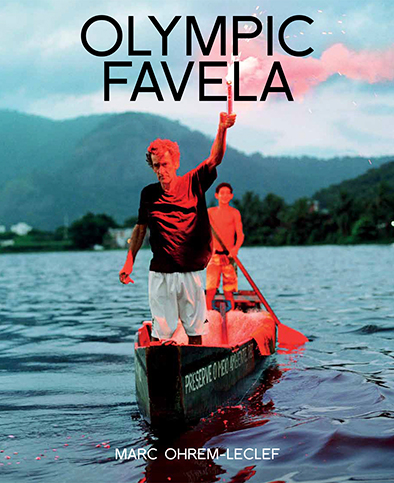
Olympic Favela- The Book: After I featured you, you were so kind to send me a copy and it is beautifully done. How have sales been and are you selling them at the Installations and Film Festival? How can someone reading this blog post purchase one?
Thank you Suzanne, I appreciate the kind words and the opportunity to share what has happened since the last feature! The book has been received very well, garnered good reviews and press coverage, and sold well. This summer sales and related press have picked up yet again with the Olympic Games approaching and exhibitions of the work in Rio, Berlin and New York.
Olympic Favela is available in the US and Europe at bookstores and online retailers such as my distributor Artbook ( http://www.artbook.com/9788862083386.html )
Signed copies can be purchased directly from my studio – I love to receive emails out of the blue from people who have seen the work and inquire about having me send them an autographed copy of the book. ( marcleclef AT gmail.com )
Some of the galleries where I have exhibited work from the Olympic Favela project also do sell the book.
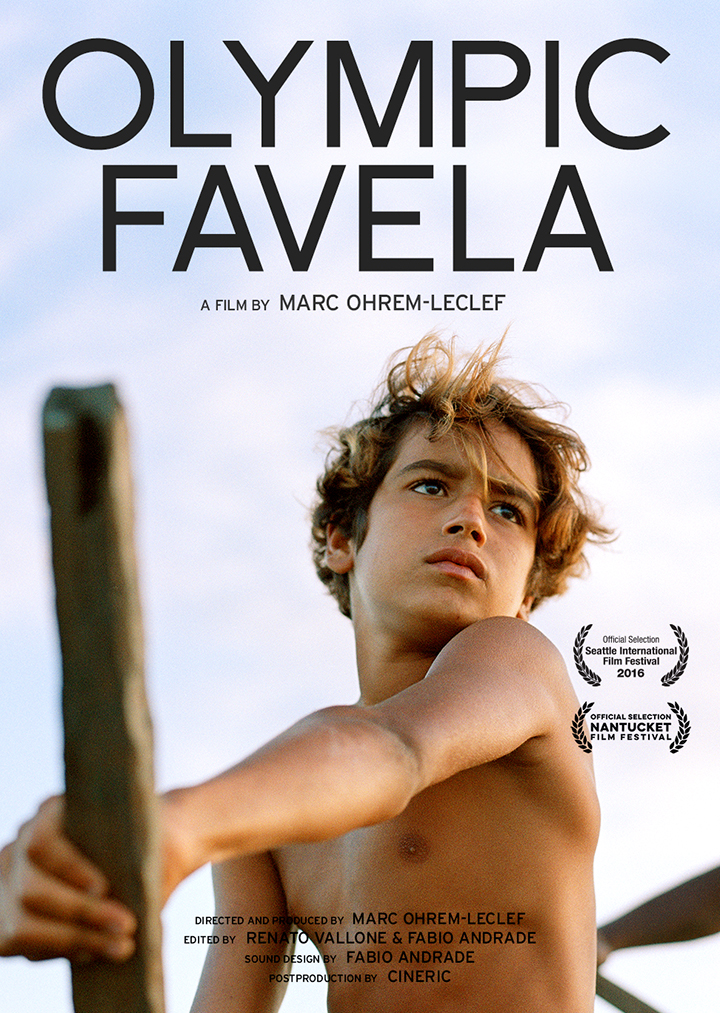
Olympic Favela -The Film (Movie sounds like a feature length film to me, and mine is a short, 19 min): which has been featured at The Seattle International Film Festival (2016) and Nantucket Film Festival 2016. Tell us more about these festivals and are there others on the horizon?
After working with my collaborators in Rio for nearly three years and seeing how some of the places that I kept visiting began to vanish as the communities were being removed, I had the desire to translate my own experience of ‘time passing and events unfolding’ to my audience by making a film.
Making a film has been a huge learning experience that was as tough as it was rewarding. Due to the rich material I made between 2014 and 2016, we were able to make two different edits: a more abstract edit for projection in a gallery space, the other a bit more narrative for presentation to cinema-audiences – this is the version that screened at the film festivals.
It was a thrilling experience to be invited to two major film festivals to show Olympic Favela – and then to see it on the big screen! My production in Brazil was very low-key and to see the footage I shot hold up so well on a full size cinema screen made me happy, and proud.
Both festivals, quite different in scale and audiences, were wonderful opportunities to meet fellow filmmakers, screenwriters and to absorb much of the information in the panels offered by the festivals, and a great new way for me to share the story of Olympic Favela.
More importantly, the audience reactions to my film, which for a documentary is rather abstract in its story-telling, were wonderful and evolved very much around my finding my collaborators and the experience of being allowed to follow their lives for such long period.
I am waiting to hear on a few more festival submissions, especially some in Brazil and Europe where I’d like to have the film seen by audiences, before releasing it online.
Olympic Favela-The Installation: This first installation was at Studio X Gallery in Rio de Janeiro in 2016 and then you just got back from Berlin, Germany. Please tell us about these installation and others in the future?
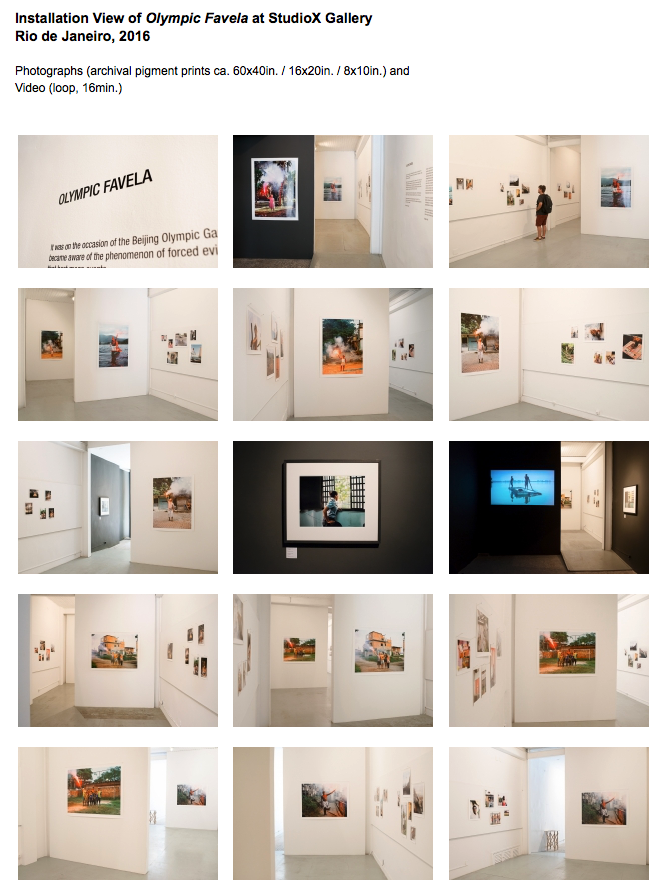
The exhibition in Rio’s Studio X was a wonderful opportunity to show the work at ‘home’.
Studio X is a beautiful space housed in a historic building in Rio’s downtown area. The space allowed for the most comprehensive installation of photographs and the projection of the film yet, including a photograph that is now in the collection of the Museo de Arte do Rio (MAR).
(The installation at a gallery space that receives funding form the city of Rio de Janeiro was also a daring move by the gallery director Pedro Rivera, given the work that is very critical of the city’s policies.)
We worked hard on getting my collaborators from their new homes, often located far away on the city’s outskirts, to the gallery for the opening event, which included an in-depth discussion with local journalist Julia Michaels and Curator Julia Baker of the Museo de Arte do Rio (MAR). I invited some of my collaborators to join the discussion – hearing them share their personal stories was the most powerful moment of the evening for me.
Following the opening night, I managed to loan a projector and showed the film to the residents at one of the hardest impacted favelas, in the local church.
Prior to the show in Rio, I was invited to share the work at Boston University’s PRC Gallery; currently the work (photography and video) is exhibited at nGbK/Kunstraum Kreuzberg in Berlin, until end of August.
A wonderful review of the group show and Olympic Favela works in it was just published on Artslant: http://www.artslant.com/ber/articles/show/46306
On August 17th an exhibition curated by Mickalene Thomas will open at Baxter Street Gallery in NYC (group show, featuring Olympic Favela works (photography and video) http://www.baxterst.org/exhibitions-3/2016-annual-juried-competition-and-exhibition/ .
Since you were featured, I noticed great press and reviews of your book and film. Can you tell us more about that?
The project has gotten a lot of attention from photo editors and writers, both online and in print. Publications and features range from fine arts media (Artnews, Select Magazine, American Photo, Slate) and trade media (PDN) to news outlets (BBC, Huffington Post, Der Spiegel).
Highlights were being named as one of ‘2014 best books’ by American Photo Magazine, and the feature on Huffington Post!
in 2015 Hafen-Universitaet Hamburg (Germany) published Self Induced Shocks: Mega-Projects and Urban Development, a book on the impact of mega events on urban culture, featuring a portfolio of Olympic Favela photographs along scientific texts. Publications like this are especially meaningful as they translate the human perspective on the issues surrounding mega events to students who may decide upon these issues in future generations.
Reviews:
HUFFINGTON POST US – Olympic Favela, June 2016
SELECT MAGAZINE – Olympic Favela, April 2016
AMERICAN PHOTO – Olympic Favela, December 2014
GUP MAGAZINE – Olympic Favela, July 2014
ARTnews – Olympic Favela, July 2014
DER SPIEGEL – Olympic Favela, June 2014
PDN PHOTO DISTRICT NEWS – Olympic Favela, June 2014
NEWSTALK – Olympic Favela, June 2014
L’OEIL DE LA PHOTOGRAPHIE – Olympic Favela, May 2014
SLATE – Olympic Favela, April 2014
GERMAN CONSULATE NYC – Cowboys and Indians , March 2012
Press:
HUFFINGTON POST Brazil – Olympic Favela, June 2016
CANAL iBASE – Olympic Favela, January 2015
a PHOTO EDITOR – Olympic Favela, December 2014
FOTOGRAFIA – Olympic Favela, July 2014
FRESH ART INTERNATIONAL – Olympic Favela, July 2014
HUNGER TV – Olympic Favela, June 2014
BBC – Olympic Favela, May 2014
CBC – Olympic Favela, April 2014
DAILY MAIL – Olympic Favela, April 2014
IRIE DAILY – Olympic Favela, April 2014
OUT – Olympic Favela, April 2014
ADVOCATE – Cowboys and Indians , April 2013
KOELNER STADT ANZEIGER – Cowboys and Indians , August 2007
ARTISTS STATEMENT –
Olympic Favela is an ongoing photography and video project that visualizes the effects of forced removal of residents in 14 of Rio de Janeiro’s favelas, implemented by the city government in preparation for the 2016 Olympic Games.
In 2012, in response to news reports of widespread evictions of residents from their homes and businesses through Rio’s housing authority Secretaria Municipal de Habitação (SMH), I began photographing the people affected by these evictions, as well as the residents organizing resistance to SMH’s policies.
Olympic Favela consists of two types of portraiture:
The first type is environmental portraiture of the residents, photographed in front of their homes, which have been designated for removal by SMH with spray-painted code numbers. The second type is directed imagery of residents posing with flaming emergency torches, photographed in their communities. In these images the residents are no longer a subject that I look upon; their role in the image becomes active as they embrace the opportunity to represent their community, their struggle, and their resistance.
Referencing iconic imagery ranging from Delacroix’s Liberty Leading the People and Bartholdi’s Liberty Enlightening the World to now-iconic news imagery of the Arab Spring, the residents’ gesture and use of the torch in these photographs invoke ideas of liberation, independence, resistance, protest and crisis while also making use of the core symbol of the Olympic Games—the torch.

The poster:
The Installations:
Marc Ohrem-Leclef was born in Dusseldorf, Germany.
After studying Communication Design at the Darmstadt University of Applied Sciences in Germany he relocated to New York City in 1998.
Ohrem-Leclef’s visual arts practice centers on immersive portraits of communities—whether they are formed by bloodlines, social circumstance, or cultural movements.
Ohrem-Leclef’s work has been exhibited in Germany, Brazil and the U.S..
It has been reviewed and featured in publications such as Artnews, BBC, Slate, Der Spiegel, Die Zeit, Internazionale, Huffington Post.
In 2013 Marc was invited as a Guest Lecturer in the Advanced Photography Seminar at Columbia University, New York. You can follow Marc on Instagram @marcleclef
APE contributor Suzanne Sease currently works as a consultant for photographers and illustrators around the world. She has been involved in the photography and illustration industry since the mid 80s, after establishing the art buying department at The Martin Agency then working for Kaplan-Thaler, Capital One, Best Buy and numerous smaller agencies and companies. She has a new Twitter feed with helpful marketing information believing that marketing should be driven by a brand and not specialty. Follow her on twitter at SuzanneSease.