APE: When I worked at Outside Magazine we had a flat day rate for assignments but then had to create all these other rates to accommodate certain photographers or certain situations where the use was more extensive. It turned into a huge mess where we didn’t know what an assignment would cost and we would need to pull old invoices to see what we paid someone last time. When I went to Men’s Journal I redid the system and changed to a day rate against space structure which was much more elegant and logical. A fashion shoot that took one day but had 8 pages of images resulted in $3200 for the creative fees, which was more reflective of the level of talent we were pulling from and the overall amount of work that went into that one day of shooting. It’s good to see Wonderful Machine shedding some light on this concept in our monthly column, because it works well for both the magazine and the photographer. When shoots are “killed” some money can be saved and photographers have a guaranteed minimum but are paid based on the total usage.
By Ben Weldon, Wonderful Machine Producer
Many magazines have contracts with rates and terms that they offer to photographers (which are generally negotiable). Others don’t have their own contracts and instead work on a case-by-case basis with individual photographers. For those situations, it’s good for photographers to have a contract template on hand. We tend to structure our editorial fees based on a day rate against space. It’s an elegant solution to the problem of how to scale editorial fees, and it’s widely used by many national magazines, but some people find it hard to get their head around at first.
Pricing for editorial photography tends to be different from commercial photography for a couple of reasons. When a company decides to produce an ad or brochure, they already know what they need (in terms of photo display and usage) before the photographer is brought in. So it’s mostly a matter of the photographer coming up with a price and terms to fit those unique specifications. Magazines, on the other hand, need to work much more spontaneously. Editorial opportunities often come up on very short notice, and they also tend to morph from the time of the assignment to the time of publication. When an editor and art director send a writer and photographer out on a project, they never know what they’re going to come back with. And the play in the magazine is going to depend largely on how interesting and relevant that result turns out to be, compared to other stories that they’ve got cooking.
So photographers and magazines are best served by a contract that can be put in place for a couple years at a time (which allows for last-minute projects) and is scaleable (to account for variations in the amount of time required, expenses and the number and size of the pictures used). After all, it’s reasonable to charge less for a project that takes a day to complete vs. one that takes a month. It’s reasonable to charge less for a project that you can do alone in your back yard with a fill card than one that you have to take a crew of 7 and a dozen cases of rental equipment to Tunisia for. And it’s reasonable to charge less for a 1/4-page photo inside the magazine than a cover and 10 pages in the well.
The day rate vs. space structure takes all of these variables into account. The day rate is a minimum guarantee that compensates the photographer for his time on the project. It tends to be fairly modest, to accommodate small projects that won’t have a big presence in the magazine. The space rate comes into effect only when the magazine ends up using multiple or large pictures. The expenses are what they are. The structure nicely scales from small assignments that the publication can have done inexpensively, while incentivizing the photographer to produce a lot of great pictures. And it minimizes the need to renegotiate after the fact, when the final piece in the magazine is different than imagined.
Here is our standard day vs. space agreement (in Adobe PDF ):
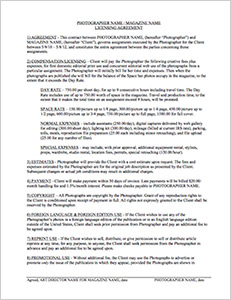
And here’s an explanation of each paragraph:


