The Daily Edit
GQ: Amy Neunsinger

Tuesday 7.9.13

Design Director: Fred Woodward
Creative Director: Jim Moore
Director of Photography: Dora Somosi
Senior Photo Editor: Krista Prestek
Photo Editor: Justin O’Neil
Art Director: Chelsea Cardinal

Photographer: Amy Neunsinger

Support: Shouldn’t It Be A Two-Way Street?

If you’ve had a photo project on indie-go-go, or Emphas.is, or Kickstarter asking for money, I wonder: have you contributed to other photographer’s projects? If you’ve got a book-signing coming up, or have published a book, did you buy someone else’s book, or go to their signing, or for that matter, their gallery opening?

As much as I can say there is a photography community in New York, I find myself questioning how much of it is self-interest and how much of it is reciprocal.

via Stella Kramer.

The Daily Edit
Wired: Brian Finke

Monday: 6.8.13

Design Director: Claudia de Almeida
Art Director: Bradley R. Hughes
Photo Director: Jim Merithew
Senior Photo Editor: Carrie Levy
Photo Editor: Kristen Fortier
Photographer: Brain Finke

This Week In Photography Books – Dash Snow

by Jonathan Blaustein

I was sitting on my porch the other day, chatting with a friend. He’s a wicked smart photographer, and has had a good bit of success, including a Guggenheim Fellowship. The ideas were flying rather quickly as we sat, rocking in our rocking chairs, killing black and red ants as they explored my territory. (They’re aggressive, and they bite, so they had it coming.)

He’d just returned from forty days roaming the hinterlands of Dick Cheney’s Wyoming, and was hungry for conversation, like a Jew who’s fasted after dropping a Torah. Mostly I listened, because he likes to talk. At some point, we reached the subject of artistic intent, which is guaranteed to rile up anyone/everyone.

My friend was an environmental activist for many years, and makes art for the noblest of intentions. He’s either trying to save the planet, or make us realize we’re all doomed. I haven’t decided yet. Regardless, he comes from a long line of artists who want to make the world a better place. The serious guys.

I mentioned that, though I occasionally vacillate, I mostly believe that no one reason for making art is inherently better than another. It’s the moral relativism argument, grafted onto an art conversation. He smiled, (or was it a smirk?) and said, sure, that’s the politically correct thing to say.

“But do you really believe that,” he asked?

I paused, and then said yes. I do. I’ve seen enough interesting art, over the years, that came from infantile experimentation, or anarchic rebellion, to believe that it’s not only the serious strivers who get to make the good stuff. Sometimes, great (or provocative) art can come from hedonistic, nihilistic nitwits, whether we like it or not.

This week’s book is a great example of the phenomenon. “I Love You, Stupid,” is a very thick book filled with Polaroid photographs (and video stills) taken by the now deceased art star Dash Snow. Before I say anything else, I’ll admit that the pictures you’ll see below will likely offend your better sensibilities. They’re meant to, and they succeed.

Mr. Snow was famous before he died, as he came from a line of very important people in the art world. (The de Menils.) I didn’t know this, nor had I seen his work while he was alive. I do remember him dying, but only because I must have heard third hand that some junkie art dude overdosed. That was the extent of my knowledge, though perhaps you know more than that.

The book contains a very well-written opening essay by Glenn O’Brien, of GQ and Andy Warhol circle fame. Great stuff, really. It will make you excited to make art, for sure, and also prejudice you towards liking the images that follow. He’s extremely persuasive, and also forthright in countering any rich-kid bias you might have. (Basically, he presents Mr. Snow as a 21st Century Shaman.)

Once you’re fired up and ready to go, you get to see countless photographs of all the bad stuff you’re not supposed to do. There is tons of sex, drugs, blood, semen, graffiti, partying, homelessness, vomit, and more sex. Seriously, if I had a dollar for every penis included in this book, I could…well…buy the book. Fortunately, all the bad behavior reeks of genuine effort. (Must be all the smack and coke.)

A little while back, I wrote about Mike Brodie’s book “A Period of Juvenile Prosperity,” and was a bit cynical about his intentions. Great project, but I could see his mind whirring as he realized how perfectly his photographs would deliver what people wanted. It wasn’t that he didn’t seem serious about his frisky lifestyle choice, (freight train hopping,) only that the concurrent calculation was also evident. This book obviates those concerns. This mayhem feels real, like it doesn’t care whether we’re there to look or not.

I’m not saying this art is brilliant. (It’s not.) Nor that you should like it. (You probably won’t.) But I’m pretty sure Dash Snow wasn’t trying to be bad. He just was. And darkness walks upon the Earth, whether we like it or not. So art that captures that essence is valuable. Every bit as valuable as the art that tries to improve upon our faulty existence on this spinning blue orb.

Bottom Line: A nihilistic, voyeuristic, bad boy thrill ride

To Purchase “I Love You, Stupid” Visit Photo-Eye

Full Disclosure: Books are provided by Photo-Eye in exchange for links back for purchase.

Books are found in the bookstore and submissions are not accepted.


Art Producers Speak: David Paul Larson

We emailed Art Buyers and Art Producers around the world asking them to submit names of established photographers who were keeping it fresh and up-and-comers who they are keeping their eye on. If you are an Art Buyer/Producer or an Art Director at an agency and want to submit a photographer anonymously for this column email: Suzanne.sease@verizon.net

An image of Lindsey Wixson from a personal portrait project
Outtake from a Loreal shoot
Enya Bakunova for Bambi Magazine
Marcela Jacobina
An image from my personal project "Nudes"
Outtake from an advertising shoot for Blank Jeans
Noreen Camody for Bambi Magazine
Outtake from a Loreal Shoot
Sara Stephens-outtake from a motion shoot
An image from my personal beauty project
An image from my personal project "Nudes"
Outtake from a recent editorial

Anonymous Art Producer: I nominate: David Paul Larson. “David is extremely talented, hard-working and wonderful to work with. Working with him is a definite creative collaboration and he brings a fresh and different perspective to every shoot.”

How many years have you been in business?

I have been shooting professionally for three years.

Are you self-taught or photography school taught?

I attended Columbia College Chicago and double majored in Advertising and Photography. I wanted to talk to my clients both as a peer and artist. After photography school I assisted Norman Jean Roy, Mark Seliger and Mario Testino. Assisting on large production, multiple day shoots is the best education.

Who was your greatest influence that inspired you to get into this business?

After being medically discharged from The United States Marine Corps I wanted a career that was detail oriented, fast paced, competitive and team driven. An early mentor told me that if I wanted to become the best I need to move to New York and learn from the best. New York has single handedly had more of an impact than anything else. Professionally and personally it has pushed me to places I never thought I would go. It’s an endurance race with yourself and your art.

Darren Aronosky, Stanley Kubrick, Guy Bourdin and Garry Winogrand have had a profound impact on my work as well.

How do you find your inspiration to be so fresh, push the envelope, stay true to yourself so that creative folks are noticing you and hiring you?

I am always looking for art directors,stylists and models to work with. I have found that the more personal work I create the more jobs I book.

Do you find that some creatives love your work but the client holds you back?

Rarely. I got into this business because I love collaborating and working with people. In the military everything is about teams and those lessons have translated a lot into my professional life. I get a lot of pleasure out of working with art directors and photo editors. Most of the work I get is a referral from existing clients so they often know a bit about me before we meet.

What are you doing to get your vision out to the buying audience?

I frequently post work  on many social media platforms-Tumblr, Twitter, Instagram and Facebook. I love showing my work in person. I try to do that at least once a week. In addition, I am sending out an email promo every 45 days and printed mailers every two months.

What is your advice for those who are showing what they think the buyers want to see?

Oscar Wilde said it best “Be yourself; everyone else is already taken.” Don’t try to be everything to everyone. Shoot what you love and over time it will develop into your vision.

Are you shooting for yourself and creating new work to keep your artistic talent true to you?

I am constantly shooting for myself and for clients. I am interested in creating timeless, raw, beautiful images that will stand the test of time.

How often are you shooting new work?

I shoot at least once a week. It’s the only way to stay sharp with your craft. I think about photography as a muscle and it constantly needs to be stimulated, stretched and pushed.

David Paul Larson is a young photographer based in Brooklyn and is seeking representation.

APE contributor Suzanne Sease currently works as a consultant for photographers and illustrators around the world. She has been involved in the photography and illustration industry since the mid 80s, after founding the art buying department at The Martin Agency then working for Kaplan-Thaler, Capital One, Best Buy and numerous smaller agencies and companies. She has a new Twitter fed with helpful marketing information.  Follow her@SuzanneSease.

How do you feel about color photography? I hate it!

It’s disgusting. I hate it! I’ve done it only when I’ve been to countries where it was difficult to go and they said, “If you don’t do color, we can’t use your things.” So it was a compromise, but I did it badly because I don’t believe in it.

The reason is that you have been shooting what you see. But then there are the printing inks and all sorts of different things over which you have no control whatsoever. There is all the interference of heaps of people, and what has it got to do with true color?

via Henri Cartier-Bresson: ‘There Are No Maybes’ – NYTimes.com.

The Daily Edit
Bike: Sven Martin


Tuesday: 7.1.13

Photo Editor: David Reddick
Art Director: Shaun N. Bernadou
Assistant Photo Editor: Anthony Smith

Photographer: Sven Martin


(click ad to see today’s visual interview )

Bert Stern, Dies at 83

Along with Irving Penn, Richard Avedon and Mark Shaw, Mr. Stern was part of a generation of photographers who made clear, clutter-free, arresting images the language of glossy magazine advertising, which until then had mainly used pictures to illustrate text.

…Robert Sobieszek, the curator of what is now the International Museum of Photography and Film at the George Eastman House, called Mr. Stern’s martini photograph “the most influential break with traditional advertising photography” of its time.

via NYTimes.com.

This Week In Photography Books – Stefan Olah

by Jonathan Blaustein

Everything’s bigger in Texas, and Americans love their cars. How’s that for mashing two stereotypical truisms into one. It’s like a mixed metaphor, only better. (Like if you kill two birds with one stone, you might cry over spilt milk. Poor little birds. They never hurt anyone. What’s wrong with you? Killing two defenseless birds.)

What was I saying?

Oh. Right. Americans and their cars. Ours are bigger than yours, if you live anywhere but here. We like big trucks and Hummers and things like that. Little cars are for sissies. And Europeans. (We all know how much I like Europe, so let’s not take my joking too seriously.)

Kidding aside, Europeans drive smaller cars than we do. It’s a fact. (Maybe the Japanese do too, but I’ve never been there. If you want to fly me over to Japan to give a lecture or something, send me an email and we can talk.) Small cars make sense in Europe, what with the ancient streets designed for horses and fiestas and such. Can you just imagine trying to navigate a Ford F-350 through the streets of Rome? No thanks.

Things are different over there, and mostly, we assume they’re better. (Except for the economy, of course.) The charm and the history are seductive to us, as we often lack that here. But we do have our own strengths: empty highways, endless horizons and kitchy gas stations, like the ones immortalized by last week’s artist, Ed Ruscha. (No, I won’t throw him under the bus again this week.)

Like “Some Los Angeles Apartments,” Mr. Ruscha made an artist book in the 60’s called “Twenty Six Gas Stations.” They were depictions of Americana, and the categorical title was likely inspired by the 19th Century Japanese woodblock printers Hokusai and Hiroshige, not to mention Marcel Duchamp and his readymades. How do I know this? Because I read it in a book called “Twentysix Viennese Gas Stations,” by Sebastian Hackenschmidt and Stefan Olah.

In this, the second edition, there are actually far more than twenty six gas stations. The name remains to ensure the reader gets the connection/allusion to Mr. Ruscha. He was the clear inspiration, and the book includes a pastiche of interviews he’s given over the years. But the book is not about him, really.

The focus is on a car culture that is as alien as I can imagine, living, as I do, in the heart of the American West. (Or as I like to call it, the land of lunatics and dropouts. Which am I? Do you have to ask?) Out here, there is space for everything. Gas stations are expansive, with plenty of room for people to hang out and try to bum spare change for cigarettes or booze. (Which they also sell, in most places.)

In Vienna? Forget about it. There’s no room for such extravagance. And if there were, they’d probably still do something different, what with their refined tastes. As it is, this book shows us that people buy gas for their cars in some pretty weird places. Like alleyways, apartment building basements, and little courtyard hideaways. Strange, and almost effete.

Let’s be real here. This book will not change your life. The photos are well crafted, with solid, formal compositions and good use of (bleak) color. They’re cool, in that pan-Germanic kind of way. But you won’t have an epileptic fit from their genius.

Instead, they provide a window into the antithesis of an archetype. Or, rather, they give us ethnocentric Americans a solid look at how the other half lives. And how we might, too, once gas prices rise enough that Smart cars are the intelligent choice for all of us. For now, they’re pretty useless out here. Once you see some 18 wheelers hauling down the road at 85mph, you’ll know what I mean.

Bottom line: Cool book riffing on Ed Ruscha’s idea

To Purchase “Twentysix Viennese Gas Stations” Visit Photo-Eye

Full Disclosure: Books are provided by Photo-Eye in exchange for links back for purchase.

Books are found in the bookstore and submissions are not accepted.


Art Producers Speak: Alex Farnum

We emailed Art Buyers and Art Producers around the world asking them to submit names of established photographers who were keeping it fresh and up-and-comers who they are keeping their eye on. If you are an Art Buyer/Producer or an Art Director at an agency and want to submit a photographer anonymously for this column email: Suzanne.sease@verizon.net

Anonymous Art Producer: I nominate: Alex Farnum. “He is a great creative collaborator, professional and wonderful with the client. He is always willing to make anything work. He is an amazing person and genius photographer”

This Gypsy story was completed in late 2012. A collaborative effort with my favorite stylist, Jasmine Hamed (www.stylistjasmine.com)
A spring fashion feature and cover story for 7x7 Magazine.
One of 20 portraits of N. California Grape Pickers during harvest.
This image is from a series I created while in Mexico. Images of people finishing their swim.
From the book This is a Cookbook. By Max and Eli Sussman (Weldon Owen Publisher)
An advertisement for the launch of a new type of mountain bike apparel - Kitsbow. Shot deep in the mountains outside of Bend, OR.
A real cowboy seen in the streets of Santa Fe, NM while on assignment for Travel + Leisure
From the Lost Coast Surf Story photograph for Kinfolk Magazine. This is where they jumped into the waves.
Shot for a Style Council story about San Francisco's most fashionable people. This was shot in the bathroom
A part of EBAY'S Show your Love campaign for Valentine's Day - 2013
From In the Charcuterie - a book by the team at Fatted Calf about meat preparation

How many years have you been in business?

This June will mark my 8th year that a.farnum has been in business..

Are you self-taught or photography school taught?

I studied Photography, Filmmaking and cinematography at the Academy of Art in San Francisco.

Who was your greatest influence that inspired you to get into this business?

I can’t say that any photographer was my early inspirations. I don’t think I was that sophisticated in my teen years. Being an “artist” was as far as I had gotten. My father gave me his old camera outfit when I was 18. This was a huge deal since it was always his “fancy” camera that we were not to get into. So when it became mine, that is when I really became inspired.

How do you find your inspiration to be so fresh, push the envelope, stay true to yourself so that creative folks are noticing you and hiring you?

The easy answer is this…..all I want to do is shoot photographs, document the world, meet and hear interesting stories. If I can do this every single day, then I will be a happy man. So this is what I do, jobs or no jobs. If I am slow, I pick a subject and a day and I go shoot it. Sometimes this includes planning a test and sometimes it is simply getting into my car and heading out. My inspiration for these ideas comes from the endless amazing photographers, writers, designers etc. etc. that I find on the web. Thank you Tumblr. Thank you Cargo Collective, thank you Instagram….

Do you find that some creatives love your work but the client holds you back?

This is an interesting question…..I think that my main priority when hired for a project is to understand the needs of my clients. Photography is a Service based industry, especially commercial photography. Even though I may be considered an artist, my main goal is to deliver what my client needs whether it’s the agency or the client. Understanding the politics is also a key to success. If you can wrap your head around the dynamics of these relationships, you can build your workflow to make all parties happy including yourself.

What are you doing to get your vision out to the buying audience?

I do a whole myriad of things. Of course the most common which are mailers, email promos, continuous blog updates (www.afarnum.com/blog) and tons of social networking, but for me, I try to complete personal projects on subjects I love and share these with the buying audience. That way, I then have the chance to bid on projects that suit me and my interests. It’s a win win!

What is your advice for those who are showing what they think the buyers want to see?

People will tell you to follow your heart, your style and to make sure to stay true to yourself. I think this is only one part of a much bigger machine. What about understanding marketing? Understanding the push and pull that goes one within an agency or magazine? Your work is a reflection of your artistic view, but that is only 50%. “Are you a good collaborator? Yes? Show me….” The pre-production I put into my jobs include presentation after presentation to communicate my vision and to allow all creatives including the client to collaborate on ideas from the get go. This leaves nothing to chance and helps all the parties understand what the plan is both creatively and logistically.

Are you shooting for yourself and creating new work to keep your artistic talent true to you?

Tons. If I am not booked on a job, I am looking for something or someone to shoot.

How often are you shooting new work?

Ideally I am shooting new work weekly and posting that work to my blog once a month or so….4 new posts per month. That has been my goal for the last four years or so.

1979 – Born to John and Cecilia Farnum in Long Beach, California, 8LB. 4OZ.
1981 – Picked up a pencil at age 2 and shocked mother with my scribble abilities.
1986 – Excelled at Dad’s weekend 3-D drawing classes
1991 – Climbed to the top of the middle school art scene (AKA bad grafitti)
1996 – Scored my first camera senior year, a Pentax K1000, never put it down.
1997 – Moved to SF at 18, art school (last photo class to be taught in film)
2002 – Moved to LA and scored my first big job as a set photographer
2003 – Then to New York, wiggled my way into a full-time Graphic Design job
2004 – Back to SF, landed a photo gig at ANTHEM, a national branding agency
2006 – Burning Man, Coachella, and real life helped me better understand the world
2007 – Started a.farnum photography hungry as a tiger
2013 – 5 years later and things are sizzlin’

Represented by APOSTROPHE

East Coast – Kelly Montez
kelly@apostrophe.net
(212) 279-2252

West Coast – Jenifer Guskay
Jenifer@apostrophe.net
(415) 824-4000 329

APE contributor Suzanne Sease currently works as a consultant for photographers and illustrators around the world. She has been involved in the photography and illustration industry since the mid 80s, after founding the art buying department at The Martin Agency then working for Kaplan-Thaler, Capital One, Best Buy and numerous smaller agencies and companies. She has a new Twitter fed with helpful marketing information.  Follow her@SuzanneSease.


AP Takes A Stake In Bambuser, The Real-Time Mobile Video Service That Helps Eyewitnesses Tell Their Stories

The pair have actually been working together for the last three years; and for the last year, AP reporters have been using Bambuser’s backend to record and then deliver video to its studios from the field; and also to source content from citizen journalists to bolster overall coverage. Notable events that have benefitted from that relationship have included the siege of Homs; video taken by activists inside the Syrian government’s Taftanaz air base; the Oklahoma tornado; the Russian meteor; and the aftermath of the Boston Marathon bombings.

via TechCrunch.

The Daily Edit
New York Times Magazine: Chuck Close

Thursday: 6.27.13

Design Director: Arem Duplessis
Director of Photography: Kathy Ryan
Art Director: Gail Bichler
Deputy Art Director: Caleb Bennett
Deputy Photo Editor: Joanna Milter
Photo Editors: Stacey Baker, Clinton Cargill, Amy Kellner
Designers: Sara Cwynar, Raul Aquila, Drea Zlanabitni

Photographer: Chuck Close


(click ad to see today’s visual interview )

Pricing and Negotiating: In-Store Display for National Retailer

By Craig Oppenheimer, Wonderful Machine

Shoot Concept: Beauty shots of professional talent in a studio

Licensing:  Use of three images in any media (excluding Outdoor and Broadcast) in North America for 2 years. Although we avoid vague language whenever possible, the client insisted on using this language, effectively conveying Advertising, Collateral and Publicity use of the images as defined in our T&C.

Location: A studio in New York

Shoot Days: 1

Photographer: Up-and-coming beauty and fashion specialist

Agency: Mid-sized, based in the Midwest.

Client: Prominent retailer with approximately 2,000 stores in North America.

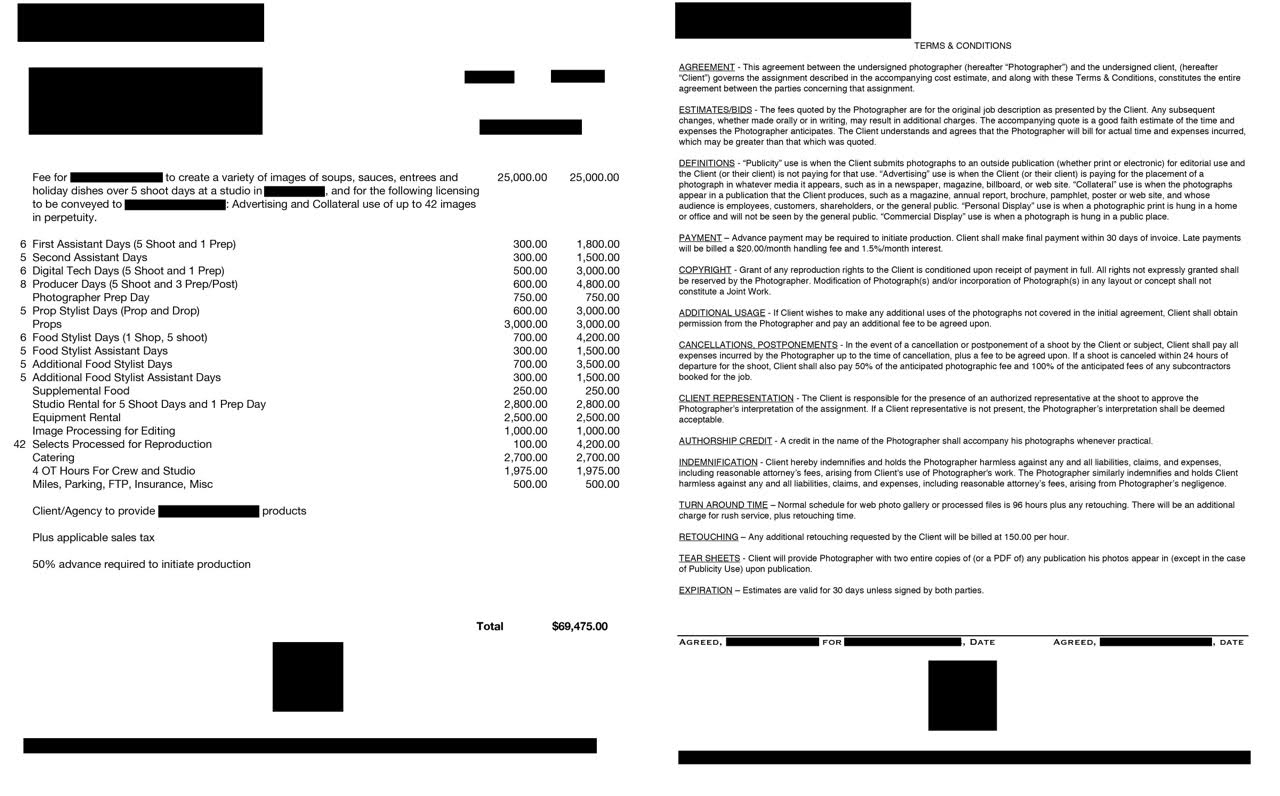
Here is the initial estimate:

estimate_1_terms

Concept/Licensing:

When the project was first presented to us, the scope was to capture individual close-up portraits of three female talent. We were presented with a creative deck that included these three shots along with details for additional projects featuring product and lifestyle images, which told us that our shoot would just be one part of a larger overall project. The creative deck also made it clear that the primary use of the images was for in-store displays, but this didn’t quite match up to the broader use that the client requested.

Upon speaking with the art buyer I learned that their intended use was limited to in-store display and use on their website (no additional advertising or printed collateral) and would likely be up in the stores for less than a year (rather than 2 years which they’d requested). It’s often the case that a client’s requested use doesn’t correspond with their intended use. In cases like this, we do our best to structure the licensing language to be more in line with the intended use. In this instance, however, I was told that limiting the licensing would not be an option.

The fact that this shoot was part of a larger project and that the photographer was eager to land his first assignment of this scale put downward pressure on how I approached his creative/licensing fee. However, the size and prominence of the client as well as the exposure level of the images put upward pressure on the fee. Another factor to consider was the value of each image in proportion to one another. Typically a shot list can inform you as to which shot might end up being the “hero” image and likely used in a much broader way than the others. Many times I will price the “hero” image (or scenario) at full price, and then discount additional images of the same nature. However, in this case, each of the three images were unique and would be promoting a different line of products for the retailer, and therefore I thought they should all be priced at their full value, which after weighing all of the factors, I determined was $5,000 each.

I checked my fee for the intended use against a few other pricing resources to see how they compared. Getty suggested $3,200 for in-store display use with a circulation of up to 5,000 for 2 years, and Corbis recommended $2,350 for this same use. FotoQuote suggested $2,700 for this use (although they didn’t offer an option to limit the timeframe) and BlinkBid didn’t have a breakdown for this specific use.  While I took these rates into account, they however did not include all of the additional licensing the client would actually be obtaining (even though they were unlikely to take advantage of it) above and beyond their intended use.

Assistants: I included two assistants to lend a hand with the lighting, grip and equipment.

Digital Tech: I included $500 for the digital tech, and then added on $750 for the workstation. The digital tech would help to manage the flow of file intake and display for client approval on set.

Stylists: For a beauty shoot, the hair and make-up styling is much more important than it would be on most other types of campaigns, so the client is typically involved in the stylist selection process. I secured quotes from experienced and represented hair stylists and makeup stylists. These rates include a typical 20% that a talent agency will add on to the stylist’s day rate. For many shoots I’d hire someone to handle both hair and makeup, but for a beauty shoot, it’s more appropriate to hire stylists with specific skills.  Sometimes stylists will bring their own assistants if many people need to be styled, but since we were only planning to shoot three talent, they did not need any extra support.

Producer: I included three days for a producer to handle the pre/post production (hiring the crew, booking the studio, arranging catering, facilitating the invoicing) as well as to be on set to make sure the day went according to plan.

Studio Rental: There are a ton of options for studios in NY ranging from small loft style shooting spaces to large soundstages. We didn’t need a giant space, so I aimed for a medium size studio at a convenient mid-town location.

Casting Days: When I started to speak with casting agents, I learned that many of them had previous experience working on shoots for this client, and they recommended that we account for 2 days of casting since the client may be quite picky. This fee covered the casting agent’s time, shooting space and booking of the talent.

Adult Talent: I settled on this rate after speaking with a few casting agents and obtaining their opinions on the fee for a shoot/usage of this nature. This was tricky since the requested usage was quite broad, but the intended use of the talent’s likeness was rather restricted (hmmm…this sounds familiar). We determined that a rate of $6,000.00/talent would bring in a decent pool to choose from.

Equipment: This would cover 2 camera bodies (~$400) a few lenses (~$100), a couple power packs and heads (~$350) as well as additional modifiers, reflectors and grip equipment (~$150)

Image Processing for Editing: This covered the time, equipment and costs to handle the basic color correction, edit and upload of all of the images to an FTP for client review.

Selects Processed for Reproduction: I worked with the photographer to determine an average of three hours to retouch each photo. Though the photographer would be handling the retouching in house, we priced it at $150/hr to ensure all costs would be covered should we have to farm it out unexpectedly.

Catering: I’ll often include $35/person for light breakfast and lunch catering, but things tend to get pricey in NYC, so I bumped it up to $50/person.

Miles, Parking, FTP, Misc: This was to cover any additional minor miscellaneous expenses during the shoot day.

Feedback: After reviewing our initial estimate, the client decided to trim the concept down from three images to two. They also told us that they weren’t interested in a live casting, and preferred to hire talent based on images in their online portfolios. This was surprising to hear because casting from cards/portfolio is a somewhat risky maneuver since there’s no way of knowing whether or not the images are current. With the caliber of agency we were working with, it wasn’t a serious concern, but it was definitely worth reiterating to the client. They also capped their talent budget at $5,000 per talent for five hours of their time on set and the usage. Their last piece of feedback was that the client rarely spends more than $8000-9000 on “beauty shoots”, however, they couldn’t tell me how the requested licensing for this project compared to that of their previous similar shoots.

On top of those changes, they were willing to limit the licensing duration (although they initially said this wasn’t an option) to six months. It still included broader usage than they needed, but the reduced duration and number of images was a justification for dropping the fee to work with their budget. Here is the final estimate:

estimate_2_terms

Results: The photographer was awarded the project, and I produced the shoot. The images will be in stores later this year.

Hindsight: While we were able to stay within the overall budget for the shoot, equipment costs ended up being higher than anticipated. The photographer required more equipment than initially discussed and the studio we booked insisted that they provide any rented equipment, and their equipment rented at a premium. If I had to estimate a project like this again, I’d probably include close to $1,000 for the digital tech’s gear and $1,300 for the photographer’s equipment.

After the estimate was approved and pre-production was progressing, I was discussing usage terminology listed on a talent contract provided by the client with the art buyer. The contract listed “unlimited” usage in addition to “in-store marketing” and “digital”. I try to refrain from using the word “unlimited” (and even “digital”) in general, and from my point of view it seemed redundant to list “unlimited” use and then specify a specific media. However, upon clarification, the agency/client understood “unlimited” to essentially mean “unlimited insertions” rather than “unlimited media”. For instance, they did not want to put a limitation on the number of printed posters they could hang in the store. While I tried to obtain clarification on this at the beginning of the estimating process, if I knew from the start that their request for “unlimited” use was really about unlimited use within in-store display and web collateral, I may have approached the fees differently.

If you have any questions, or if you need help estimating or producing a project, please give us a call at (610) 260-0200. We’re available to help with any and all pricing and negotiating needs—from small stock sales to big ad campaigns.