MARSHALL MCKINNEY, Art Director at GARDEN & GUN

I met Marshall in 2001, when he landed his very first job with the Outside Magazine Art Department and I’ve enjoyed watching him climb the ladder moving from magazine to magazine over the last few years. I was especially pleased when I heard he was going to run the Art Department at Garden and Gun because it seems like the kind of magazine where someone can really leave their mark. Not only do they have an awesome name, they appear to have the backing and foresight to produce a magazine that’s more of a luxury item. This is something that will serve them well as the media landscape evolves in the coming years, because I believe magazines that are printed well on nice paper stock, with big glossy photos, will be rewarded with a loyal audience and advertisers.

So, tell me about Garden and Gun, what does it stand for?

Garden & Gun, our no-nonsense name, represents the soul of the Southern lifestyle ––the land and the conservation of it, the sporting life, arts, culture, travel and food. It also says dual audience, a magazine that appeals to both men and women. The name Garden & Gun captures the spirit of the discerning Southerner’s sense of heritage and pride while conjuring thoughts of high craftsmanship, elegance and subtle detail. In fact, G&G has come to be part of the Southern lexicon. In blogs, I sometimes see people refer to something as being “G&G.” It seems the name was just born out of a strong sense of tradition. I personally like the name very much because whether it is received favorably or not it forces one to contemplate.

Obviously the magazine is very well funded but I’m wondering if you think there’s a future (beyond generous investors) for regional magazines that want to have a national reputation?
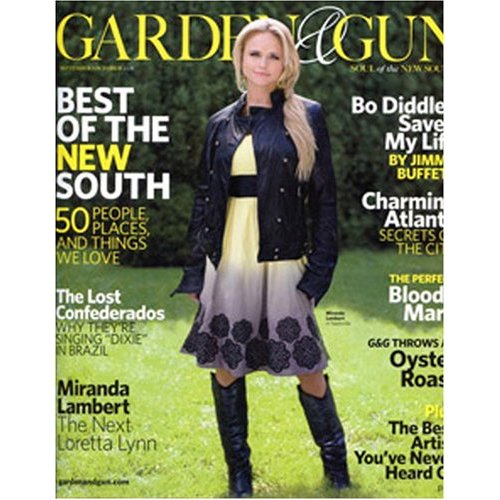
Garden & Gun does have a national reputation, no doubt about it. I attribute that as much to the novelty of our name / brand and tasty editorial content as our financial wherewithal. However, it is important to remember that G & G is a national magazine about a regional lifestyle—not a regional magazine. So, do I think there’s a future for regional magazines with a national reputation beyond generous investors? The answer is YES! I think there is a future for regional magazines and I think that future is (sorry for the forthcoming exclamation point) bright! I mean, look at Denver’s 5280, Virginia Living or the Texas Monthly franchise, which all appear to be fat and happy. Then there are new launches like Forbes Mountain Time, which hopes to bottle the lifestyle of an affluent regional audience.

I believe in the power of print. It’s here to stay. No other medium in the world translates the awesome authority, emotion and intensity of images better than paper. The reader is not staring into a light source but rather enjoying reflective light bouncing off (in our case) quality stock and tantalizing photography. Add that to editorial fare that conjures a healthy, connected—albeit “unique”–– lifestyle with a strong sense of place and voila! another successful magazine is born. (Ahem, if only it were that easy.)

Tell me about the photography. Are you hiring a lot of regional photographers? Are you paying national rates?

We hire a blend of national and regional photographers depending on the assignment and its location. However, we are very fortunate at Garden & Gun to have access to several brilliant shooters right here in our backyard of Charleston, SC. Those shooters being Squire Fox and Peter Frank Edwards. As to whether or not we pay national rates I’ll just say we are competitive and ALWAYS pay on time.

Your website (here) is amazing. 99.9% of magazine publishers are afraid of giving the content away online or they’re afraid of making the online content as enjoyable to read and look at as the printed content. Why do you think you can prove them all wrong?

We arrived at our website philosophy like this: We asked ourselves, what is everybody else in magazine publishing doing? Once we deduced that, we then made a decision to do the exact opposite. In our case, lead with the bold use of photography and use as much as possible or as much as the content will allow. In my mind the thinking is this. We serve an affluent audience. One that expects quality content at a high presented tastefully or at a high taste-level—particularly when it comes to the packaging. Again, the stock we print on speaks to the fact that G&G recognizes the magazine as a luxury item. Therefore, we aren’t afraid of giving content away on the Internet because we feel like our audience wants G&G prominently displayed on their coffee tables.

All that said, though, look for a tweak to the website in the coming months as we are morphing the site to better take advantage of e-newsletter technologies. However, I don’t anticipate our newly developed web strategy conflicting with our philosophy to give all our images the star treatment online.

How do you like to be reached and what types of photography and photographers are you looking for?

I’m looking for down-to-earth, easy-to-work-with photographers who are committed as much to their craft as developing personal, lasting relationships with their clients. I look for shooters who own their style and know exactly how to get the goods in the can. I also look for shooters who specialize in a certain kind of photography whether it be portraiture, travel reportage, product, etc. I also liked to be reached in creative ways via the internet and snail mail. I like seeing photography printed on paper but I like the convenience of the Internet.

I like to find young hungry talent as much as the next AD but the realities of the business are such that many of the editors at this level want the peace of mind that comes with hiring a known quantity. Editors at national magazines are quite savvy and familiar with the photography talent that revolves around the publishing world. As much as I’d like to bring along eager, talented young shooters, sometimes it can be very difficult. With looming deadlines hovering over everyone’s head, it can be tough to fight battles where bringing on an unknown is concerned. There’s just not enough time in the day—not to mention the fiscal concerns and scheduling nightmares that would ensue if, they didn’t come back with the right images.

All that said, editors and art directors alike know it when they see it. They know talent and original thinking. So for any young shooters out there, my best advice to you it is to hone your craft, dedicate yourself to it and don’t fear these sorts of obstacles but rather recognize that they exist for your enlightenment. It’s cliched but true that nothing worthwhile in life ever comes easy. You have to want it, you have to earn it and you have to be resilient and open at the same time. But enough with the preaching already. BACK TO WORK!


Popular Newspaper Columnist Quits Citing Slow Transition To The Web

Jay Mariotti, star sports columnist and 17 year veteran of the Chicago Sun-Times abruptly quits after signing a new 3 year contract.

Mariotti told CBS 2’s Dorothy Tucker that he decided to quit after covering the Olympics in Beijing because newspapers are in serious trouble, and he did not want to go down with the ship.

“It’s been a tremendous experience, but I’m going to be honest with you, the profession is dying,” Mariotti said, “I don’t think either paper [Sun-Times or Chicago Tribune] is going to survive.

“To showcase your work … you need a stellar Web site and if a newspaper doesn’t have that, you can’t be stuck in the 20th century with your old newspaper.”

Read more (here). Thanks Loren.

Aurora 15

I’m editing the Aurora 15 this week (here) and it’s kind of a cool, innovative way to show off your agency and photographers.

Here’s What I Think Of Your Pictures

I was looking at a photographers pictures recently trying to figure out what kind of advice I should give and having a difficult time of it, because I felt like they had perfectly decent pictures and they were a perfectly decent photographer, but I felt nothing for the images.

I recently re-watched the Johnny Cash movie, Walk The Line and even though it’s such a cliché for artists, it still sent tingles up my spine when the scene occurs where Johnny goes in to make his first record and runs into what must have been the most prescient record producer in the world, who delivers the mother of all lines to Johnny. Here’s how it  goes in the movie:

Hold on. Hold on. I hate to interrupt… but do you guys got something else?

I ‘m sorry.

I can’t market gospel.No more.

So that’s it?

I don’t record material that doesn’t sell, Mr. Cash… and gospel like that doesn’t sell.

Was it the gospel or the way I sing it?

Both.

Well, what’s wrong with the way I sing it?

I don’t believe you.

You saying I don’t believe in God?

J.R., come on, let’s go.

No. I want to understand. I mean, we come down here, we play for a minute… and he tells me I don’t believe in God.

You know exactly what I’m telling you. We’ve already heard that song a hundred times… just like that, just like how you sang it.

Well, you didn’t let us bring it home.

Bring… bring it home? All right, let’s bring it home. If you was hit by a truck and you were lying out in that gutter dying… and you had time to sing one song, huh, one song… people would remember before you’re dirt… one song that would let God know what you felt about your time here on earth… one song that would sum you up…

you telling me that’s the song you’d sing?

That same Jimmie Davis tune we hear on the radio all day? About your peace within and how it’s real and how you’re gonna shout it?
Or would you sing something different? Something real, something you felt?
Because I’m telling you right now… that’s the kind of song people want to hear.
That’s the kind of song that truly saves people. It ain’t got nothing to do with believing in God, Mr. Cash.

It has to do with believing in yourself.

I hear the train a coming, it’s rolling around the bend and I ain’t seen the sunshine since, I don’t know when…

—-

That’s how I feel about photography right now. I want to see something real. I want to see something I haven’t seen a hundred times before. I want to look at pictures that make me feel something.

Casting, Styling and Props

Those three little gems are usually left out of editorial shoots to save money and time but I can tell from the few instances I’ve had all three on set, the change in the resulting pictures is profound.

Of course, great photographers are good at doing all of that (obsessing over the details in pre pro and on set) while taking pictures too but having those people in the process can make the images stonger… and keep the photographers sane.

In fact, if you’re not already paying close attention to those 3 facets of picture making you can improve your photography dramatically by doing so now.

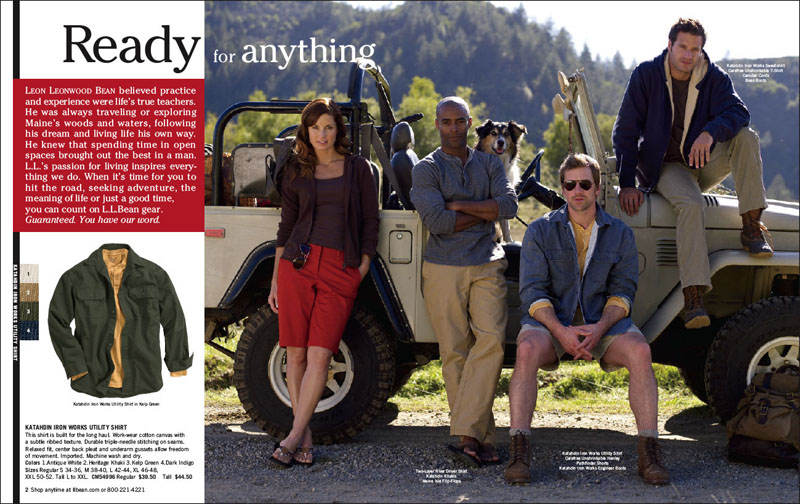
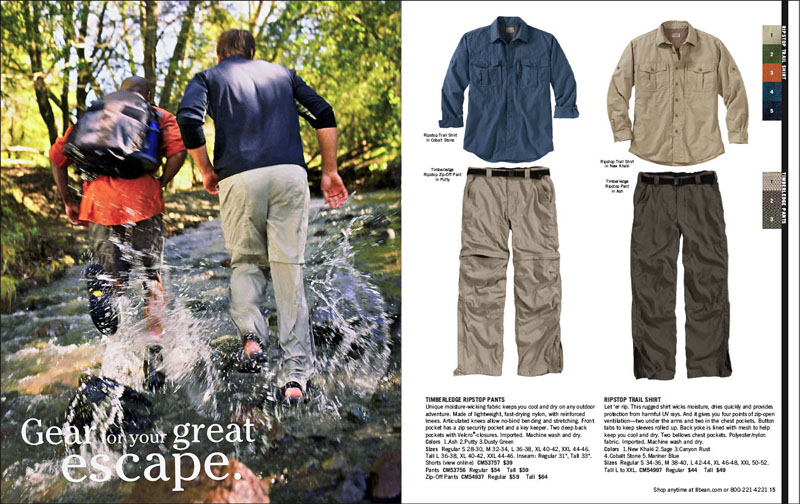
DJ Stout at design collective Pentagram and of Texas Monthly fame tackles the venerable brand of L.L. Bean and uses casting, styling and props to effect a major face lift.

Before:

After:

Before:

After:

Read how he did it (here).

Joerg Investigates Self Published Books

Joerg Colberg has an good post on his experience and comments from readers on their experience with, on demand printing of photography books (here).

“…the images inside the book look like crap. They look like something printed on an extremely cheap printer…”

“What I do want to point out is that while printing books on demand might sound like a great idea, it is ultimately up to the photographer to perform quality control. And getting books printed on demand might in fact lower the threshold of the quality of photography books to a noticeable extent…”

“…I find it slightly surprising that while many photographers – especially those who grew up before the so-called digital revolution – know the names of expert analog printers, there does not appear to be a corresponding pool of expert digital printers.”

If anyone knows of any high quality on demand photography book publishers it would be good to hear about it (or email Joerg so he can add to his post). The very first books I started seeing with portfolios came from .mac and I remember the photographer telling me she tried them all and .mac was the only one where the color was consistent. Not sure what happened to them but now I only hear about blurb, although I’ve only actually seen a couple and they seemed fine but then again, I’m used to magazine printing; )

Newspaper Escape Plan- Facebook Group

Description reads:

Escape from newspapers while you can! At this rate, everyone will be laid off. Did you leave on your own terms? Or did someone else make that decision for you? Were you “involuntarily separated?” Let’s help each other get through this!

Take your journalism skills to a new industry that appreciates and wants you. Post job listings, tips, resources and personal experiences. Rework that resume and cover letter. Get the skills you need. Try to stop reading Romenesko every day and let go of an industry that doesn’t care about or deserve you.

Journalism and the newspaper industry are two different things. We are still passionate about journalism and its role in our democracy. We can still do it in new and innovative ways. The newspaper industry is an abusive relationship. We keep getting beat up but we keep coming back because we love him. It’s time to leave.

See it (here).

SEO Is Not Just For Wedding Photographers Anymore

I know that for a wedding photographer or a local portrait photographer, SEO (Search engine optimization) may be one of the most important things for their business after the images. What could be more simple for a potential client than typing city and state plus the word photographer in google? I’d never given it much thought for editorial and commercial photographers because there are better ways to find those people and the results google used to spit out were never that great. Well, I think times are changing and when I see Dan Winters buying keywords (here) I know they’ve changed quite a bit (several years ago he didn’t even have a website).

I think about SEO a great deal now, because I build websites for a living, but the thing that struck me the other day was how many times in the past I’ve typed into google the name of an advertising campaign or a story in a magazine that I saw somewhere but forgot who shot it and never, ever, found what I was looking for. This will and probably has already changed as a new generation of photographers blog about their shoots and those of us blogging about the industry in general report who shot what for whom. There are other reasons photographers want good search results of course but the amount of times I’ve tried and failed to find someone this way seems like a good reason for everyone to think about it.

Anyway, now I’m business partners with Erik Dungan, someone who’s spent many years helping wedding photographers improve their search results and building websites that are SEO friendly, so I thought I’d ask him some questions about it.

Can you tell me the biggest SEO myths and how they came about?

The biggest myths tend to be outdated information from the web 1.0 (or earlier) days. For some reason, this bad information keeps circulating into the hands of new photographers every year–like a bad email forward.

The biggest myth is definitely that meta tags provide any meaningful impact on your search engine rankings. People learned long ago that it was easy to game the system with meta keywords. Search engines haven’t given the keywords any significant weight for a few years now. The meta description affects how your result is displayed–but it too has little (or no) weight on your position.

Second (especially for photographers) is that Flash-based websites can’t be optimized well. If you embed your Flash correctly, provide alternate content, and use links appropriately, Flash sites can be optimized just fine. I’ve done it for several sites. Adobe’s recent announcement could make things even better–but even now, getting a Flash photography site on page 1 is possible.

I’ll throw in another myth regarding searching behavior. For some reason, photographers often worry about how their site ranks when searching for their name. Trust me, if a potential client knows of you by name, they won’t have a problem finding your website. Worry about your market and areas of expertise. Optimize for those searches, provide appropriate content, and the long tail of search terms will fall into place.

I’ve always thought of SEO as stuff you do to the code of your site, programmer stuff. Are there really things photographers can do on their own without mucking about in the code?

Definitely. One of the biggest is blogging. Good blogs naturally use layouts, page elements, links, and URLs that search engines love. Setup a blog and make sure you have links between it and your site’s home page. Then, blog at least once a week about the jobs and projects you’re working on. Search engines love content, so make sure you’re blogging about photography. People love tutorials and behind-the-scenes stuff. Regularly blogging about photography builds appropriate content and improves the chances of getting quality inbound links. Who cares if no humans read your blog. The search engine benefits alone are worth it.

Also, many websites include a CMS of some sort, allowing you to adjust elements of the site without getting your hands in the code. For example, your browser title is an important ranking factor and many control panels let you adjust that.

On the other hand, I always encourage photographers to be brave and get into the HTML code for simple things. It’s not for everyone, but c’mon–if you can calculate exposure values in your head, I hope you can edit a TITLE tag without doing any major damage.

And what about in the code. What should photographers make sure their website designers have done?

Related to my above point, the more you can control aspects of your site (via a CMS or control panel), the better. That goes for SEO changes or simply keeping your site fresh with new images. The days of having a developer build a site from scratch and having to call/email him for every minuscule update are over.

If you’re building a Flash site, there are some additional questions to ask. You want to make sure your Flash is embedded properly–using OBJECT/EMBED tags is not ideal for SEO. You want to make sure your Flash content is embedded with JavaScript and that it’s mirrored as HTML content in one way or another. If this paragraph doesn’t make sense to your web designer, it’s time to find a new one :)

I’ve heard a few pitches from SEO companies where they’re basically saying they can game google or that they work closely with google. Is this a scam?

I’m hesitant to call anyone a “scam” without hearing the pitch, but I’m leery of most SEO pitches–especially if they’re cold-calling you. Be skeptical of any monthly subscription offer. Any of the following pitches should also throw up red flags:
“we will guarantee you #1 ranking or Y amount of traffic” (no one can make guarantees like that)
“we have a partnership with Google/Yahoo! and we can put you at position X” (I’ve heard this one myself … organic searches don’t work this way and its easy enough to do your own ad campaigns)
“we will submit your site to all the major search engines for $x per month” (since that’s not necessary anymore, it’s not something I’d want to pay for … especially monthly)

There are more, but in the end … real SEO pros don’t seek you out–you seek them out.

Ok, give me you best tips for getting higher and better search results.

Ok, here’s what I’ll do: I’ll toss out 10 tips that will help photographers here rank higher. I wont go into too much detail, but I’ll keep an eye on the comments and try answer any questions people may have. You can also find more info just by searching around.

Establish a baseline

1. Make sure you have web stats installed on your site and your blog (Google Analytics or Mint)
2. Install the Rank Checker plugin for firefox. Plug in any keywords or phrases that are important to you and see where you rank now. Check it every 1-3 weeks and add new phrases as you see them in your stats.

Blogging

3. Set up a blog (WordPress if you want it on your own site; SquareSpace, TypePad, or WordPress.com if you want a hosted version) and start blogging once a week.
4. Make sure your blog links to your site’s home page and vice versa.
5. Collaborate with 3 industry peers. Link to their site and/or blog (on your blog’s sidebar) and ask them to do the same. NOTE: I don’t advocate huge, convoluted link-trading schemes. I’m talking about peers that you actually know and work with.
6. Submit your blog to Google Blog Search and Technorati. You only have to do this once and some blog systems will do it automatically.

Site updates

7. Edit your browser title, making sure that it contains at least 2 keywords/phrases that are important to you. This is easily the biggest “bang for your buck” update that you can make.
8. Update your About/Bio page. Don’t just write about how you fell in love with photography after your dad gave you his old Rollei. Write about what you do, where you do it, your specialties, and past clients.

Local search

9. Submit your business to Google’s Local. It takes a few weeks to get in there, but it’s worth it.

Inbound links

10. This tip is a bit general (and related to #5), but inbound links (links to your site from other sites) are crucial for SEO. Contact peers, mentors, agencies, editors, clients, or local publications that you have worked with and have a good reputation. The goal is to get a link to your site. It could be from a “recommended photographers” page, a blog post, or just a simple credit/byline. When it comes to local publications, be creative–offer to write a how-to article or take some headshots.

Another DOP Blog, David Griffin at National Geographic

I was checking out the TED video of David Griffin, Director of Photography at National Geographic (here), that I discovered on Shoot The Blog and wanted to send him an email but instead discovered a few blog postings that I think you might be interested in reading (here).

The last one from May tackles Film vs. Digital (here) and ends with this wonderful quote:

“At National Geographic we do not require photographers to shoot one way or another—we support both approaches. Ultimately, we care more about what is being photographed, and less about how.”

Maybe, we will start seeing more blogging from working DOP’s in the future, National Geographic is certainly ahead of the curve when it comes to websites.

Burnett and Jarecke in Beijing

David Burnett and Kenneth Jarecke are shooting and blogging from the Olympics.

Kenneth (here) and David (here).

I found this little tidbit from Kenneth to be interesting:
“… the people at Octagon (the sporting agency that represents Phelps) in my opinion really screwed up here. Not only did they try to sell the exclusive rights to pictures of Michael with all eight of his Beijing medals (rumor has it the highest offer was only $225,000, which I guess was not enough to tarnish the gold so no money changed hands), they really screwed the good people at VISA.”

Media Needs A Makeover

The pace of doom and gloom stories for printed media continues unabated but I’ve noticed more and more that are offering brilliant insight into the problem and even a few solutions.

A story in Business Week about a thriving newspaper industry in Germany (here) surmises that the problems with US newspapers is not the internet it’s the content:

“I suspect the real reason German papers still thrive is their embrace of competition. Unlike so many U.S. papers, Bild was never part of a quasi-monopoly that allowed complacency. It’s telling that Bild doesn’t deliver —it depends on newsstand sales. ‘Bild has to prove itself at the kiosk every day,’ says Deputy Editor-in-Chief Michael Paustian.

That pressure helped Bild maintain its focus on original content. It uses almost no wire copy and brags that every story is an exclusive. Even during the crisis years, Bild kept its 800-strong editorial staff intact. What advice does Diekmann have for American newspapers? ‘It’s too late.’ ”

Along a similar note Dr. Samir Husni (AKA Mr. Magazine) scolds all the top magazine titles for causing the failing newsstand themselves by selling subscriptions at cut rate prices. The practice, to offer dirt cheap subs as a way to control circulation and meet rate base not only undermines newsstand sales but in my mind it destroys the content by bringing in consumers who are barely interested in reading the magazine in the first place and forcing the editorial staff to cater to a more general audience of readers. Dr. Husini’s unlikely cure for the newsstand woes:

“Stop chasing the numbers of customers and concentrate on customers who count. The first step in doing such is stop the rate base gimmick. You can’t anymore chase a rate base number and try to meet that number. Today’s customers are different and reaching those who count is much more important than counting them.”

Mygazines continues to make headlines for allowing consumers to freely scan and distribute their favorite magazines in a clear violation of US copyright laws but it doesn’t look like they will go away anytime soon because they’re owned by the same company that runs Pirate Bay (CNet story here). They’ve been on Hollywood’s most wanted list for several years now and appear to be indestructible.

There are many, many reasons why this will never become the napster of the publishing industry; it takes a lot of effort to scan an entire magazine and converting magazine pages into jpgs hardly seems like a brilliant solution to portability online, to name a few, but it’s certainly caused quite a few people to sit up and take notice and spark discussion. I agree with this motley fool story entitled “It’s the end of publishing as we know it” (here) when they say:

“Magazines like Cosmo, Wired, and Playboy always looked like prime online properties, dishing out their advice, entertainment, and other well-written and popular articles through this huge series of tubes. But here we are, well into the digital age, and most of them simply haven’t made the transition yet.

If Mygazines teaches Time anything, it would be how to present the print magazine in a tasty online form, easy to navigate and easy to use. Copy that model and then improve on it, inject a bit of revenue-generating advertising, and see if your readers prefer the official version with corporate backing or some fly-by-night rip-off where everything is free but nothing is guaranteed. Now let’s see which publisher might be the first to get a clue so we can invest in it.”

Of course publishing companies are like lumbering giants and as risk adverse as you get (a few serve as retirement accounts for their owners), but it would only take one textbook case of a magazine doing it right online and proving that the revenue and audience exists to turn the entire industry around.

I don’t think printed magazines will ever go away completely and why should they, people still like to read them and they’re awfully convenient for the airport, bus, train or limo rides, but the audience is limited and will continue to shrink so publishers need to follow the young audience and the casual, used to buy it for 1 article readers where they’ve gone, online.

Also, if you’re simply going to reprint the entire contents of the magazine online with all the advertising intact it should be free. Simple math will tell you that the newsstand and subscriptions prices don’t even cover the printing and distribution cost for a single issue, so if I’m saving you that expense the least you can do is not charge me for it online. If you’re going to transform the content online and run epic photo essays, allow reader interaction and leverage the technology available then the possibilities for audience and revenue are endless. If you treat the internet like a piece of paper you may find equilibrium between audience size, expense to produce and profit but the the multi-million dollar profit glory days are now coming to an end.

Overall, the theme here seems to be content, quality content. Can it really be that simple? I think so.

UPDATE: Pirate Bay refutes ownership of Mygazines (here). Thanks Sean.

Wall Street Journal Photo Blog Name Change

The Wall Street Journal changes the name of it’s photo blog from Big Picture to Photo Journal (here). Honestly I don’t think the name change was necessary but obviously you people are in charge now. Feels good doesn’t it.

PDN Online Redesign and A New Feature

PDN Online has a new look and a new feature called PDN Compass (here) where you can mark on a map where you live and what you shoot then presumably Photo Eds and Art Buyers and other potential clients will search by location and specialty and easily find you. Sort of like PhotoServe.com which is something I’ve always used to search for photographers in a particular location but this one is free. Hey, getting with the new economy are we PDN, except I still see those shiny gold locks on all the big articles, so maybe not so much.

Anyway, I haven’t totally checked it out, but it will need critical mass to be worthwhile for buyers. I wonder if that’s still possible in 2008, where leveraging the community to do all the work (free labor, free service) is becoming a dated concept. We shall see.

A Light At The End Of The Tunnel

Two recent developments have me excited about the future for photographers:

1. Magnum photographer Thomas Dworzak is in Georgia for The Wall Street Journal and they’ve got a nice online slideshow to go with it (here) but then they take it a step further and have a BIG picture page with a comment area (here). Spread the word. It can only get better.

2. Andrew Hetherington sells out of a series of 220 prints in 9 minutes. All because he’s a brilliant photographer and…he has an audience (read about it here).

It can only get better as more an more newspapers and eventually magazines adopt the big picture strategy and need professionals to go out and deliver powerful content. And, photographers with an audience can count on publishers seeking them out to tap into that audience and their additional channel of distribution.

Also, check out the 10 Misconceptions about photography. I’m feeling pretty good about what lies ahead.