Most newspaper Web sites just aren’t very good

I’m enjoying this blog Recovering Journalist and found this post on newspaper websites spot on (here).

“…But that’s the problem: They’re usually putting out online versions of printed papers. They’re still pasting newspapers onto a screen–and the state of the online art has moved way past that.”

“Spend some time with an online newspaper–and compare it to leading Web sites–and you know what I mean. Most newspaper Web sites have a gazillion links on the home page; the eye has no idea where to look. They’re ugly, overstuffed and foreboding. They’re trying to do way too much. The most successful Web sites, by comparison, usually are minimalist, and designed for quick scanning and visiting. Believe me, there’s no fast read when the “National News” header on a newspaper Web site sits atop 10 or 20 small-type headlines. Snore.”

“There’s more: Newspaper Web sites still are organized like, well, newspapers. They follow the traditional News/Sports/Local/Features model from print. That’s not a bad organizing principle, but it may not be well-suited for the Web, where readers are used to quicker, even simpler organizational schemes. (Check out Google’s home page, which is still all about pretty much one thing: search.) Focus on what readers want, not on how your print newsroom is organized.”

He’s even got solutions.

Hopefully someone will listen.

3M Finds The Joys Of Social Media and Will Now Discover the Pitfalls

A photographer takes pictures of people covering a coworker’s car in Post-It Notes. He posts the shots on Flickr and they go viral. More than a year later 3M, maker of the Post-It decides to try and capitalize on the image and contacts the photographer about a license. The photographer asks people he knows in the photo industry what a fair price might be and gives them a quote. Michelle, the emarketing supervisor at 3M tells him she will just copy it instead, for much less… and does. Read and see the whole deal (here).

Now, social media is great. Word can spread fast about cool and interesting things but you have to be a complete moron to not know that it can go both ways. Not only can they get sued for this type of behavior I’ve suddenly lost my appetite for Post-It’s.

Report From VISA pour l’Image

Paul Melcher had this to say:

“The best and most incredible event of this year VISA was probably the projections open to everyone, on a giant screen, in the Place de La Republique. The attendance was spectacular. It seemed that the whole city of Perpignan was there, forgetting the comfort of their homes and TV, to sit and watch great images. At a time when everyone screams the death of photojournalism, this was a nightly slap in their mouth. And it should make us wonder. If people are so hungry to see great photography, who is really killing photojournalism ? The public enjoys it, photographers are producing it, agencies are making it available, so why this slow disappearance?”
[…]
“Some agencies have seen their best year ever in 2008 and are very optimistic about the future.”

Read it (here).

Photoshelter Stops Selling Stock

Effective 10/10/2008, The PhotoShelter Collection will discontinue stock photo licensing.

We’ve made a strategic decision to focus our efforts on enhancing our original product, The Personal Archive.

Explanation (here).

A Good Resource For Finding Women Photographers

You probably know how much Photo Editors like their photographer lists and really any edited group of photographers is handy when looking for people to hire or looking for new people to add to your personal list.

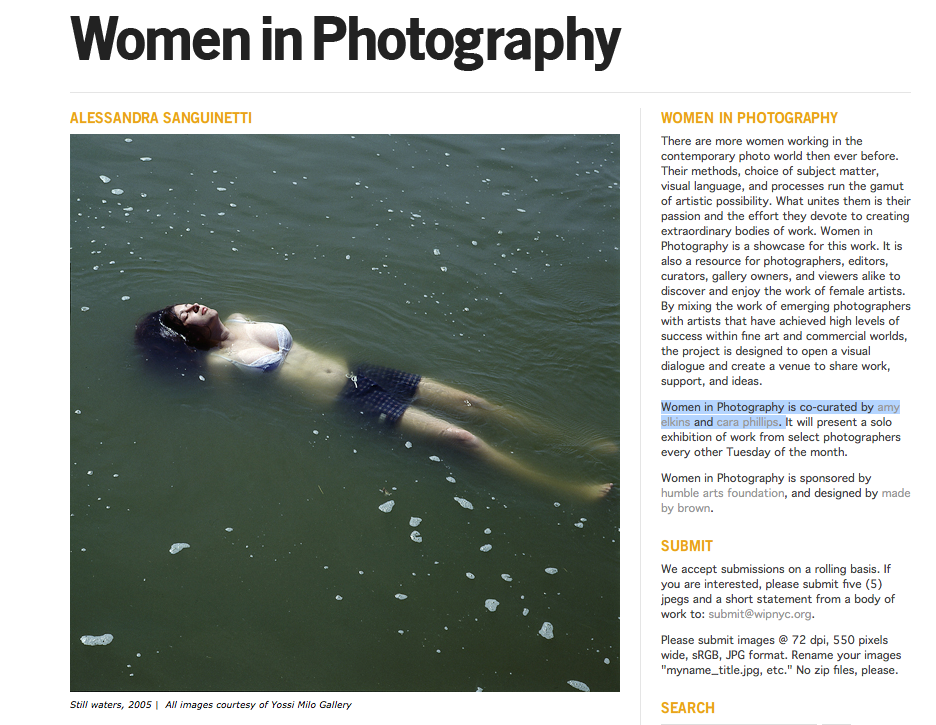
I think this Women in Photography website (here) will become a very strong group from which to find talented photographers to hire. I like that it has a very specific point of view as defined by the co-curators amy elkins and cara phillips.

I mentioned to someone the other day that there are many resources that serve as lists of photographers for the creative community that you can buy into. But, if you don’t agree with the list of people you’re buying into, why not just go make your own. If it’s useful and the creative community knows about it, we will use it. The Women In Photography website is a good example of this.

The Women In Photography Website

Wired, Really Pulls Back The Curtains

Wired continues to amaze me with their behind the scenes blog on the making of a magazine story. If you’ve never seen the edit on the first draft of a story go have a look (here).

Fair Use of Photography On A Blog

I’d say most people writing about photography and/or photographers on a blog are using the “Fair Use” limitation in copyright law (here) as a way to avoid having to get permission and possibly pay for the use. I use it sometimes and in turn I can expect to see things that I write about quoted and used without my permission as well.

I’ve been asked a few times by readers “What’s fair use and what’s illegal when using photography that’s not yours on a blog?” I can’t actually answer that question, because I’m not a lawyer, but I would like to help bloggers understand the best practices for using photography that doesn’t belong to them, so when I saw this “Code of Best Practices in Fair Use for Online Video” (here) I thought I should create one for photography (and not 16 pages long), since it doesn’t already exist. There’s really no end in sight to the practice of bloggers writing about a photograph or a photographer and then posting a picture, so don’t you think it’s time we set down some guidelines on what acceptable and what’s not? I’m going to post the best practices guide on the url http://www.fairusephoto.com and I’d like it to represent what photographers and photo industry bloggers feel is acceptable. Here’s what I think:

Nearly all the photography in the world is copyrighted and belongs to the person who took the picture.

The absolute best practice for using photography that doesn’t belong to you is to ask for permission first.
Oh, you thought there was more? Email or call the photographer and ask for permission. It’s that simple.

If you are looking to cite “fair use” as a way to publish copyrighted images without permission because you believe it falls under the following:”for purposes such as criticism, comment, news reporting, teaching (including multiple copies for classroom use), scholarship, or research, is not an infringement of copyright” then you should follow these best practices:

Always include the photographers name and links to both the image(s) you are writing about and their portfolio in your story or in the caption to the image.

The destination of the anchor link for the image should be the page where the image was found (most blogging platforms have the anchor link to a larger size image so this has to be changed manually).

The bare minimum number of images should be used to make your point. You want to pique the readers interest so they visit the photographers site to see a full selection of images.

Use a screenshot of the image (instead of downloading the file used on their site) and include as much of the surrounding page as possible so it’s obvious that the image came from another website.

The end result should always be that readers, who find the photograph interesting, click to visit the photographer’s site.

Please understand that this is a best practices guide and following this guide does not exempt you from copyright infringement and potentially a lawsuit from the copyright holder. It is ultimately up to the courts to determine if your use was “fair use.”

Here are some resources for further exploring copyright and fair use:

Copyright Law of the United States of America and Related Laws Contained in Title 17 of the United States Code.

Copyright Term and the Public Domain in the United States, 1 January 2008.

Summaries of Fair Use Cases.

US Copyright Office- Can I Use Someone Else’s Work? Can Someone Else Use Mine?

Let me know what you think.
Newsweeklies, Where To Go From Here

Here’s a debate on Fox Business via Mr. Magazine where the two pundits brought on to debate Time vs. Newsweek end up taking different positions on what those two newsweeklies should actually be covering to stay relevant.

Dr. Husni, J schooler and clearly a big champion of printed magazines argues that newsweeklies need to change their content to better become a bridge between what happened last week and what’s about to happen and how it will effect readers. John Friedman columnist at Market Watch dismisses printed magazines and the newsstand entirely claiming that the battle is on the web and the newsstand is dead.

Do you carve out your place on a shrinking newsstand to deliver something nobody else does or do you evolve your business model to chase news online? To do both well, will take a serious investment.

A New Way To Read All Those Photo Blogs

I gave up a long time ago trying to keep a decent list of links to photo blogs and have always relied on Andrew Hetherington’s list over on WhatsTheJackanory? whenever I wanted to do a little browsing and of course I tried to saddle him with the responsibility of keeping track of the good blogs by posting about it. He also has a pretty good track record for outing blogs before the author is ready, including yours truly and most recently Vincent Laforet (FYI- If you link someone in your blogroll when setting up the blog they can see it in their site admin).

I was helping him move his blog to wordpress and updating the look of it and we stumbled upon a really cool way to browse blogs. He’s calling it Blog Patrol (www.blogpatrol.whatsthejackanory.com) and it might take a little getting used to, but I’ve been testing it out for a couple weeks and I like how it shows posts from all the blogs he’s watching chronologically. The real beauty for me is that you can scan the headlines of all the blogs in a matter of minutes then visit later in the day to see what’s new. I think it will catch on as the place to visit and see what’s happening in the photo blog world.

Single Serve Websites, A Cool Trend

Andrew Zuckerman has a great new book coming out called Wisdom and instead of just announcing it on his portfolio site he created a whole new website for the book (here). In fact he’s done that with his other projects as well: Creatures (here) and High Falls the movie (here).

I also noticed that Phil Toledano does the same with his projects, Phone Sex Operators (here) and Days With My Father (here).

Finally, Anthony Georgis showed me his new project called Blood Makes The Grass Grow and it has its own url (here).

Emerging trend or passing fad?

I’m into it. I don’t think it’s necessary to hang everything off the same url anymore. The better search becomes and the more that people are talking about photography and photographers online the less likely people will find you by simply typing your url into the browser. What I really like about it tho is how easy the work is to pass along now and how it suddenly doesn’t exist as just a portfolio piece but instead becomes a finished product. This is how things spread and turn up in unlikely places and get discovered by people who otherwise would never know your name.

This is the hardest thing for media companies to understand. They think about the brand and about making sure everything is in one place where it can be controlled, but that actually ends up preventing people from running into you in unlikely places and therefore prevents casual readers from discovering a piece that’s relevant to them. The casual readers are who’s leaving magazines because it’s just not worth the effort anymore for the 1 or 2 stories that you found interesting and because it’s more convenient to find them online. You can capture them back again if you are willing to let the content go free and roam around unlikely places to be discovered.

Anyway, it makes me think about the lists I make and the projects I’ve done with photographers. I think it would be cool to do a few things and then set them free and see where they turn up, who runs into them and how popular they might become.

Google’s Browser Has A TOS Rights Grab

“…by posting anything (via Chrome) to your blog(s), any forum, video site, myspace, itunes, or any other site that might happen to be supporting you, Google can use your work without paying you a dime.”

“And for the record, Microsoft tried this years ago with MSN messenger, where MS got an irrevocable perpetual license to all IP that passed through MSN messenger, and the net basically revolted.”

“There are some people who have claimed that this is standard legal jargon for every piece of software. Not only is that simply not true, no clause even close to that is in the Firefox terms of service.”

Read about it (here), Thanks Bart.

The Making of A Magazine Story

Wired is giving everyone a look behind the magazine making curtain with a new blog called storyboard (here).

Wired is probably the perfect candidate for something like this because they seem to have a decent grasp of their mission and don’t feel the need to cut corners and/or try to bullshit their audience. I hope we really do get to see the entire process and for example, get a peek at the first draft of the story and see just exactly why it needs a ton of work like I always used hear from editors when one of those first drafts came in. Then we could watch as the CD and PE discuss approaches for the photography and hopefully see the raw unedited film from the shoot, unless of course they hire Dan Winters in which case you will only see the final images (ever). And, finally maybe we can listen in as editors stand around the designers computer trying to come up with a clever headlines and pull quotes while the managing editor is standing nearby checking their watch because everyone is waiting for a round to start.

Yes, this could be very entertaining for all of us.

Via, Boing Boing.

Finding A Rep or Starting A Collective

Good piece by Nick Onken on his quest to find a new rep (here). This part rings true for me:

“The roster of talent is a huge factor as well as I’m realizing. Being repped by an agency that only reps a certain level of talent, automatically takes you to that level(at least it appears that way from the outside). Brand association is huge, and by associating with other brands that are maybe bigger than you, creates a credibility.”

One of the big reasons for Photo Editors to work with a rep is not the photographers we already know but the people we’ve never heard of, who they basically endorse and lend considerable expertise.

This new photographers collective Luceo Images (here), got me thinking about how photographers can just band together and form an agency and certainly there’s a few high profile photojournalist collectives that exist and seem to make it work.

David Banks, one of the founders with Luceo told me this, when I questioned him about the value a collective creates on the client side without the rep to “vouch” for the photographers:

“The other reason for all this is our belief in helping each other out and being open in the photo industry rather than the one-for-all mentality that is so engrained. We can all work together to edit new projects, work up budgets, make pitches and generally have power in numbers.”

Makes sense and it’s not something I’d considered since this probably doesn’t occur with the reps where the photographers are brought together by the rep and not each other.

(Onken via, A Visual Society)