The Next Generation Of Photo Editors

I think the way clients and photographers communicate and reach each other and the job of Photo Editor will profoundly change in the next decade. There’s exciting technology to take advantage of and the potential of the internet has barely been tapped by publishers. I wanted to start talking with .com and junior Photo Editors to look at the way they’re using technology and get a feel for what the future might bring.

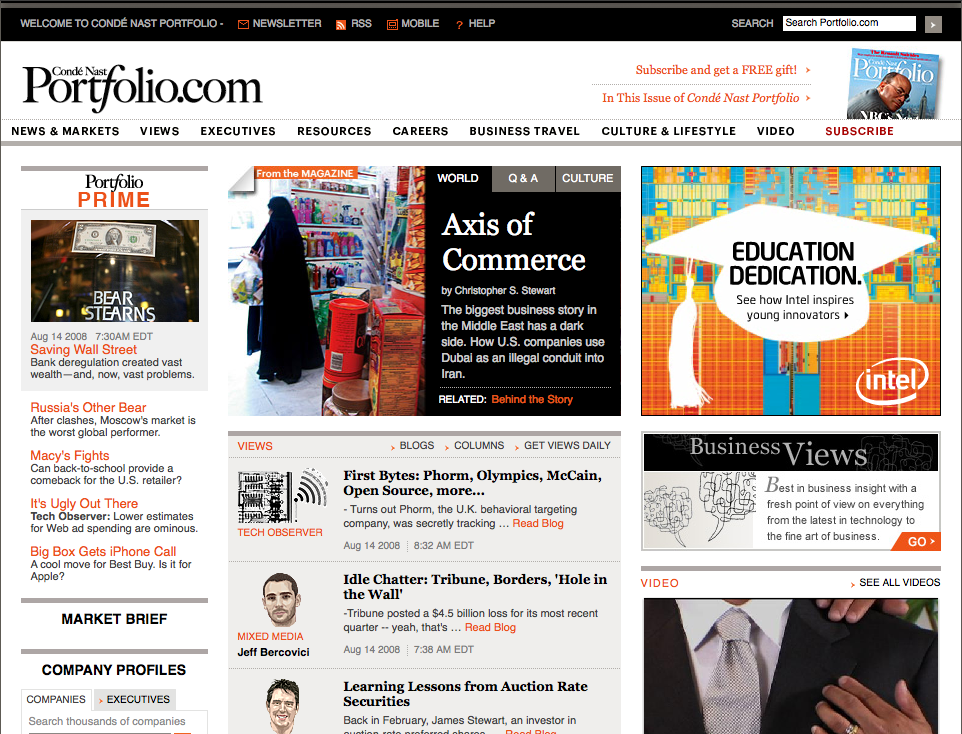
I met Ryan Schick at the Photoshelter panel in NY a few weeks back and found him to be very well spoken and thoughtful about the industry. Ryan works for Condé Nast’s Portfolio.com as the News Photo Editor where he sources all the daily news pictures and develops larger photo essay projects. He’s young and a .com Photo Editor so I thought he might have a different take on how he finds photographers and how the future might play out.
You seem like a fairly technologically savvy Photo Editor. Is that a generational thing or have you made an effort to incorporate emerging technology into your workflow?

I wouldn’t say it’s necessarily a generational thing. I’ve worked with editors who are significantly older that are interested in technology as a device to develop more efficient ways to receive the imagery they need from the photographers in a timely matter. New means of image transportation and tools that enable more efficient communication have always interested me. Email has always been a central tool in my life. Heck, my first email address was 73514,1650@compuserve.com. This was back in 1992 before AOL, Prodigy, and others introduced alphanumeric email addresses.

I’m curious about how you communicate with photographers and your thoughts on how it might evolve.

Instant messenger is a remarkable tool, if properly used. Given it’s intimacy and the opportunity for it to be invasive to the recipient, it requires a certain amount of sensitivity on the users part There are multiple photographers I talk with on a daily basis via IM. Example; I communicate on a daily basis with photographers who are currently working on projects. It’s remarkable to witness a project develop, in real-time, with a photographer who is half-way around the world. Observations and suggestions are easily communicated; picture ordering, toning, and other variables can be done on the fly.

Apple’s iChat video capability is a tool that I still have yet to take to completely. I’m not sure how this will progress in the future, but for the time being I find instant messaging to be an sufficient replacement for email and phone conversations.

What about the ways photographers market themselves to Photo Editors. Books, mailers, email campaigns. Certainly there’s room for change there. The books are so expensive to make and ship certainly we eventually don’t need those anymore do we?

I still believe that photographers might not necessarily need the big-tent image distribution agencies to be successful in today’s market. I’m more impressed by the photographer who has taken the long-term investment strategy of developing personal relationships with his or her editors. There are magnificent tools out there that photographers can utilize to represent themselves and ultimately distribute their material.

I’ve always admired the photographer who updates his or her online portfolio on a regular basis. In a way, I think the digital reformation has made many of the dead-tree portfolio books we’ve grown accustomed to obsolete. I know it’s a tough market for most photographers out there and portfolios are not inexpensive to produce. I’d rather see photographers develop an online portfolio that demonstrates their personal eye toward presentation and detail and put their money back into a personal project that will help them along with an underdeveloped skill-set.

Email distribution and mailers are also objects I’ve taken greater attention towards in recent months. There are several photographers out there, including a young Philadelphia-based photographer named Steve Boyle, who take enormous strides to constantly bring editors attention to their every-growing body of work. Steve’s persistence in developing a visual style of his own is equaled only by his determination to constantly develop open channels to editors. I’m not certain whether or not this is an off-shoot of his efforts in self-promotion, but he seems remarkably well informed in visual trends and even runs several of his tests by me on a regular basis.

This however is not something that he and I fell into overnight. I cite this because I think many photographers take the ‘battering ram’ approach toward self-representation. I cite an example of a photographer who was referred to me by a former colleague and for whom I have an enormous amount of respect for. What started as a recommendation and an appointment to view his body of work turned into a multiple-times-per-day phalanx of phone calls and emails. By the time the actual appointment to meet came around I had frankly grown exasperated by his persistence and for better or worse was uninterested in the actual meeting.

What about a photographers website, do you ever do more than just go and look at the pictures?

I don’t just use a photographers website to look at the work they want to present (ie. putting their best face forward); there is another facet of their site that I’ve grown remarkably fond of. Being a user of Safari, I have a quick-tab on my address bar that currently loads the following personal blogs:

aphotoaday.org
Kirk Mastin
Michael Rubenstein
Jensen Walker
Robert Caplin
Justin Fowler
Mike Terry
Matthew Williams
Tara Todras-Whitehill
Mark Rebilas
Dustin Snipes
Thomas Boyd
Chris Detrick
Rachel Hulin’s ‘Shoot The Blog’
& Redux’s RSS Feed

At current count, I check these blogs and 21 others on a daily basis. Not all of these blogs are updated regularly but several of them, including Matthew Williams’, are well developed because they give you a better idea into the scene the photographer was given and how he executed his coverage. I like being able to see a larger take whenever possible. I think a personal blog can be a remarkably effective tool for a photographer to communicate to an attentive audience. I’m certain I’m not the only editor to regularly check photographers’ blogs, but I think as photographers continue to recognize this as an effective tool of free self-promotion, its popularity will continue to grow.

Certainly in the not too distant future all publications will have .com Photo Editors or the PE will spend much of their time working on the .com side of the photography. With a healthy budget and unlimited pages to publish work how can this not be a great thing for photographers? Why do I keep seeing tiny little photographs on publishers websites?

At Portfolio.com, one of the things we quickly realized was that we could publish additional material that would not have otherwise made the magazine, not due to quality issues but from the finite amount of pages in the magazine delegated to individual features.

Case in point: Photographer Michael Christopher Brown developed a magnificent photo essay for our July 2008 edition on the efforts of Chinese authorities to divert precious water resources from farms and villages in the surrounding provinces to fill the expansive fountains that line the Olympic promenade in Beijing. Portfolio editor Sarah Weissman had an initial edit of 30 images from the more than 250 image submitted by Michael. Through their mutual cooperation, Michael and Sarah consolidated his take into 5 images that were eventually published in our print edition. Recognizing the opportunity to develop a more robust online presentation we added an additional 7 images to our slideshow to expand the depth of the visual coverage associated with the online article. (See it here)

This can be a lesson to editors who are currently wary of their own dot-com’s ability to recognize the expansive opportunity they have to present the work that they and the photographers have labored so hard let see the light of day. Given the limited amount of financial resources (read: free) required to publish a slideshow online I would only envision further publications using their dot-com’s in such a fashion for more robust photographic essays online. Many of them already have.

As for the tiny pictures on our site, I wish there was a more effective way to maximize the exposure of multiple stories with large imagery, but from a basic design aesthetic I find that to be quite difficult on a news site.

However, I do salivate over the photographic presentation of Garden & Gun magazine online. Beautiful!
Plagiarism in 2008

Jody Rosen, a writer at Slate Magazine, was alerted by a reader to a story in a small Texas alternative weekly called the Bulletin where “10 and a half paragraphs copied nearly verbatim from ‘A Pirate Looks at 60,'” were plagiarized from an essay he wrote on Jimmy Buffett.

So, Jody writes a story for slate (here) about the plagiarism and uncovers a writer and possibly publisher who nab stories online and re-appropriate them for their tiny (20,000) unsuspecting audience.

After the story comes out the publisher is inundated with emails and the stories about the plagiarism spread around the blogosphere (here, here, here and here).

The Bulletin ceases publication and the writer issues a statement (here).

Does anyone think they can get away with this shit anymore? Do you really think you can steal someone’s words (pictures and designs too) and not get caught in 2008?

Can Editorial Photographers Make A Living Anymore?

I’ve often wondered? I certainly know plenty of photographers who do make a living in editorial photography and have always assumed there’s a large cliff between them and those who want to make it their profession but I have no clue what kind of money is being made and how many people are making it.

PDN is going help solve that problem with a survey (to find out what editorial photographers earn, how they’re surviving, and what kind of rates they’re getting) editorial photographers can take (here).

The survey comes at an difficult time for editorial photographers because by all indications we’re headed for a pretty bad winter of dropping circ and advertiser belt tightening (here and here) that can only result in fewer assignments and money available for photography. Hopefully we’re not far from the bottom and the industry can rebound like it did after 2000. With more and more photography headed online where the distribution and printing is virtually free it seems like publishers could still manage to pay for original photography so their publication doesn’t start to resemble google.

I think we’ve reached a critical juncture for the editorial photography industry and it’s time to take stock of where we are so we can make changes that will ensure the long term health going forward. The industry used to just take care of itself but I’m not so sure that will be the case in the future.

Heineken Discovers Flickr Isn’t Full Of Free Photography

The incident below can serve as an important warning to corporations that mistakenly think Flickr photographers won’t jump your shit if you infringe upon their copyright. Also, they should keep in mind, the cc license is virtually worthless in protecting you, if you mistakenly believe those photos can be used for free, because it can be revoked at any time (Dan Heller explains here).

One of the photographers who’s work was stolen, Richard Sharman, sent me the following:

A website run by brewing giant Heineken was leeching hundreds, if not thousands of copyright photos through the flickr API and posting them to promote the Oxegen music festival in Ireland.

The website at, www.heinekenmusic.ie was pulled after Heineken Music Ireland started receiving demands for payment from photographers for the unauthorized commercial use of copyright material.

There is active discussion about this at several flickr groups including (here) that was set up specifically to discuss the matter. There are a number of screenshots there of the website and the use of copyright images.

There was a comment on their blog which appears to come from within the company about the problem with the heinekenmusic.ie website:

Normally our player should’ve only display photos with commercial CC license, he’re gone something terribly wrong and we’ve currently disabled the flickr photos module on the player. We’re currently looking into the thread on Flickr and see what we can do for the photographers …
I’m sorry if we’ve offended photographers …

Finally, it appears that Heineken is sending settlement emails to the photographers who contacted them with the following offer: “Accordingly, we would be willing to pay in full and final settlement an amount of €15 per image allegedly used” which might get a few to go away but no those who make a living shooting pictures.

You have been warned.

Planet Magazine, Global Travel Photo Contest

Interesting trend happening where magazines are holding contests to dole out assignments. At least everyone gets a fair shake instead of some photo ed handing out assignments to their friends ;).

The Grand Prize winner will receive a round-the-world ticket with a 10-page portfolio assignment covering your trip.

Enter (here).

Chris McPherson stopped by to show his portfolio

Someone mentioned to me the other day that Chris McPherson was red hot at the moment, so I thought I’d do what I normally would have done when working at a magazine and called Deborah Schwartz to get his book in for a look. Only this time I shot all the pages and posted them here so you could have a look too.

Editorial book:

See a full frame slideshow (here).

I have to say that is one, well put together book. Excellent pacing, juxtapositions and the whole thing hangs together nicely reenforcing his style and vision.

Advertising tear book:

See a full frame slideshow (here).

iPhone Websites

This very simple application allows you to build an iPhone website for your portfolio: SmallFolio.com

It’s a nifty solution and even though I work with the guys who made it I had nothing to do with it. Dang.

A Cluetrain Manifesto For Newspapers

A blog post  written by William Lobdell, an 18 year veteran of the Los Angeles Times entitled “42 Things I Know” should serve as a clue train manifesto for newspaper (cluetrain is here and here).

As a former media insider I know the feeling of “this shit is broke and you clowns have no clue how to fix it” that he’s expressing in his post. I’ll highlight a few of the points I strongly agree with here:

3. … the business model for newspapers is broken.

5. … it can’t be fixed.

7. Technology has run laps around the print media — giving readers instant news, open-source journalism, no barriers to become publishers, and an infinite news hole.

8. The idea that your daily news is collected, written, edited, paginated, printed on dead trees, put in a series of trucks and cars and delivered on your driveway — at least 12 hours stale — is anachronistic in 2008.

11. Newspapers were unbelievably slow in embracing the Internet, even though younger reporters have been pleading with their bosses for years to embrace the Web.

15. Business side of the paper was worse in recognizing the Internet’s potential and its threat to the newspaper business. I once suggested that, since Craig’s List had arrived on the scene, The Times should match that business model and give away most of its classified ads (since we were already losing it already) in exchange for Internet readership and premium ad prices for corporate advertisers (such as employers). The business people laughed.

17. You can’t just transfer a news gathering operation from print to the web. Revenue on the web is fractured (like cable TV) and a news web operation can support far fewer journalists and layers of editors. It requires a different mindset.

24 … We operated as though we had a monopoly on truth and great journalism for far too long. We didn’t listen to our critics and sometimes our readers. That cost us.

33. If I were publisher, I’d have a clear mission statement for The Times’ editorial department (if you ask 100 journalists at The Times about their mission, you’d likely get 100 different answers).

35. I’d get realistic estimation on the size of The Times’ future work force and then make one large cut to get it there (good sources say another 150-200 layoffs are on the horizon). An internet operation can’t support a huge newsgathering operation, and morale would improve if everyone knew no more major layoffs loomed. People can deal with reality; it’s just this surrealistic no-man’s-land that make it impossible to move forward and has good people bailing out.

36. I’d take the very talented journalists I had and develop a SERIES of websites that provided the best information for that beat/subject matter. The Web is all about niches. The Times, for instance, could have the premiere sites for every professional and college sports team in Southern California. It could be THE place to turn to for news on City Hall, Los Angeles Unified School District, and Los Angeles Police Department. Not to mention Southern California environmental issues, LAX and the coast.

42. And this is ultimately why I left The Times. Though the paper has been in business for 125 years, it had become riskier to stay than to go.

Visit the entire list (here).

The people who can take media into the future are sitting right there, on staff at all the major publishing organizations, but they’re slowly leaving, so somebody needs to get off their ass and empower them to help make changes. I asked for a blog at the last two publications where I worked and finally had to just start one on my own.

Oh, and don’t miss Simon Dumenco shredding the LA Times Magazine to pieces in Advertising Age (here).

Simon Barnett, DOP at Newsweek Prepares for the Olympics

Courtesy Daimen Donck/NEWSWEEKWith the Olympics just around the corner I thought I’d check in with Simon Barnett of Newsweek, because he’s hired his very own dream team of photographers (Laforet, Miralle and Powell) to provide coverage of the event.

The Olympics start next week. Are you ready? Can you explain a little bit about how someone prepares to cover an event of this magnitude?

I think we’re ready!…. There’s a tremendous amount of pre-planning involved in this, I’d say more than any other event, period. The fact that so many events are happening at different locations, often at the same times, makes the correct scheduling a pivotal part of how well we’ll do. We’ve been working on it for about a month and are just about done. We’ve gone over and over the schedule trying to predict the big stories while not forgetting the interesting smaller events, and also factoring in that the photographers are, occasionally, entitled to a little sleep.

How did you come up with the dream team of Laforet, Miralle and Powell?

All are ex-Allsport staffers (now gone, an early Getty acquisition), as I was I too. I was Allsport USA’s managing editor in the 90’s and worked closely with Mike Powell, so we go way back. Vince and Donald joined Allsport after I left to be a part of the team that started ESPN the Magazine. Even though I don’t get to do that much sports nowadays with Newsweek, I’ve always kept an interested eye on the sports photography scene, and I know that I have assigned the three best, most original sports photographers available.

Allsport really was an amazing place for photography—at it’s peak it was to sport what Magnum is to photojournalism. There was an incredible hunger at the agency, and often a quite intimidating rivalry amongst the shooters. I remember clearly the harsh ribbing that some of the youngsters would get if they couldn’t follow focus 6 frames of an athlete running at them on a 600mm. They’d all be challenging themselves to shoot difficult pictures, on massive tele-photos, using 50 ASA Velvia in the shade, skillfully timing the peak action at the only possible moment when it froze sufficiently to yield a sharp image at a 1/60th of a second. That era produced the likes of Simon Bruty and Bob Martin, both now at SI, and guys like David Cannon and Clive Brunskill who are still with Getty today. Allsport photographers were always shooting portfolio-type images, trying first to make art, and, in a classic sports sense, driven to beat the hell out of the competition.

For this Olympics, I thought I’d to try and approach it that way again, this time for Newsweek. I have given Mike, Vincent and Donald a dream brief at the biggest event in the world—go make great photographs first, worry less about recording every medal.

With the media revolution that’s underfoot and the ability consumers and professionals have to publish text, photography and video, instantly to a world wide audience, this will certainly be the most published sporting event ever. I know the media is granted special access but you’re still sitting there shooting from same perspective as hundreds of other photographers with the exact same global reach. How do you produce original work in an environment like this?

The Olympics are tough to make look different, and they’ve never been tougher to cover than they are today. Hundred’s of photographers are penned in the same place, all on the same lens, all using the same camera (which begins with C). If you go back pre-autofocus, pre-digital, the best photographers had an easier time of distancing themselves from the pack. But now, with these amazing cameras, much of the technical skill we used to prize in professionals, such as exposure on chrome in changing light, the ability to manually focus, and critical lens choice, has been automated. I’ve told my guys to go author these Games the way they see it, and with that I am hopeful they might be freed to see something unique.

How will you resist the call to publish the images everyone else is publishing and instead present an original point of view?

I should clarify that the plan I lay out here is one that assumes that the Olympics passes as a purely sporting event, and one that does not escalate into an unforeseeable news story, such as was the case in Munich 72, or with a Tanya Harding Olympics. If a big news story overtakes the sports story, we’ll adapt to deliver that. That’s something that I can say we’re pretty used to doing. Statistically speaking, the chances of one of my three photographers being in a better position, and having a better photograph of a news event than the wire services is fairly unlikely. And if that happens, I will surely be looking for the best news picture, wherever it comes from. The Olympics has a habit of producing these bigger-than-sports stories about half of the time, so we are bracing for that eventuality.

So, now that shooting sporting events is no longer technically difficult, is it the job of Photo Editors to ensure the health of the industry, by bringing the next generation of Laforet’s, Miralle’s and Powell’s into the fold?

It is a duty of the photo editing community to mine for the next generation. As I say, technically publishable pictures can now be taken by almost anyone with a 200 dollar point and shoot, so hunting for the people who have a point of view, and can express their unique vision in photographs is more important than ever. It’s now less about how to technically get the image recorded and so much more about the mind behind it.

Tell me a little bit about working on an event of this magnitude from a DoP’s point of view. Lot’s of meetings, last minute adjustments of coverage and a ton of frames to edit?

For us, this is the first time that our focus is overwhelmingly to our web presence, so with that we’ve come up with a new approach to editing. Each of the three photographers will manage their own photo blog, editing and uploading their best images –along with, I hope, some very personal anecdotes about what it’s like to be there experiencing it. I hope this creates a form of photo “Survivor” between them, where they are in a kind of creative competition. Then, I’ll go in to their blogs each day and edit what I deem to be the ‘best of’ which will be up on a showcased Newsweek.com gallery around noon each day. It’s kind of photographic natural selection.

Are you doing anything unique with all the photography you’ve commissioned? Where should people go to see the coverage?

Newsweek.com and our photo blog Visions of China. And we welcome feedback…

ORPHAN WORKS – IMMEDIATE ACTION NEEDED

THIS IS URGENT – YOUR IMMEDIATE ACTION IS NEEDED

UPDATE (here).

The Senate is “hotlining” the Orphan Works Bill at this very minute, which means it could pass within the hour.

PLEASE CALL BOTH OF YOUR SENATORS IMMEDIATELY and ask them to either vote NO or put a hold on the Bill.

S. 2913: Shawn Bentley Orphan Works Act of 2008

Whether you’ve called before, or have never called, this is is the moment, the second where it counts. This cannot wait, you need to call NOW.

This could be your last chance to make a stand for the protection of copyright.

Here is a link providing contact information for Senators/Representatives:

http://www.visi.com/juan/congress/

Thank you,

Constance Evans
APA National Executive Director

Julia Graham
APA|NY Regional Director

Free Magazines Online

Mygazines (here) looks to become a place where consumers can scan and share their favorite magazines, although it looks like there’s some professional scanning going on there. This would be so great if the magazine publishers had actually come up with it but sadly it will probably take this kind of content stealing for publishers to wake up and smell the coffee. There was a fashion magazine scan site (here) that I used to look at once an awhile but it looks like they’ve had their content removed. Is this starting to sound like the recording industry?

Via PDN Pulse.

A Photo Folio- New Website Design Company For Photographers

I’m happy to announce the launch of my new website design company for photographers:

APhotoFolio.com

It was 6 months ago, when I had assumed that not working in New York meant not working in the photography industry, that I decided to pursue internet related projects, so that I could stay engaged. A Photo Folio joins the blog as the income producing part of what will eventually be many different products and services for photographers and photo editors, some free some not and I promise, not all beginning with an “A.”

I feel blessed and lucky to have met two talented, hard working guys who build websites on the wedding photography side of the business. Erik Dungan and Mike Caston started BigFolio.com in 2004 and have grown it into one of the top destinations for wedding photographers seeking web portfolios. From me, they have endured endless stream-of-consciousness emails, philosophy statements, wouldn’t-it-be-nice missives and all manner of inside magazines jargon and handled it all with aplomb.

We built two designs, a kick ass control panel (so you can go change everything around) and a home site to house and sell it all. The price is fair, the designs are contemporary, clean and built with a clients eye (just show me the pictures and no music please). They display photography beautifully and are easy to navigate. Additionally, I’ve added consulting on the portfolio edit and logo design (with a typography expert) as an important component to building effective websites. If these designs don’t appeal to you now every few months we build a new one, so you can let me know if there’s something you’re really looking for.

Ok, that’s the only sales pitch you’re going to get out of me. I hope some of you who are in the market for a portfolio will consider ours.

The Agonizingly Slow Pace of Change

” …Young journalists are less willing to stay at newspapers because the papers are so slow to change their culture.

Newspapers have a history as top-down organizations where senior management huddles in conference rooms to decide what everyone else will do. Innovative ideas usually die on the vine or in bureaucratic red tape. And that’s frustrating for young folks who want to be change agents at newspapers and make a difference.”

Read about it on MediaShift (here).

How Will Condé Nast Survive?

Condé Nast will survive the shift of media online because for the most part they produce something that can’t be replicated online.

This is from a story in the NY Times last weekend:

“Condé also consistently sells more ads than its competitors and at higher prices, though some of its magazines make little or no profit. Even so, spending money to make money, and focusing on premium products to attract readers and advertisers, has clearly worked for more than a decade, though its margins are thin compared with those of its competitors. Condé executives say it generates close to $5 billion in revenue, has operating margins of around 10 percent and profits of about half that. Analysts and bankers say that Advance as a whole, which carries no debt, is worth, conservatively, $15 billion.”

Read more (here).