The Daily Edit – Support Photojournalism: Guide to Ukraine

Support Photojournalism

Curator: Paul Bellinger Jr.
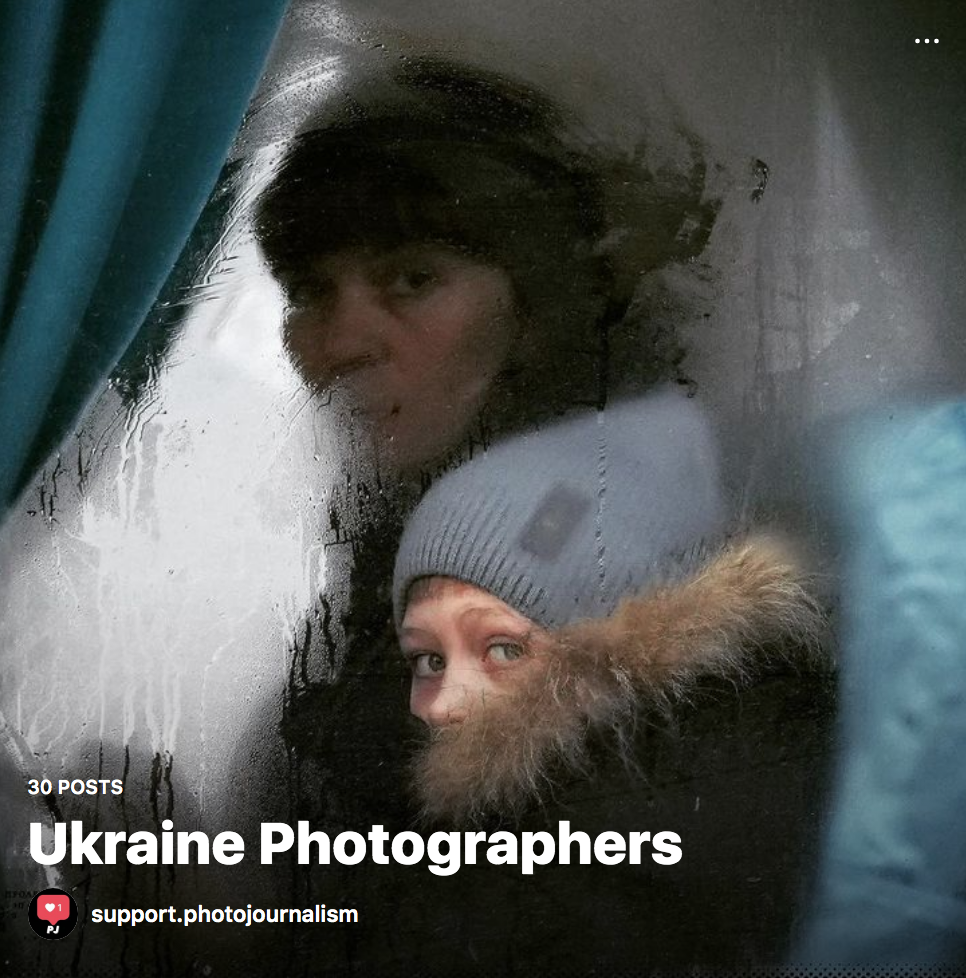
Ukraine Guide 1
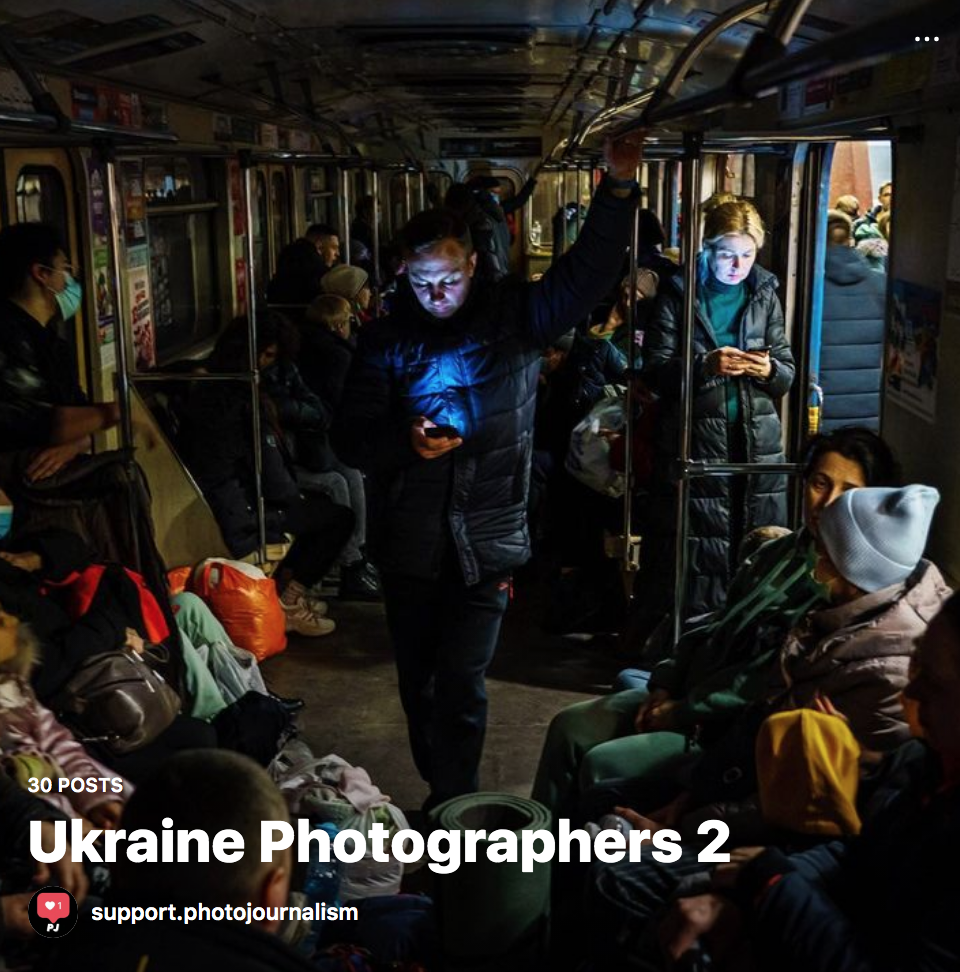
Ukraine Gude 2
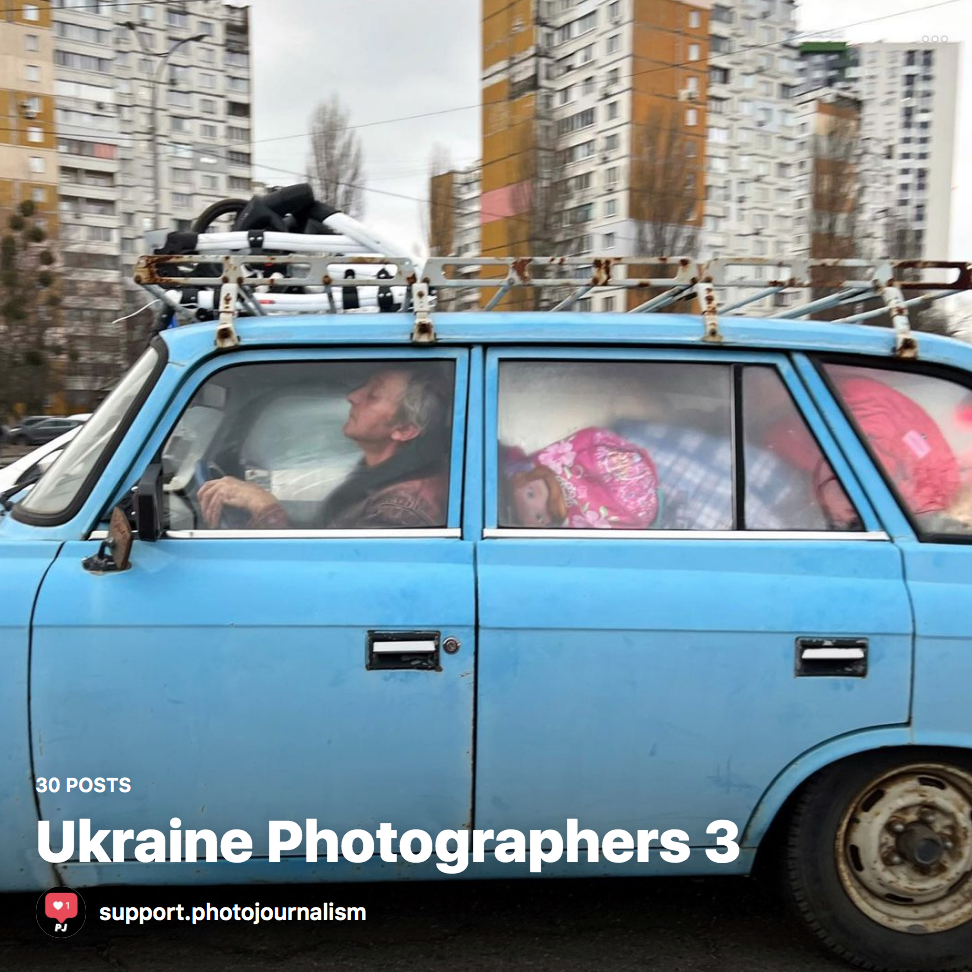
Ukraine Guide 3


Heidi: Along with giving agency to the local and relevant photographers, how and why did these guides come about?
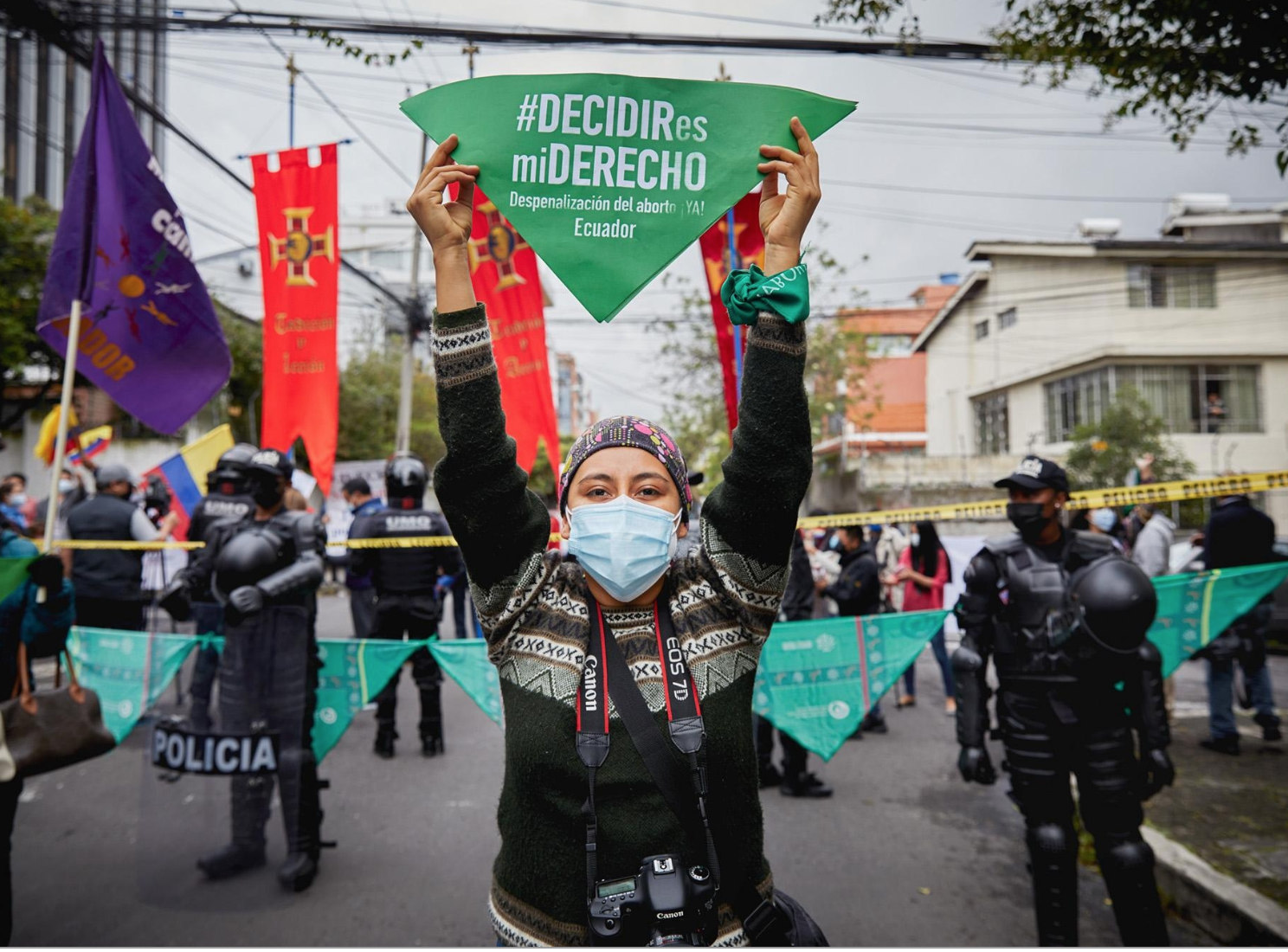
Paul: Well the purpose of my instagram account @support.photojournalism is to promote the work of photojournalists, documentary and street photographers from around the world and to strengthen our community as photographers. These photographers are generally over worked and under paid so my goal is to spread appreciation for the important work they do. I try to set a good example of being generous on Instagram: sharing, reposting, saving, liking, commenting, all the little things I can do for free to uplift photographers. I repost about 10-15 posts a day on Instagram stories, all from photojournalists, documentary and street photographers. I’ve been doing it for about a year and half now. I’ve gotten to know our community really well and we have photographers from around the world. When events happen, I usually see the pictures on Instagram before they are published anywhere else.

How are you leveraging Instagram tools?
When Instagram rolled out the guides feature (basically a self contained, numbered list, made up of Instagram posts, with text fields for a title and a caption) I started using it right away because one of the options is to make a guide from your saved posts. I was already saving around 250+ posts a week to consider for reposting on stories so I had the idea to make a weekly guide of what I thought were the best posts of the week. Instagram limits guides to 30 posts, so it’s basically a roundup of my 30 favorites from the week called “Weekly Faves.” It’s very easy to share a guide on your instagram story so this gives people a really easy way to share the work of 30 photographers in just a couple taps on their phone. Hopefully when people see the guide they click through and follow the photographers and start engaging with them.

Tell us about your Weekly Faves
I’ve never said it out loud, but in my mind these Weekly Faves are kind of an alternative to the “Photos of the Week” slideshows that most major publications do. I say alternative, because of course I have my own subjective ideas about what makes a good picture or story, but also because I’m not limited to photographers that work only for one agency or another, or one publication or another, or even limited to pictures that have been published anywhere besides Instagram. My Weekly Faves also differs in content because I mostly follow independent photographers. It gives me a reason to look back at the previous week and be a little more considerate. I’m always in awe of how much amazing work is posted each week from our community. It’s really hard to only pick 30.

How did the Ukraine guide come about?
Making the Ukraine guides came on kind of a late night delirium actually. I could barely keep my eyes open after listening to coverage on TV and scouring Instagram for hours on the day that Putin ordered the invasion of Ukraine. I knew several photographers on the ground in the weeks and months leading up to the invasion and they had already started posting work from the invasion. I was reposting their work and they were reposting the work of other colleagues on the ground. I knew we were about to see an avalanche of posts and I wouldn’t be able to keep up reposting all of it. So before I passed out with my phone in my hand around 3am, I had the idea to use Instagram guides to make a list of all the photographers I knew working in Ukraine, and then I’d just post that guide on my story and people could go follow all of those photographers and keep up with what was happening in Ukraine on their own. The community did the rest, sharing the guide generously and sending me messages with more photographers that were in Ukraine, especially Ukrainian photographers. I updated it with new photographers and it quickly reached the 30 post limit for guides. By then, it had already started going viral thanks to our community for being so supportive of their colleagues on the ground in Ukraine.

What is the intended goal of the guides and are they acting like an agency of sorts, or is this more of a grassroots collective?
The immediate goal was to provide a resource for spreading reliable information from Ukraine. I want @support.photojournalism to be useful to the people who follow it, helping them stay informed about what’s going on across the world. There is a lot of misinformation out there. Photojournalists provide the antidote to misinformation. I want people to be able to get their information straight from the photographers themselves, including photographers who are from Ukraine. I believe in the power of pictures to show the world through another’s eyes. Pictures share different perspectives on what’s happening. In order to make a picture, the photographer has to be there, on the ground, bearing witness to whatever is in front of them and that gives pictures an element of persuasion that few other mediums have.

I also wanted to let everyone within our community know who was already on the ground so we could all start promoting their work and hopefully they could get their work licensed, published etc., so they can earn a living and be able to keep going. We really need to pay photojournalists more so they can focus on making pictures and not worrying about how they’re going to make ends meet or cutting corners on their health and safety. If nothing else, I hope we got their work some love and it lifted the photographers spirits during difficult times.

But the broader goal is always the same: to promote photojournalism, documentary and street photography, and to build community. These photographers put their lives on the line to cover dangerous situations and inform the public about what’s happening in the world. To me they’re like rock stars, or better yet, super heroes. They play a very crucial role in our society but they’re under appreciated today. They work hard to make amazing pictures under the toughest conditions so I think the least we can do is thank them for their service to society and spread the love for their work.

Lastly, as photographers we’re stronger together. We can use social media to promote each other and the stronger our community is, the better off each individual photographer will be. Individually we may only be able to reach a few thousand people, but together we can reach millions. So I try to use social media to connect photographers and foster a community of lifting each other up, sharing each other’s work. I also host a weekly audio-chat room on Clubhouse for all of us to get together and talk about anything and everything photography related. Hearing each other’s voices on Clubhouse has helped us become closer friends over the last year and many of us have met up in person as well. Our core group is very strong now and we all help each other and our community however we can.

I saw you held a 2 hr conversation on Clubhouse, what were the most salient points from the discussion?
We have a weekly audio-chat room on Clubhouse every Tuesday at 5pm PST (Wednesday mornings on the other side of the world). We talk about all things photojournalism, documentary and street photography. Every week we are joined by some of the leading photographers today, along with editors, photography students and non-photographers who want to learn from the discussion and ask questions. It’s very casual and everyone is welcome. We usually go for two hours and people come and go as they can. Last week we had Nicoló Filipo Rosso stop by after he had just won a staggering four awards at the Pictures of the Year International (POYi), one of the most prestigious awards in our industry. The previous week we were joined by Gabrielle Lurie, who had just won back to back Photographer of the Year in a Small Market along with three other awards at POYi (she might be the only person to have ever won back to back years like that). Natalie Behring and Raquel Natalicchio co-moderate it with me and they are both outstanding photographers too.

How do people get involved?
For Ukraine I’ll defer to Ukrainians who know best. Marta Iwanek  has been sharing a lot of useful information and has helped me with the guides so I would start by following her. For our community, the best way is to follow along on Instagram and you’ll always be informed about what’s happening with us. I use Instagram stories to share the work of many photographers everyday, so I would love it if people go follow those photographers and show them some love by liking and sharing their work and supporting them financially when they can. People can come to our Clubhouse room to learn more about the people behind the pictures. There are several photography organizations that do good work for photographers that people can donate to such as Women Photograph, Diversify Photo and Black Women Photographers. I highly recommend people in the US to join or donate to the National Press Photographers Association because they do a lot specifically for photojournalists. Beyond that, subscribe to a newspaper or magazine or buy a photo book.

The first piece of what is considered modern journalism was published in 1703 by Daniel Dafoe, (Great Storm of 1703 in Britain) 317 years later we have the same need for journalism, but why is this even more important now?
I think it’s more important than ever now. Democracy and journalism are co-dependent so the erosion of journalism also erodes democracy. Journalism is essential to democracy because it informs the public, a necessary precondition for holding leaders accountable which is really the essence of democracy. Funding for journalism has been in decline for a long time now, with newsrooms and bureaus closing at an accelerating pace in the 2000s. I think we’re starting to see the political consequences as data show that democracy is weakening around the world for the last several years.  It’s impossible to know to what extent, but I think it’s pretty safe to say that strengthening journalism will strengthen democracy along with it, so it’s more important now than ever.

What are the benefits of the smaller footprint photography has over video, aside from speed and isolating a single moment?
When it comes to making pictures or videos, there are some practical advantages for photography in that it requires less/smaller gear, less storage, less computing power, editing time, etc. Video cameras are getting smaller and smaller though and many photographers make video with their cameras now too. But yeah if you have a smaller footprint then you can be a little more nimble and get into more situations.

When it comes to the output, photography and video are similar in their believability. When people see video or picture evidence of something, they tend to believe it because they know the person who made it was actually there. They’re both important and effective at visual communication and have their strengths and weaknesses. One benefit of still photography is that it can be printed and widely disseminated in print. Once printed it’s permanent and it doesn’t require electricity or internet to look at it. Through newspapers, magazines and books the still image has further reach and more staying power than video. Even when you’re looking on a phone, a still picture takes less time to look at. It has immediate impact. I think that’s another benefit of still photography in an age where the average attention span is extremely short. I have a lot of respect for video too though, ideally we’d have both and a lot of people in our community do both.

This global network of photo journalism provides a POV and firm ground for objectivity and lived experience. How has social media opened the aperture for creators to share their images free of traditional media institutions.
I believe one of the goals for journalism should be to provide as many perspectives as possible. Social media has given us access to more points of view than ever before, so it has had a democratizing effect on the images that are being made and seen. The types of stories we have access to now is unprecedented. Our ability to find talented photographers anywhere in the world through social media is really incredible for telling stories with more nuance. You’re right, many of these stories might not have ever made it through that institutional shaping you’re talking about with the major publications out there. Social media has removed the gate keepers, to an extent. But the gap between the work that is being made and the work that is being published by these institutions is still massive, and these institutions still have enormous reach, far more than individual photographers. It’s a double edged sword, photographers can reach more people than ever but their chances of being paid a reasonable wage are lower than ever too. So there are many more pictures out there today but there are also many more unpaid photographers out there now too.

Can you speak to your personal connection to journalism?
My mentor was a photojournalist. I know a lot of photojournalists and I’ve studied the work of many of the great photojournalists in history, so I would say I’m an admirer. I don’t call myself a journalist, only a photographer. I’ve done a few journalism assignments over the years but it’s not my career. I’m connected to it now as a freelance photo editor, curator, and community builder.

To connect with Paul please email him at paulbellinger@gmail.com

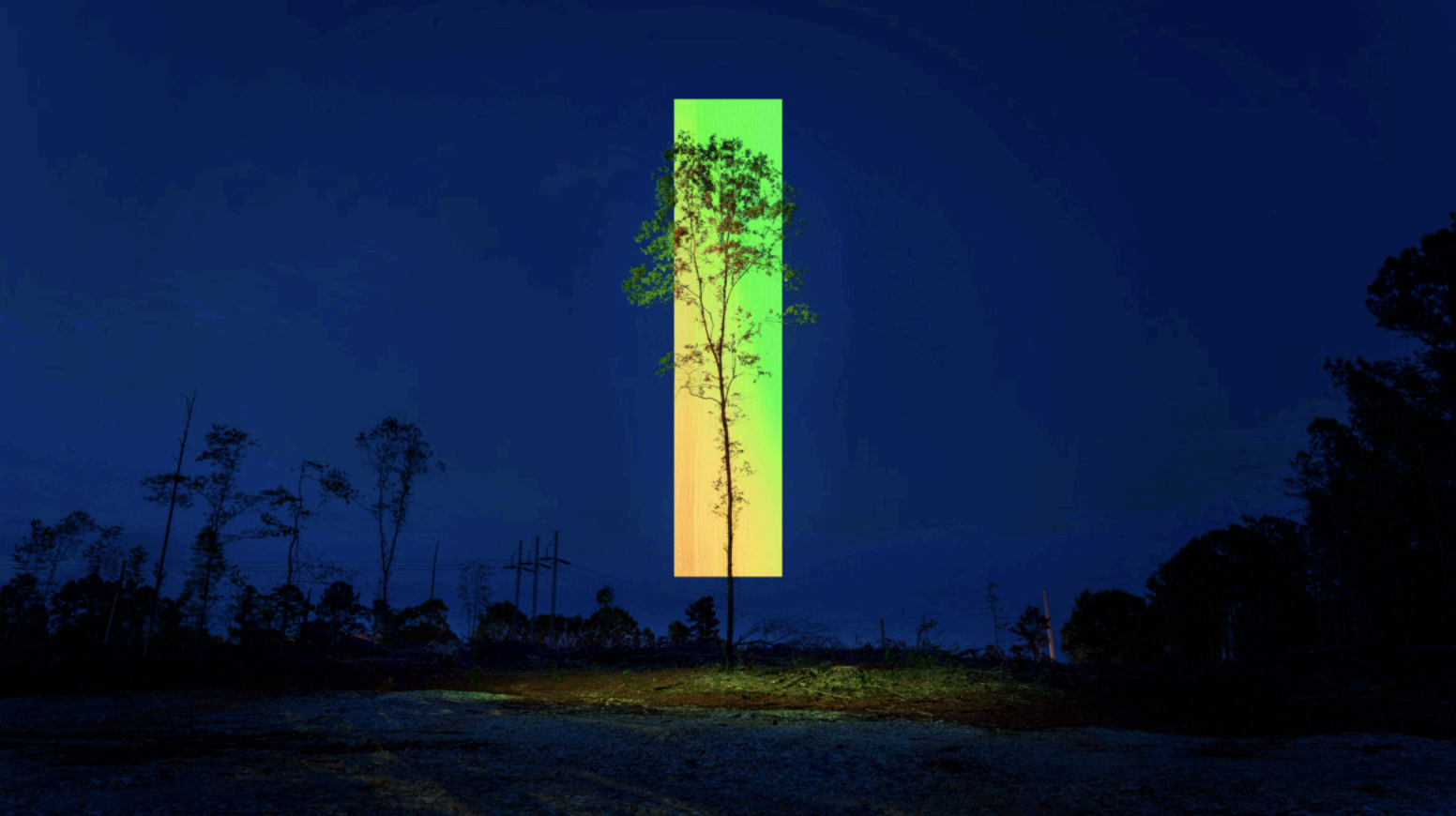
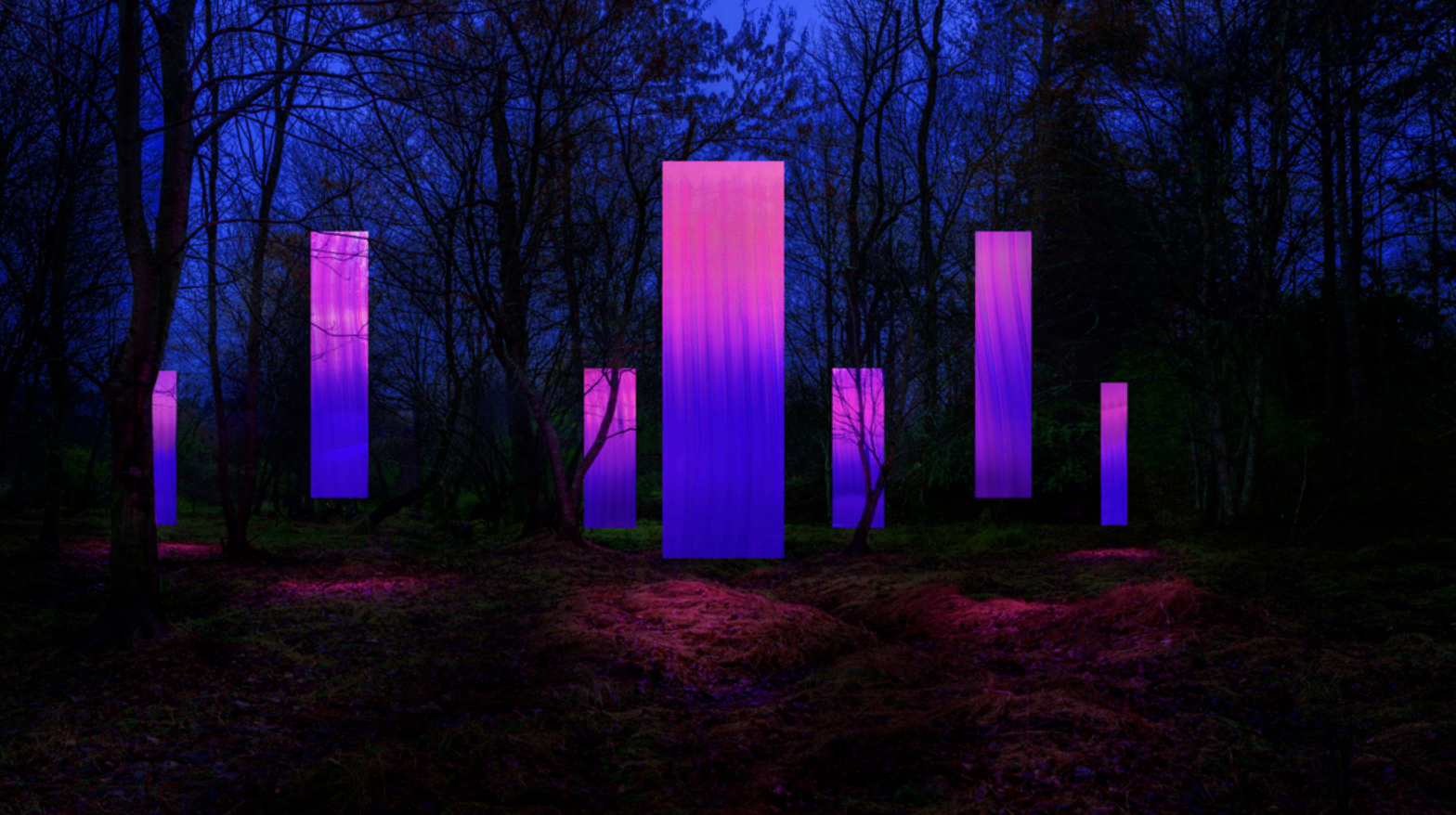
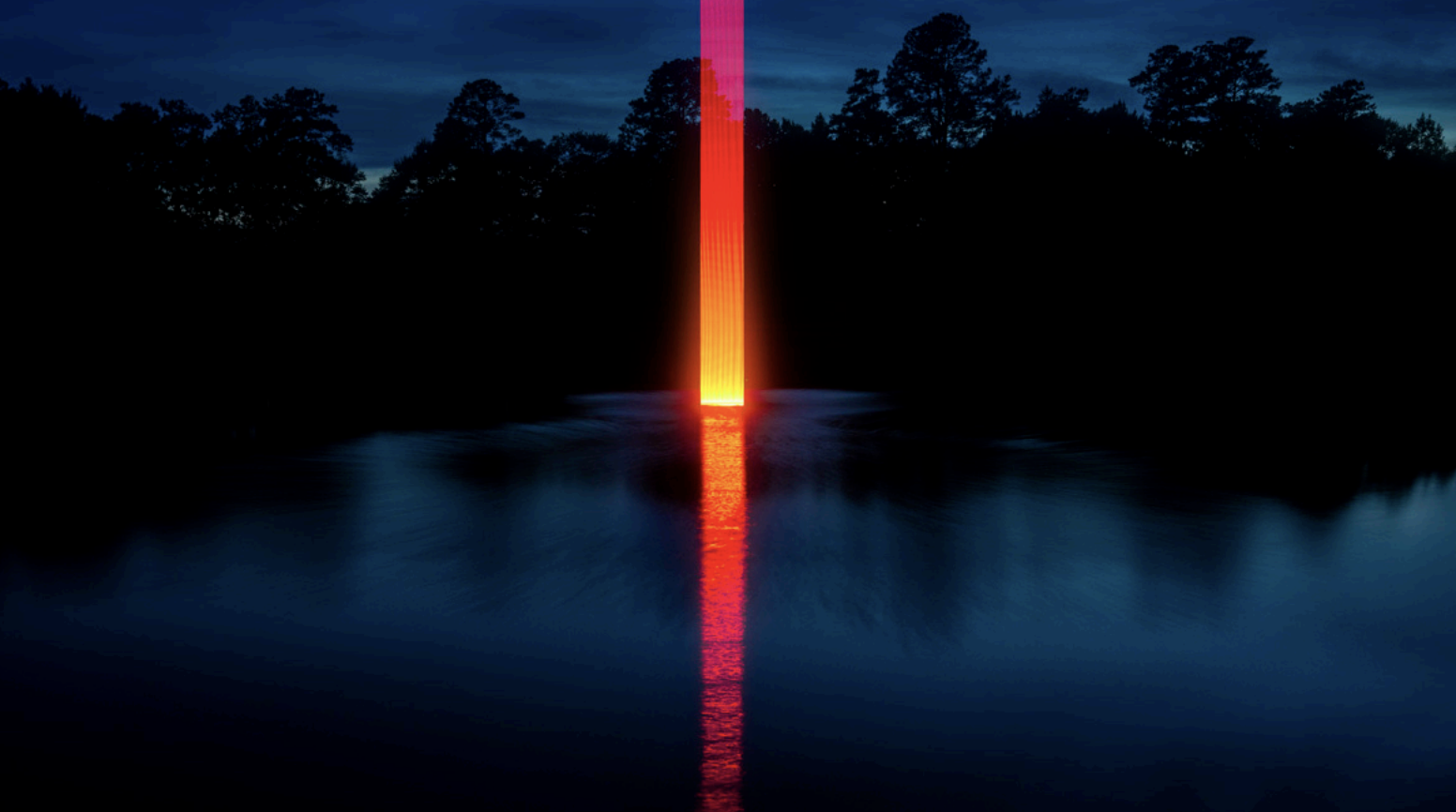
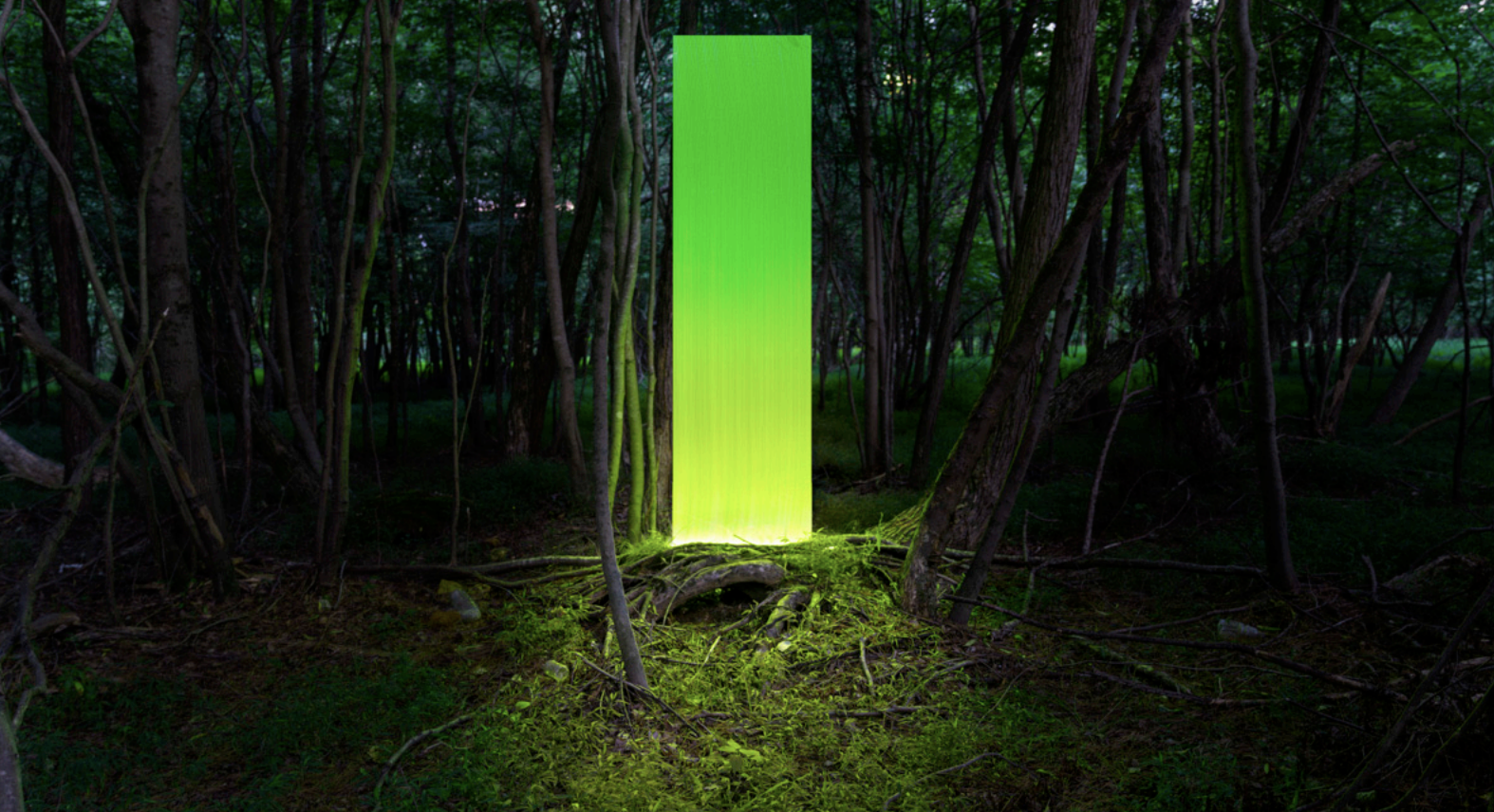
The Daily Edit: Transient Eclipse: Jeffrey Moustache

Photographer: Jeffrey Moustache

Heidi: How did this series come about?
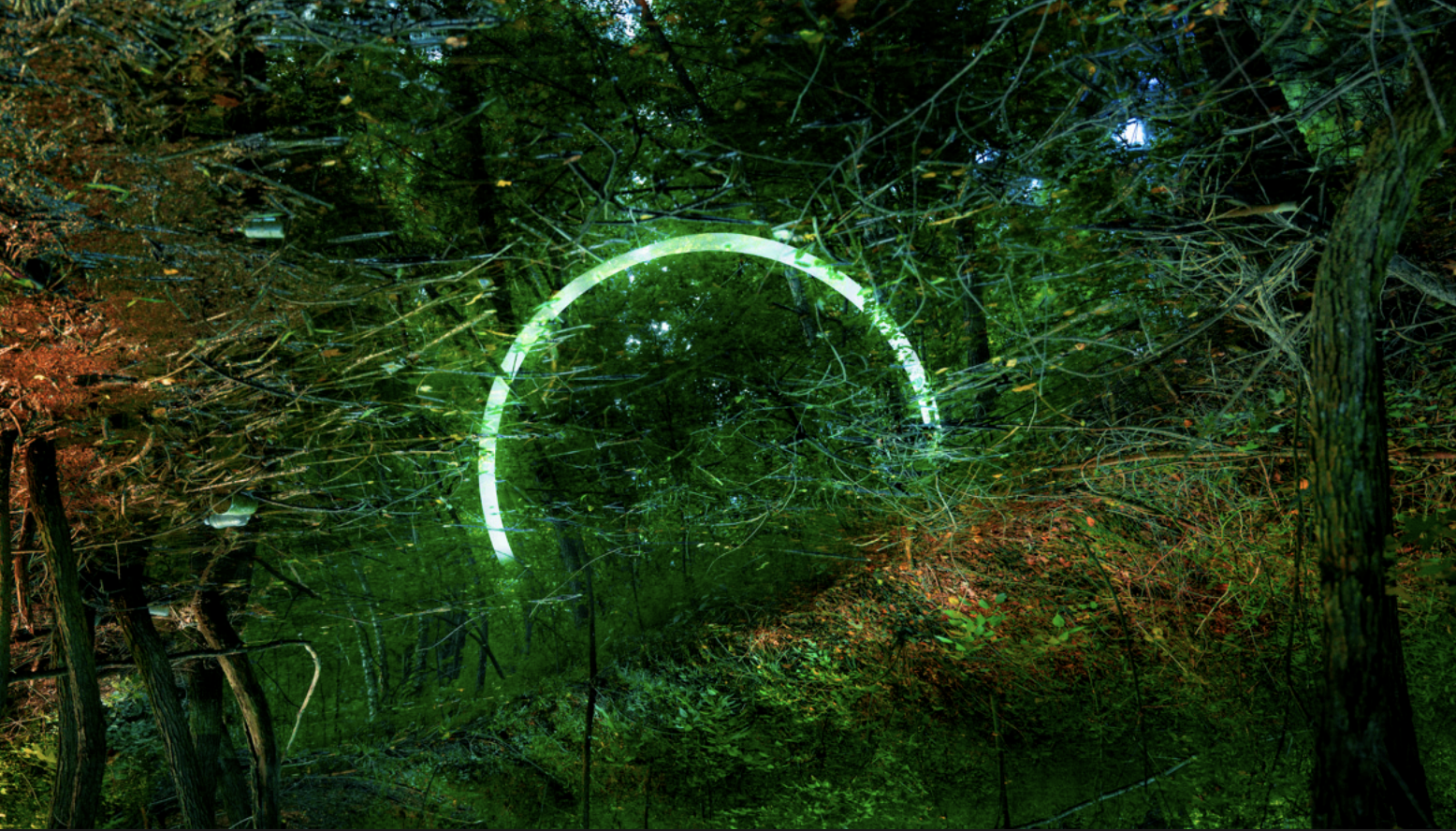
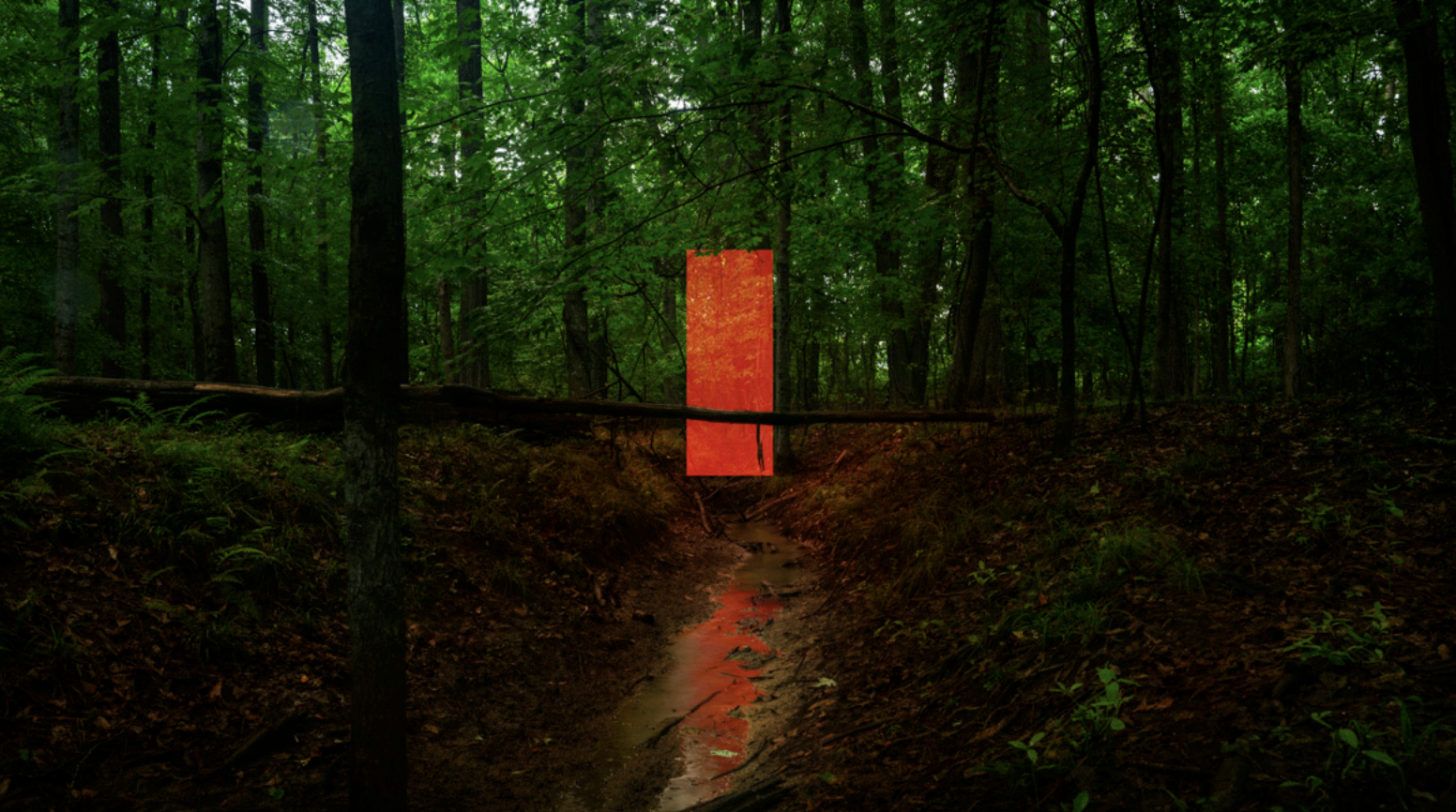
Jeffery: I have been working on this series for a few years now as it has slowly evolved from a separate series I pioneered utilizing flashes and LED lights on drones back in 2015.  It has since evolved into these landscapes just before the pandemic began as an exploration of space, light, color and my involvement with nature.
How long does the set up take?
My setup times are fairly short,  I have become very efficient in preparing for an image, setup of my light sources and creating them in the field takes a few minutes but times to create the final image range anywhere between 15 minutes to an hour total depending on which “Light Brush”  I am using: ie; if I am using a large drone, or shooting multiple variations/ locations in one outing.

Are you scouting at night as well?
I typically do my scouting during the day while out on walks or while I’m driving to or from a shoot. I try to take different routes as much as possible to possibly discover something that feels right. I will mark the locations, take photos on my phone, figure out when the best lighting may be, go home and then sketch out a concept in my notebook and go from there. I try to setup to shoot around twilight to capture some ambient and then continue until It’s too dark to see, which can be tricky at times navigating out of the woods or through the fields while trying to avoid holes, puddles, thorns, spiders, anthills etc.

What shapes are the light sources?
My sources are a variation of LED panel lights, tubes and other “light brushes” I have created over the past couple years to achieve different results.  Some are square. Some are large rectangles, others are spherical, I have a couple I can attach to my heavy lift drone and fly, others are color changing.

Is this commission or personal work?
As of now this has been a personal endeavor which I have began to intertwine with commissioned work when applicable.

Will you continue this series?
Yes, there is a larger gallery here but even that is a small portion of the collection that has been created and continues to grow and evolve.

The Daily Edit – Leland Bobbé: Early Work


Photographer: Leland Bobbé


Heidi: How long did you work on this project, New York City 70s? and what was your process for shooting? ( did you walk everyday? was your camera always with you?)
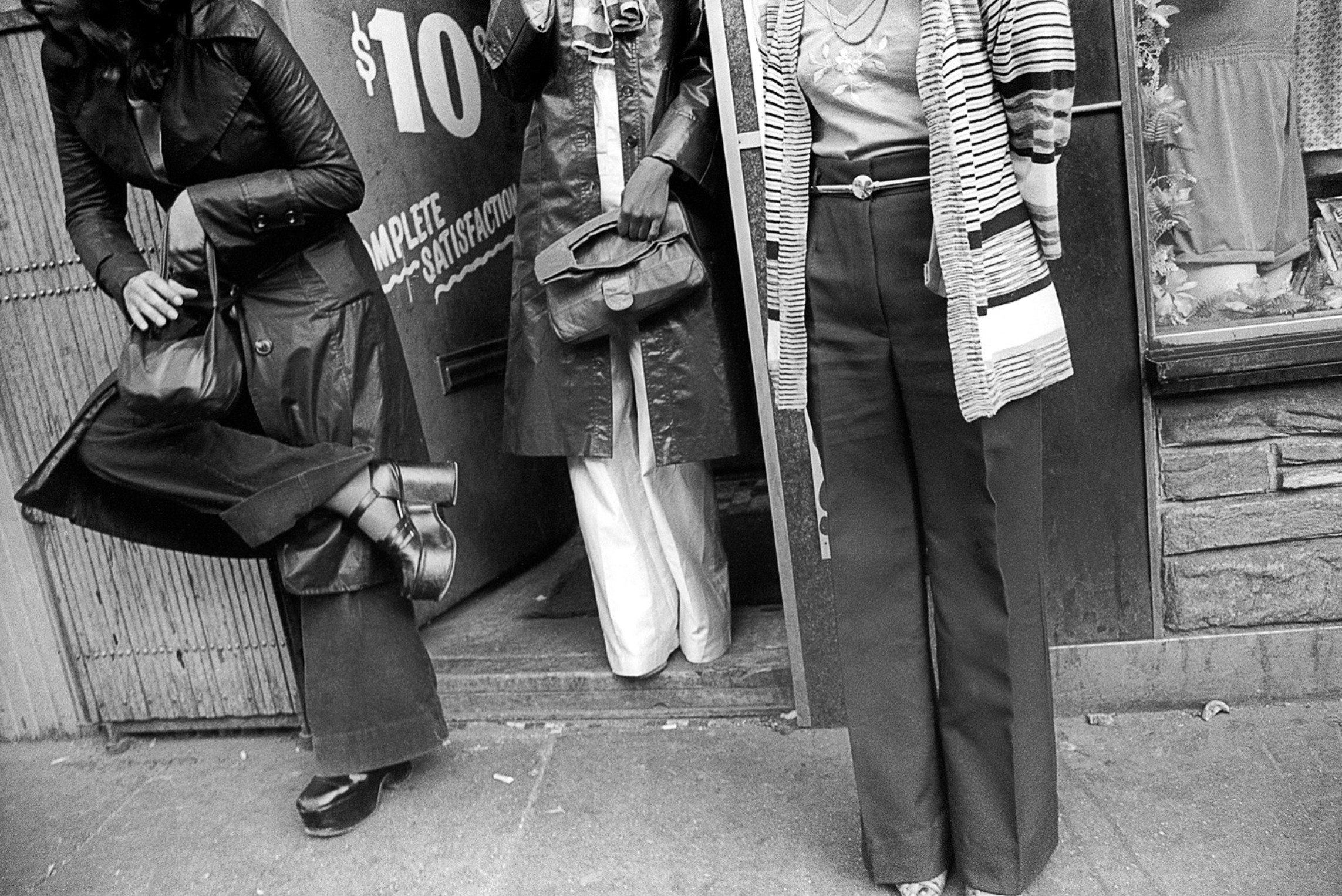
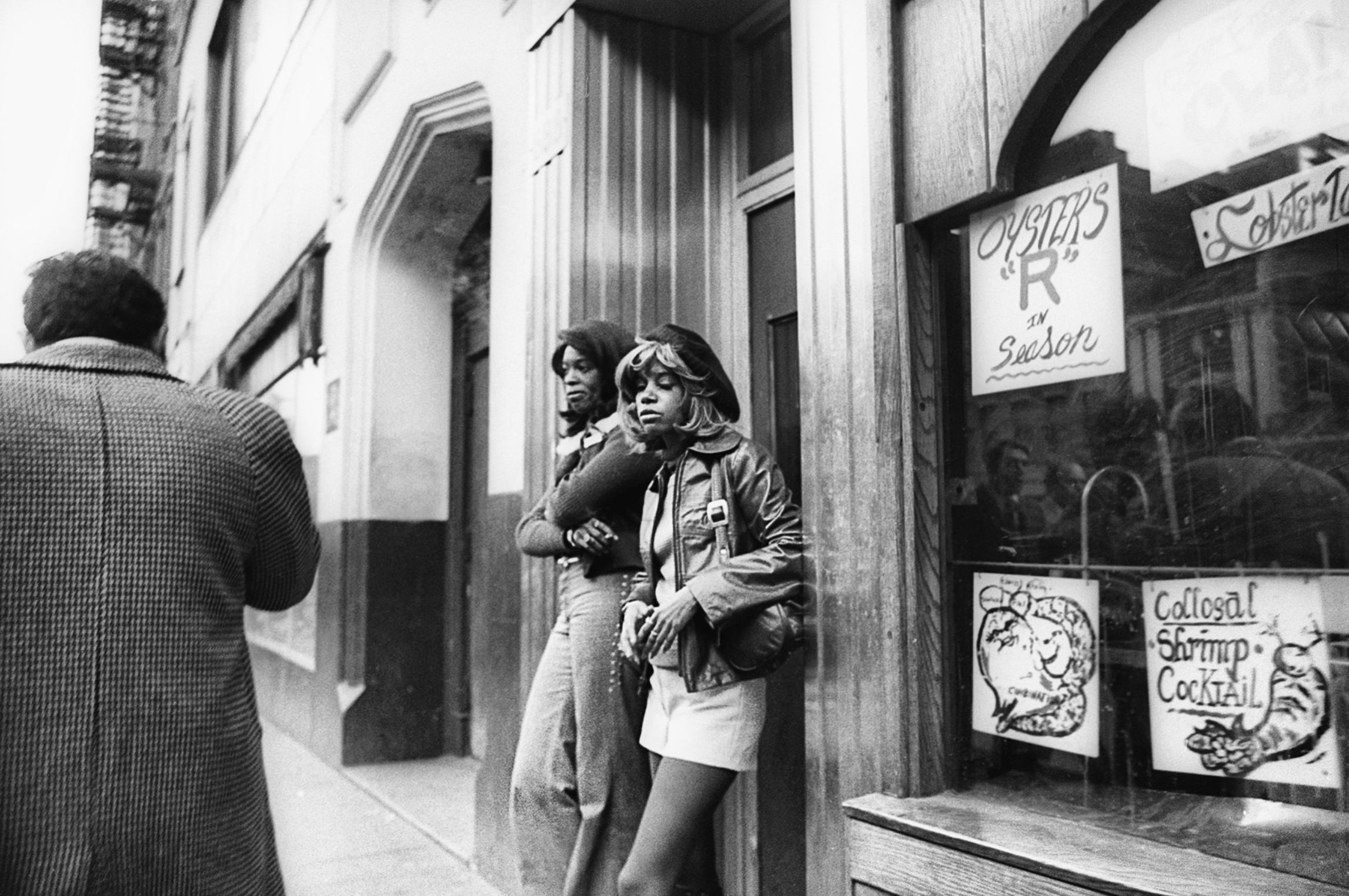
Leland: I never really considered my 70’s NYC street photos of Times Square, The Bowery and general NYC to be a “project”. It is a collection of photos of street scenes that I felt compelled to capture. I moved into Manhattan in 1974 and my main interest was playing drums in a band that was part of the CBGB’s scene. Photography was a hobby at that point. To support myself during this time I drove a taxi and spent hours on the streets observing the different neighborhoods. I didn’t bring a camera with me when I was driving because it would have been an easy target for a thief. Remember, this was the 70’s in NYC. Whenever I was going anywhere outside of driving a cab, I had my camera with me. Often, I would just go out with my camera either on foot or on by bicycle looking for things to shoot. For much of my Times Square work at that time I used a 28mm lens pre-focused at about 5-6 feet, while holding the camera at my waist and firing off shots as I walked by. I also used an 80-200 zoom when I didn’t want to get to close. 40 years later I realized that I had a collection of images of a period time in NYC that no longer existed. Times Square turned in to Las Disney and The Bowery turned into high end condos and restaurants. I showed these images to a curator at the Museum of the City of New York and they took 18 images into their permanent collection.


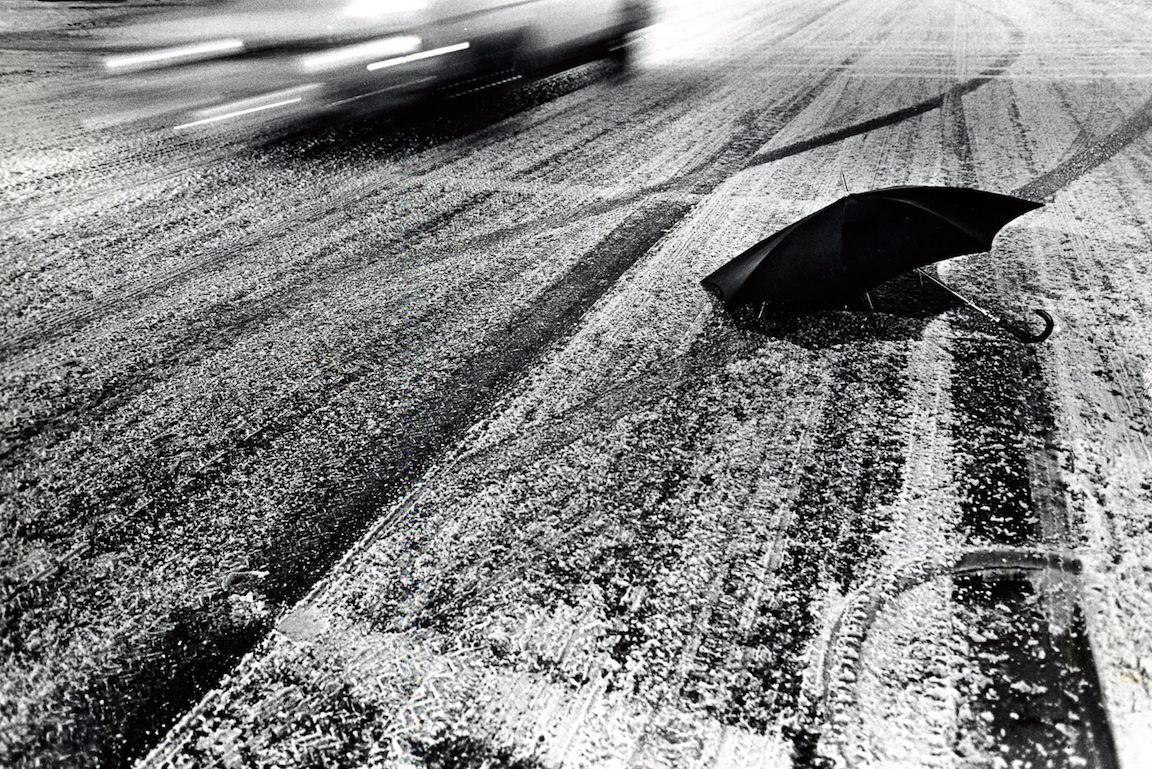
I loved the umbrella story, did you go out in all rain events in NYC and what drew you to the shape and visual appeal of the discarded umbrella?
What attracted me to shoot discarded umbrellas on the street was not so much the shape of the umbrellas but seeing this discarded object on the street while life continued to hustle by this inanimate object. Many of these photos were shot at shutter speeds slow enough to capture the feeling of motion to illustrate this without total blurs usually at about a 30th or a 15th of a second. I would go out and look for these umbrellas after a rainy, windy day when umbrellas would get destroyed. I brought a portfolio of these over to Modern Photography Magazine and they ran a story titled Stormy Weather which was the first time I had any of my photos published.

When do you know a project is “done”?
Good question. I know a project is done when I feel like I’ve been there, done that or I feel as if I’ve said all I need to say. I just know when it’s time to move on.

What have you been working on lately?
The most recent photo project I finished was a collection of B&W street photos of NYC during the Covid lockdown in the spring of 2020. I titled this project Public Isolation. I have lived in Manhattan for 45 years and I’d never seen anything like this before. The streets were empty and quiet. I tried to captured photos with just 1 person in the frame to illustrate isolation. The museum of The City of NY is currently in the process of making selections for their permanent collection.

I’m currently working a music video of a song I wrote and recorded titled Don’t Know When (2020) incorporating my NYC lockdown photos and NYC Black Lives Matter protest photos shot by Mychal Watts.

What would you tell your younger self about photography as a career?
I’d tell myself that it ain’t easy. I’ve been through numerous reinventions and phases over the years and have learned and that one must keep evolving. It’s really important as a commercial photographer to develop a personal style and to shoot personal work to keep the creative juices flowing.

The Daily Edit – Sashwa Burrous


Modern Huntsman

Design Director: Elias Carlson
Photographer: Sashwa Burrous
Writer: Lindsey Browne Davis


Heidi: How long have you lived in CA and when did your relationship with good fire begin? 

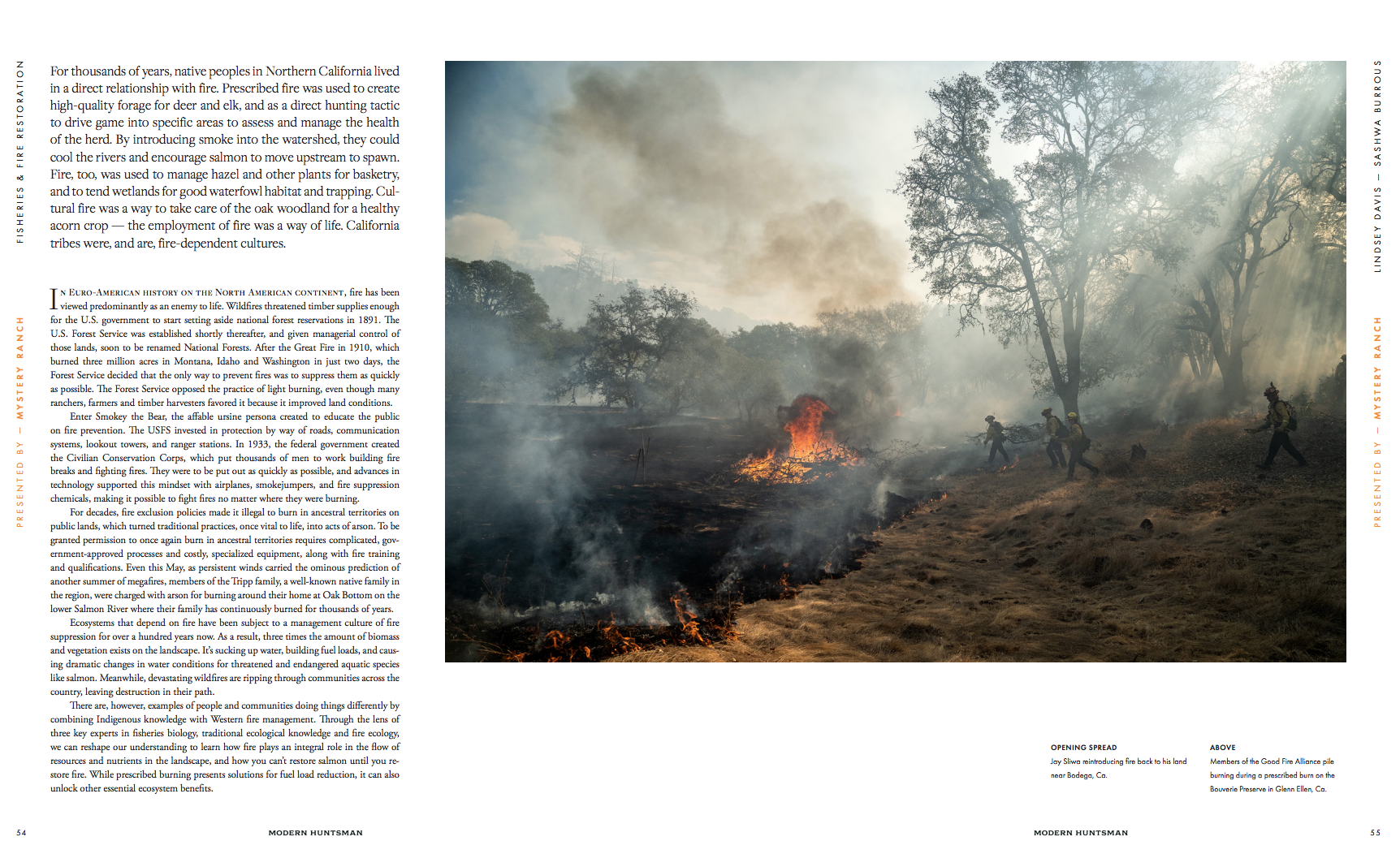
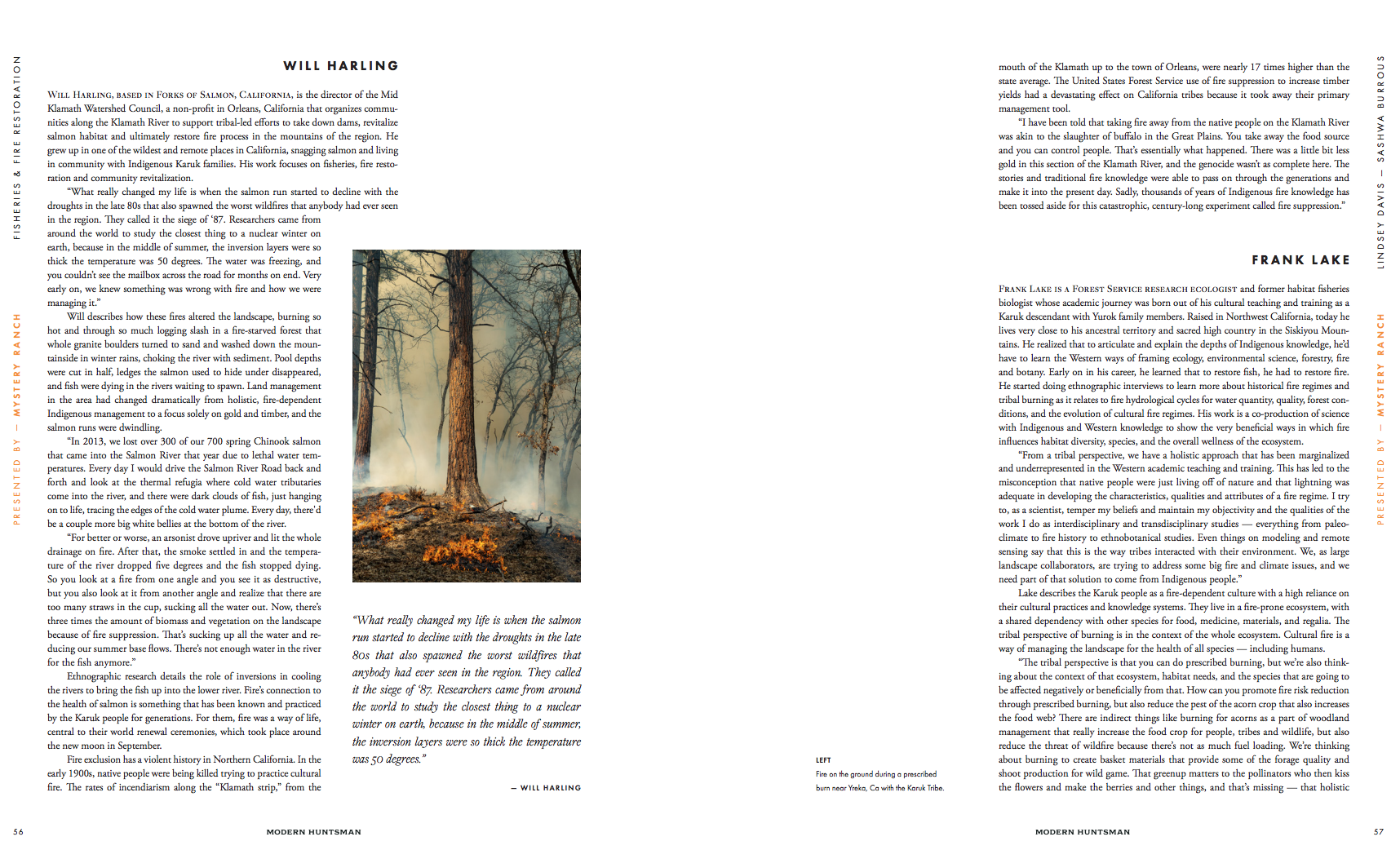
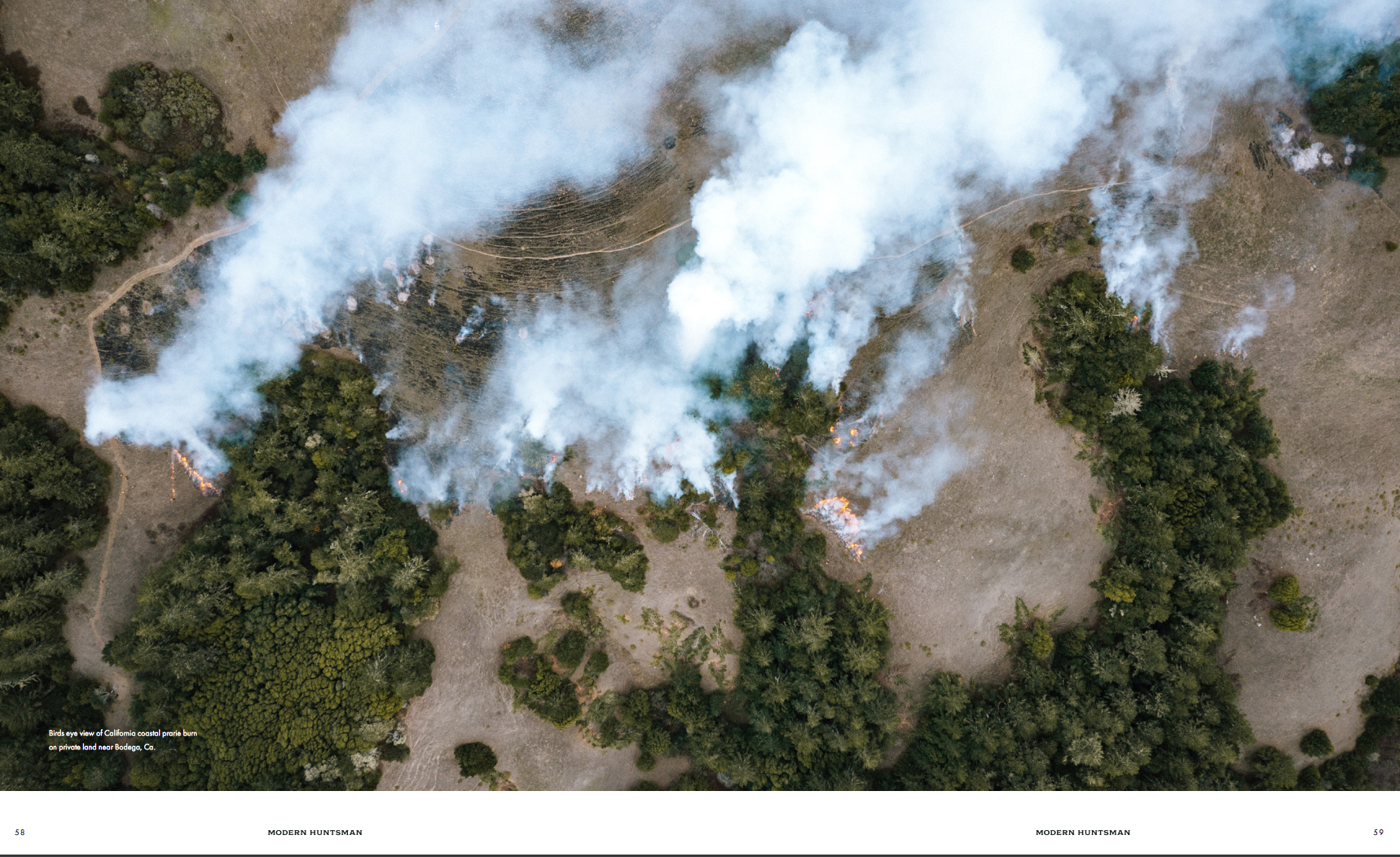
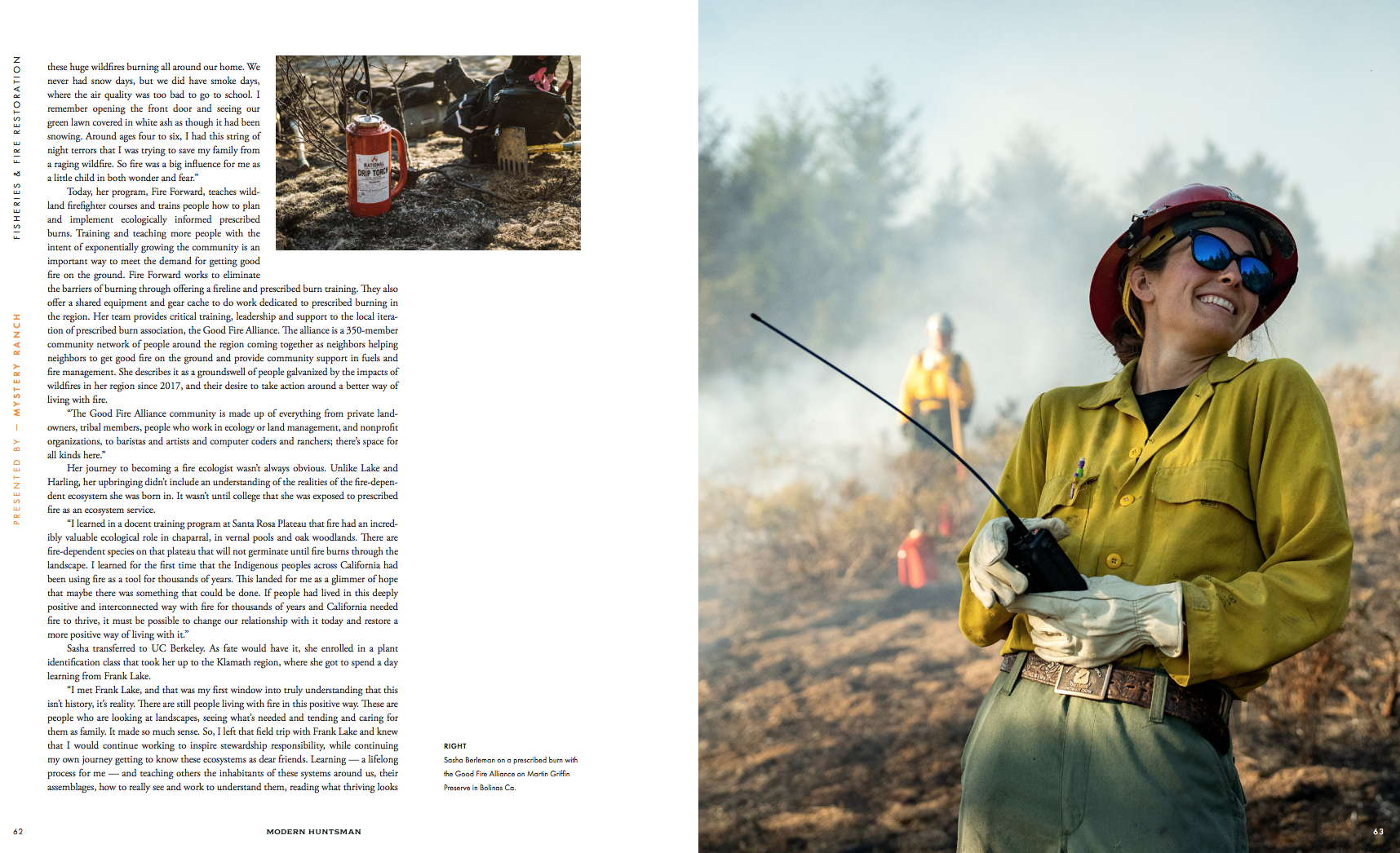
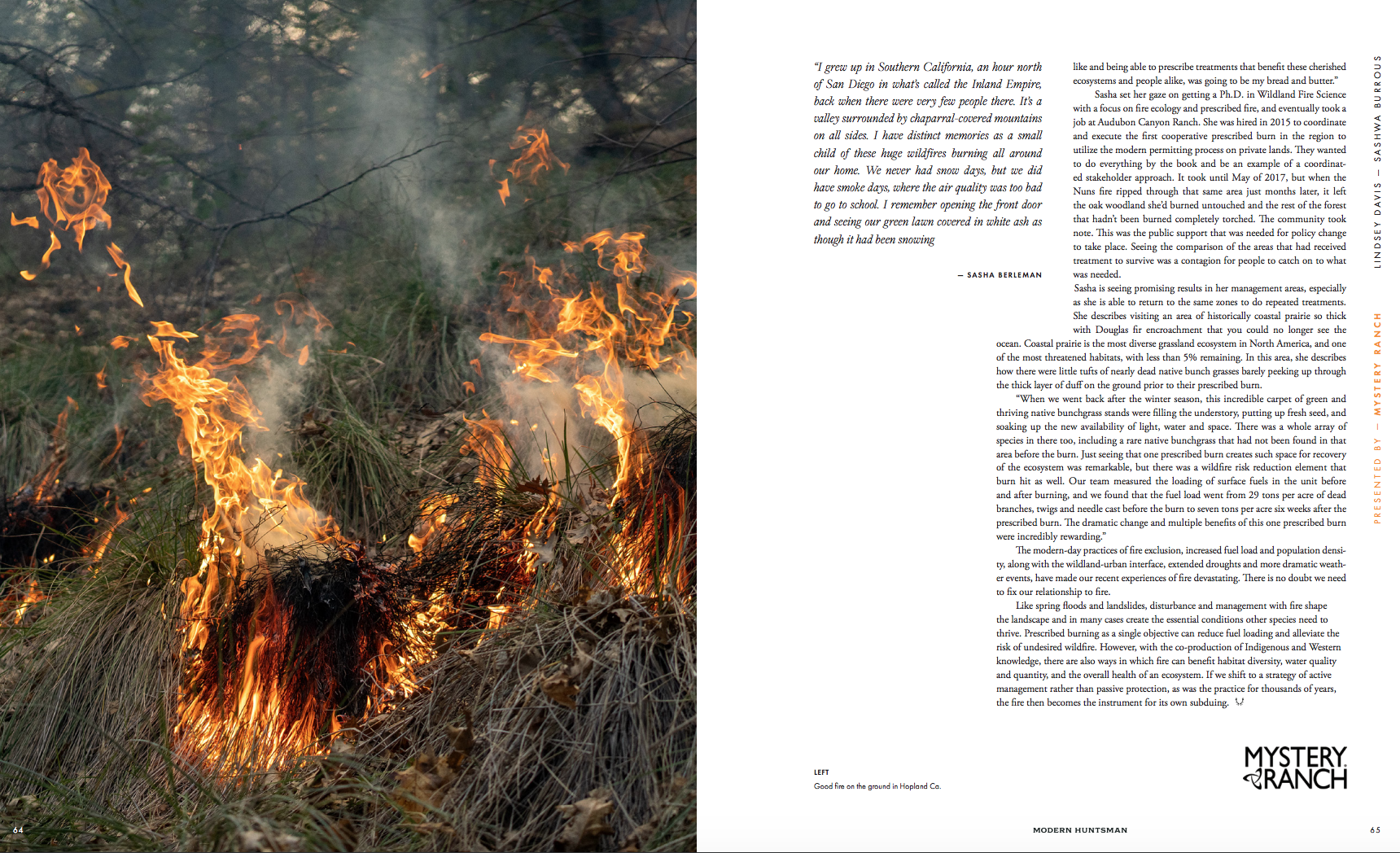
Sashwa: I was born and raised in rural Sonoma County, California, Coast Miwok / Southern Pomo territory, and grew up just two ridges over from where I live now in Occidental.  A tiny town nestled in the redwoods, not too far from the coast. My interest in “good fire” started in 2017 when Sonoma County saw record breaking wildfires, taking out entire neighborhoods, blanketing the entire county in smoke for weeks on end and waking a lot of us up to the reality that we are all living within a fire adapted landscape here in Northern California. I quickly  realized that if I wanted to continue to live here in California I would need to learn to be in better relationship with fire. My interest in fire led me to start shooting a prescribed fire course with Fire Forward in Santa Rosa. Through photographing the course as a personal project, I began to learn both the skills needed to photograph wildfires along with how to reintroduce good fire back onto my own land where I live in Occidental.

Was this a personal project?
A majority of the images  you see in this story I made on my own time. I found myself really inspired after every burn. I would come away with a ton of ideas, excited to sit down and edit what I just shot, a feeling you don’t get on every shoot. I have learned that when you feel that spark of creativity, to lean into it. Oftentimes  “personal projects” are where an artist’s most powerful work comes from. The trick is then how to integrate this passion into “client work” so you can put food on the table.
After sharing stories with Lindsey Browne Davis, an outdoorswomen writer and good friend, we came up with a story about fire and water and how these two elements interact and relate to each other. We pitched it to Modern Huntsman for their Water Issue, the story got approved and was sponsored by Mystery Ranch.

What was your training like for this? Was the desire twofold; to be of help and gain access in order to document? 
After shooting a few wildfires I realized that in order to do this safely I really needed to look into getting some formal training.  Not only did I want to make sure I was safe when shooting the fires, I also wanted to be in service to my community and deepen my relationship to the land I am stewarding.  I learned a lot from photographing the prescribed fire course with Fire Forward but I wanted to take it a step further.  I signed up for and completed my FFT2 (Wildland Firefighter Type II) training in 2020. This course is the first step in becoming a Wildland firefighter and is required for a majority of the prescribed burns I attend.  The training was really interesting and helped me understand how to read the wind, clouds, and topography, all important lessons in situational awareness.
 
What are a few of the challenging aspects of photographing fires?
Personal safety and health are probably the most challenging and important aspects of shooting fires, especially wildfires.  There is a lot of gear (Personal Protective Equipment) that is necessary as well and knowledge on how to get yourself into the right position. This sometimes means driving hours through dangerous roads to get to the other side of the fire because the wind changed slightly.
The smoke alone can be a huge challenge.  After 3-4 days of shooting in conditions of 400+PPM in the air you can’t help but think how this is affecting your personal health.  As a new father I often question whether or not I should continue chasing these stories.  During fire season, I literally have the truck packed and ready to go at all times. If there is a local fire, I often have to leave the family with short notice to get the shots I need. This is exhilarating but also hard on my health and on my family.
In relation to photography specifically another challenge is the speed in which you need to move. Oftentimes you literally have seconds to pull out your camera, compose and make an image before needing to get yourself to a safer place. It’s a stark contrast from the commercial work I often do in studios where we spend hours perfecting every aspect of each image we’re creating.

I know you also have an interest in the power of the ocean, how are they different and similar in your creative approach to meeting them?
In my experience there are far more similarities than differences. The first that comes to mind is that with both elements humility is key. When interacting with the ocean and with fires, you learn really quickly that you are not in charge. Instead you learn to slow down and observe. For instance, when I show up to the beach to shoot a surf sequence, the first step is to watch the ocean, observe the wind and current to ensure it’s safe to go out with the camera. Similarly, before a prescribed fire you take time to observe and analyze wind patterns, like wind direction – is it a dry (offshore) east wind or a wet  (onshore) western wind coming off the coast. These factors play a huge role in whether or not it’s safe to carry out the burn. What I love about shooting in both of these elements is you never know what you are going to get. They are both complex and unpredictable which keeps me inspired and curious to learn more

The Daily Edit: Wink Face Photography: Wendy Domanski


Wink Face Photography

Photographer: Wendy Domanski
Instagram

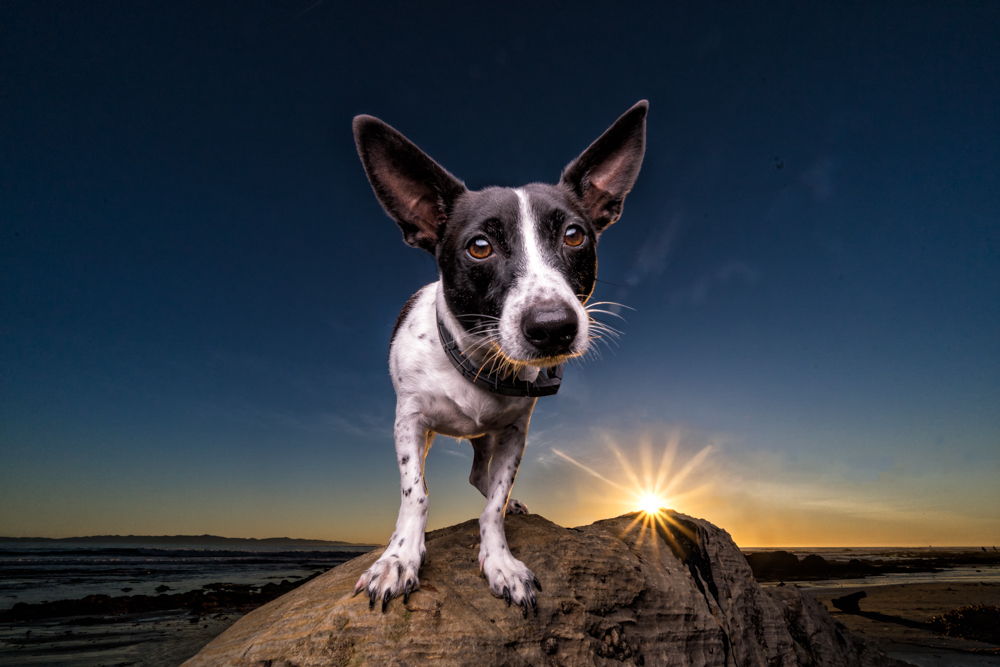
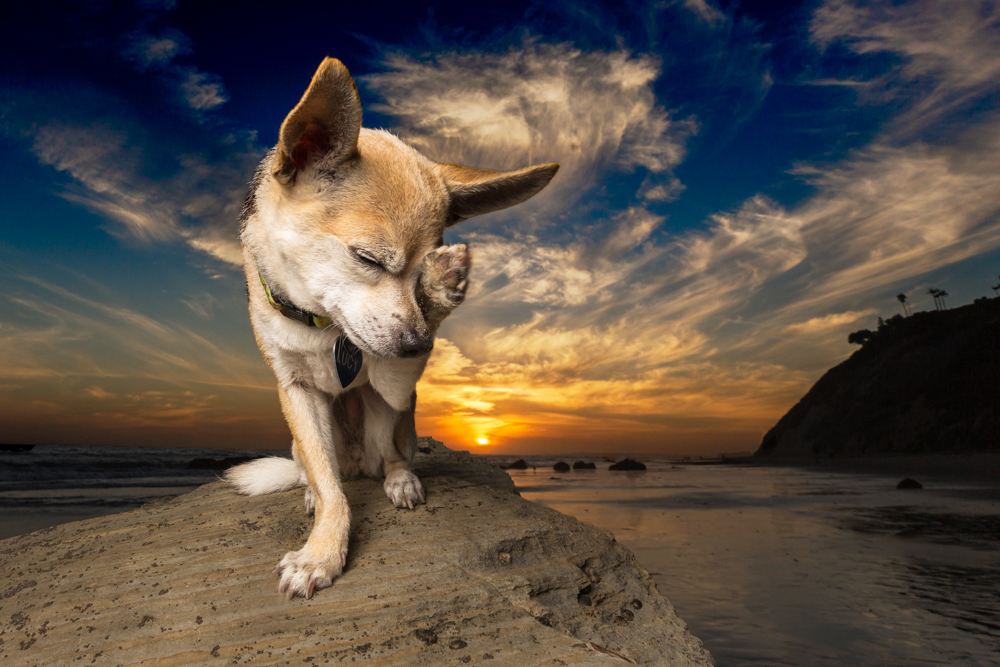
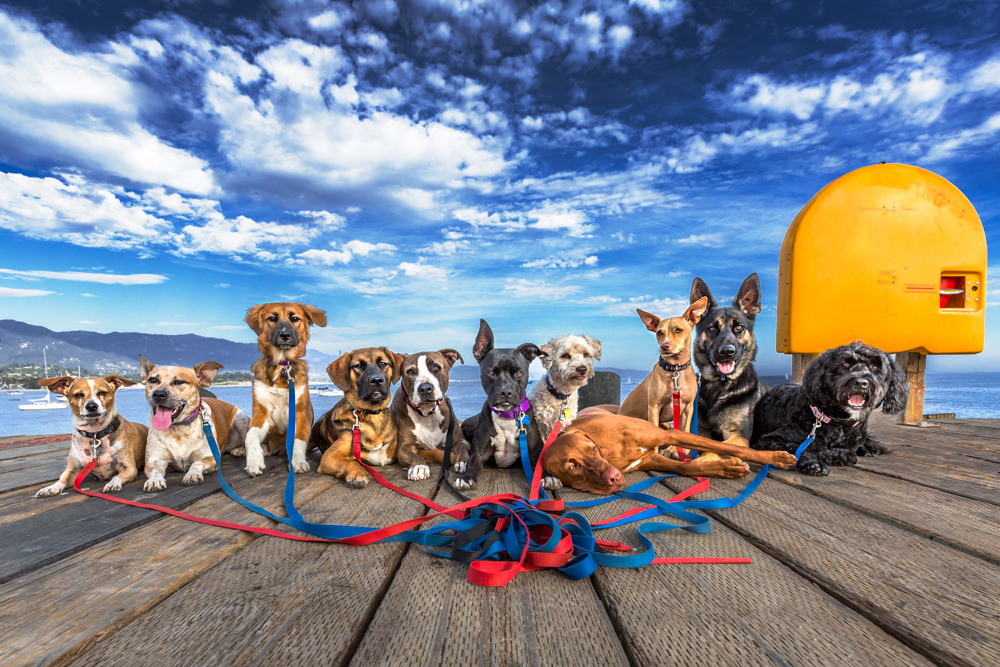
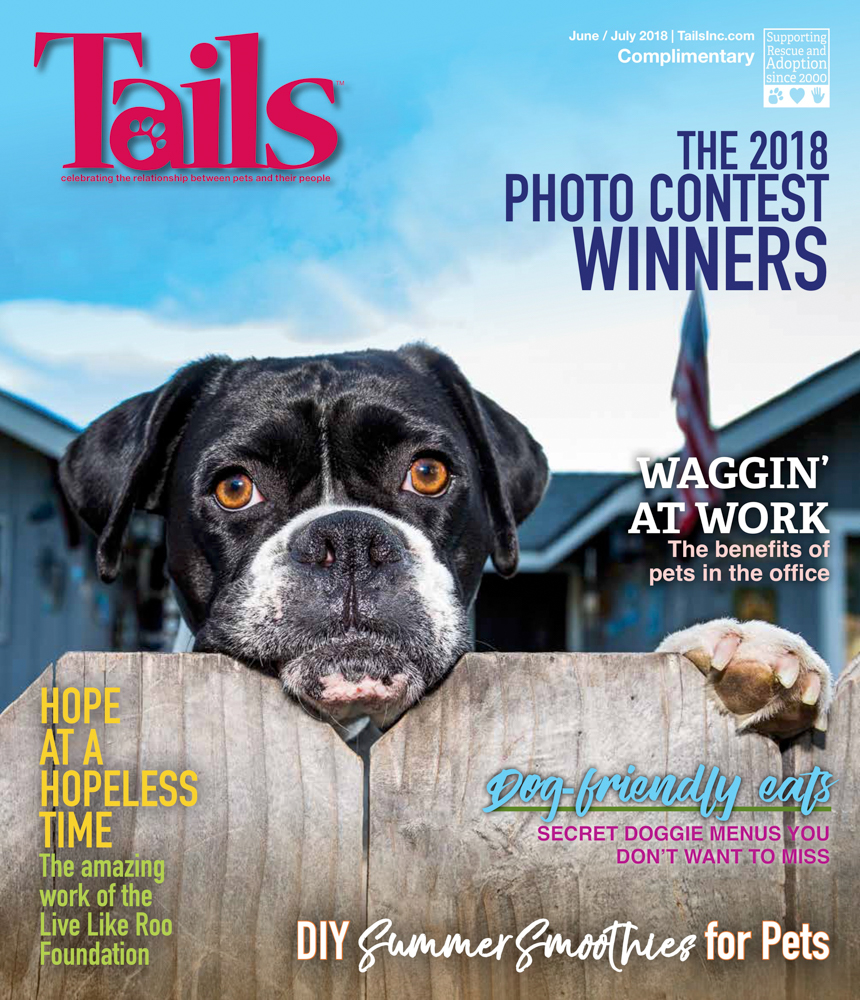
Heidi: Who is more nervous on set, the dogs or the owners?
Wendy: It can be a combination of the two scenarios. Sometimes the dogs are a little shy when they see the camera or hear the shutter. If I am using off camera flash some dogs can be a bit nervous with the bright flashing lights. I always take extra time with the nervous dogs and start to desensitize them with treats if they are food motivated. The dogs are rewarded with a treat every time the shutter is pressed so they view it as a positive experience. The is especially true for dogs at the shelter that are often coming from a loud and stressful environment. The key is to go slow with them and help build trust before you can even think about bringing the camera out.

For the 2-legged people on set, a lot of times they’re worried or anxious about their dogs not behaving perfectly. I always try to have a conversation with them prior to the session and communicate with them that not everything is going to go perfectly and that’s okay. They are dogs or cats or whatever pet it is. There is a lot that is going to go wrong. I always tell them, if I wanted to photograph perfect dogs I’d be a stuffed animal photographer and what’s the fun in that?!  If the owners are stressed the dog will pick up on it and it will ultimately translate to a stressed-out dog which clearly doesn’t make for great photos. I want it to be a fun experience for the dogs and the humans so I’m always very reassuring and joking with the owners to help put them at ease and laugh a lot at the “bloopers” so they know it totally normal and part of the experience. At the end of the session I hear more often than not from the owners they had so much fun.

What are some of the creative ways you have to engage the dogs?
Every dog is different and it’s important to learn what motivates them. The best way to do that is to have a conversation with the owners prior to the session. For dogs it could be a ball, a treat, their favorite toy, or maybe certain words they react to. I’ll ask the owners if their pet is nervous around new people, loud noises, whatever it might be. The more information you have on the dog in advance the better it is so you can be prepared for the session. Noises are also a great way to get their attention.  I always have my bag of every noise maker in the world including whistles, squeakers, and duck noise makers to name a few. I’ve also perfected a lot of silly noises myself to help get the dog’s attention. I often get a of strange looks from the owners and anyone observing the session wondering where the crazy sounds were coming from — “Did your camera make that noise?!” which always makes me laugh. I wish my camera made all those sounds and it was so easy.  My dolphin noise is a classic example. You have to be prepared to do whatever it takes to get the dog’s attention and not care how crazy you look.  I find that this helps to put the humans at ease too. If they’re also in the photos I’m getting genuine smiles from people laughing at me and having fun and I’m just fine with that.  An important point to make with the noises however is that you must be prepared to the take the photo right after making the noise as each sound will only work once, maybe twice and then it’s time to go to the next trick in your bag.

How has this type of work informed your photographic eye and you as a creative?
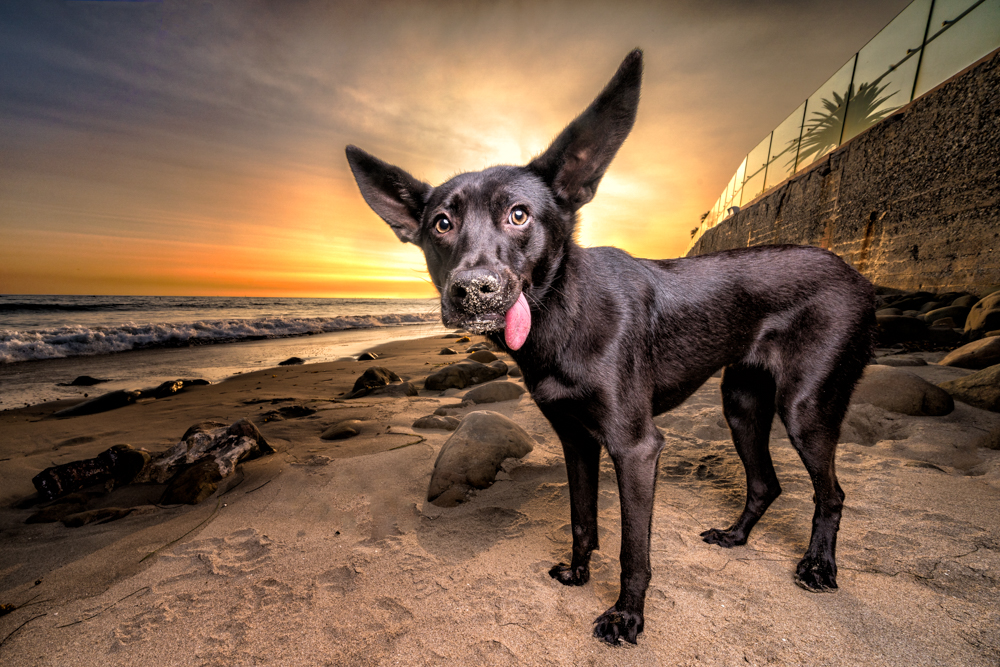
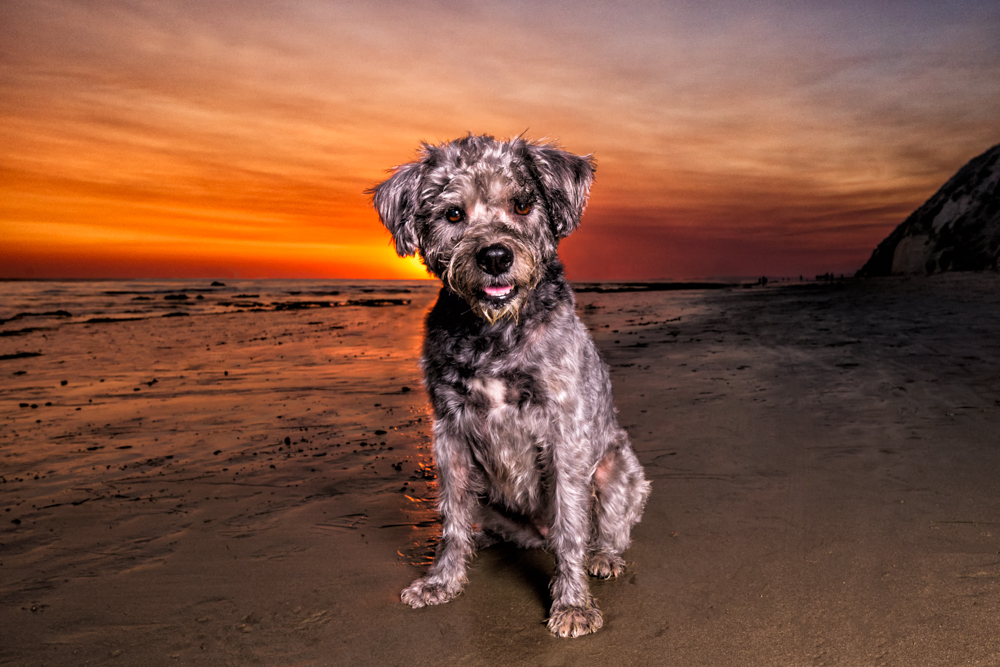
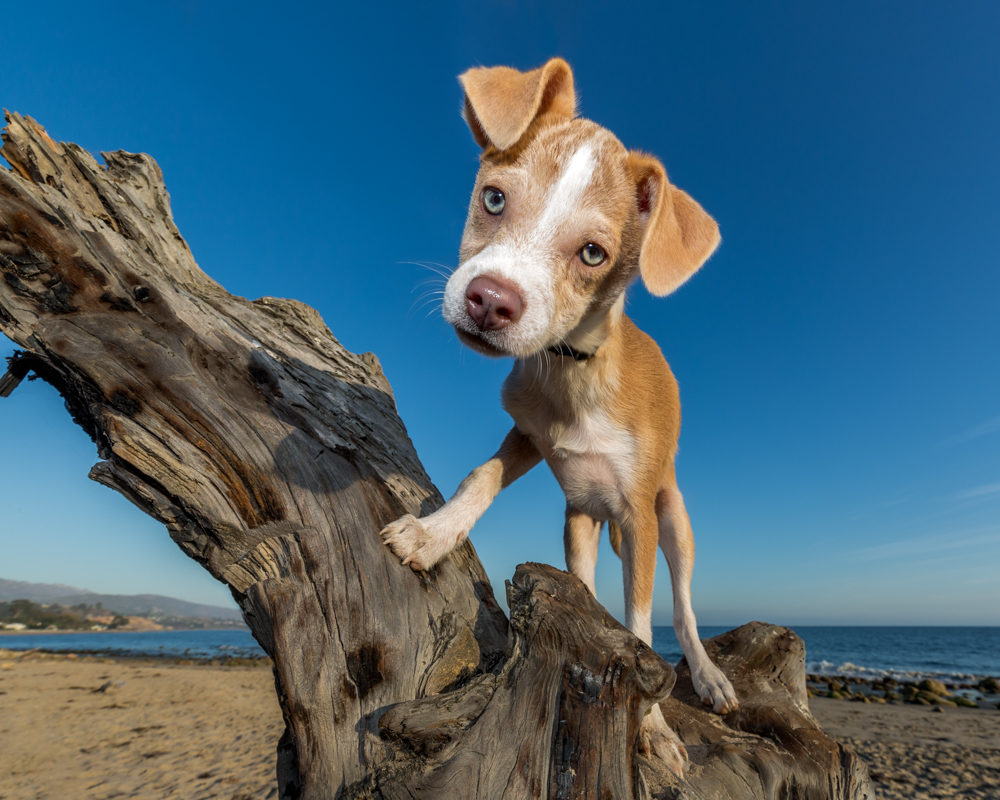
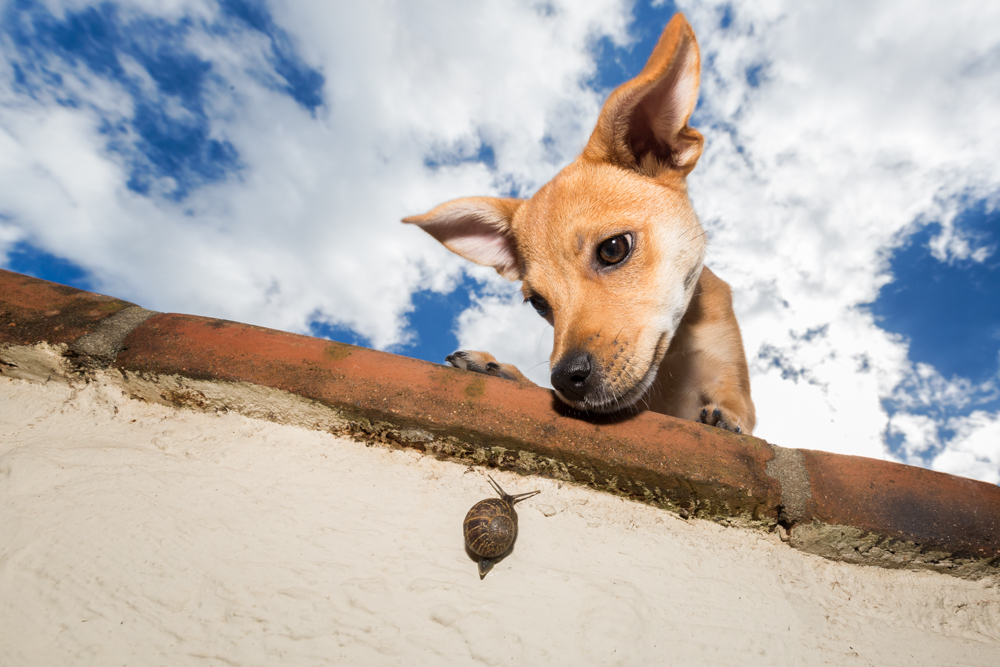
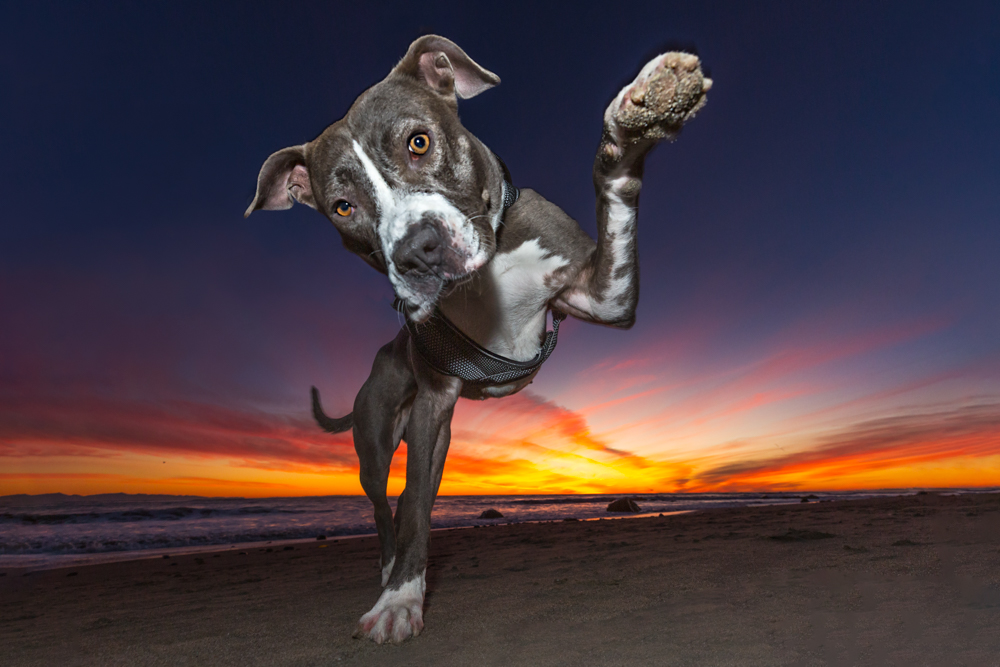
The key to pet photography — especially dog photography — is to engage with the dog and bring out their unique personality. If a dog is happiest at the beach and running and jumping in the water then naturally we will pick a beach setting and we will do action shots. If a dog is nervous around other people or pets we may choose a quiet park.  Based on how the dog is reacting and I may help put them at ease by choosing a longer lens so I can give the dogs more space.  For the happy go lucky dogs that are playful and quirky I will often use my wide angle lens and get up close and personal to show off their funny expressions. This is often my favorite lens for pet photography not only because it helps bring out their fun features, but also to help incorporate the background or sky that is often an important element in my photos.


Your photography also involves outreach and rescue, how did that come about?
I’ve been very active in animal welfare and rescue long before I became a pet photographer. In fact, it was the main reason that I became a pet photographer. I wanted to help take beautiful photos of the dogs at the shelter to help get them noticed and adopted faster. At that time I was in medical device sales and had no idea how to use a camera nor did I even own a fancy camera.  I decided to take a leave of absence from my job and attend photography school in Montana the summer of 2015. While I was there I volunteered at the local Humane Society and Animal Control photographing their adoptable dogs and cats. This not only helped the shelters but it gave me valuable experience photographing animals and learning the craft of pet photography.

I fell in love with photography so much that when I returned home I took a leap of faith, quit the sales job and pursued pet photography full time. Keeping true to my mission of helping animals in need, in addition to booking regular client sessions I continue to donate a substantial amount of time photographing animals at local shelters as well as donating photography sessions to benefit numerous animal welfare agencies including C.A.R.E4Paws in Santa Barbara, CA.

What type of change have you seen since the onset of the pandemic?
The biggest change has been the amazing number of people who have adopted or welcomed pets into their homes. I have had an increase in client sessions wanting to photograph their new family members. Sadly, as people are going back to work many dogs are ending up back at shelters and shelters across the country are filling up once again.

What is the main difference for you photographically, beside verbal (words) between dog and people portraits? and how are they similar.
For me the main difference between photographing people and dogs is that people often require a lot more direction and posing. They look to the photographer for more guidance and can be self-conscious about their appearance.  They may want techniques to help minimize whatever their perceived issue is or ask me to “Photoshop it out” if possible. But it’s exactly the opposite with a dog — whatever makes them different is what I want to capitalize on. If the dog has big ears then perfect, I want to get those ears in all their glory. If it’s a dog with a big head, long tongue whatever it is that is unique to them, I want to show it off. I feel like more people should embrace those unique things that make them so different.

Regardless if it’s a dog or human that I’m photographing, the most important things to do are to make a connection with them, put them at ease, and always have fun. I don’t want any forced smiles. For people that may mean I’m using my Midwestern sarcasm to make them laugh. For the dog, I’m probably doing something odd or funny or making the dolphin noise which many times works for both.


The Daily Edit – Patagonia Fall 2021 Journal: Paris Gore

Patagonia Fall 2021 Journal

Photographer: Paris Gore
Photo Editor: Jakob Reisinger

Heidi: How did you expand as a creative and photographer while working on this story, “Child of the Setting Sun” for Patagonia?
Paris: Working on this story was very personal as I was part of the accident and close to the family. Most of the projects I’ve worked on in my career I’ve felt close to or always have some sort of tie to the story but this was just on another level. Knowing everything that went on and being so keen to show this piece the way I felt it should be showcased really drove my creativity out to shoot a certain way I felt I had never photographed before. I usually pull inspiration from New Yorker style photo pieces and wanted to really bring out a lot more emotion than what I feel like I normally do.

Where did you take this portrait?
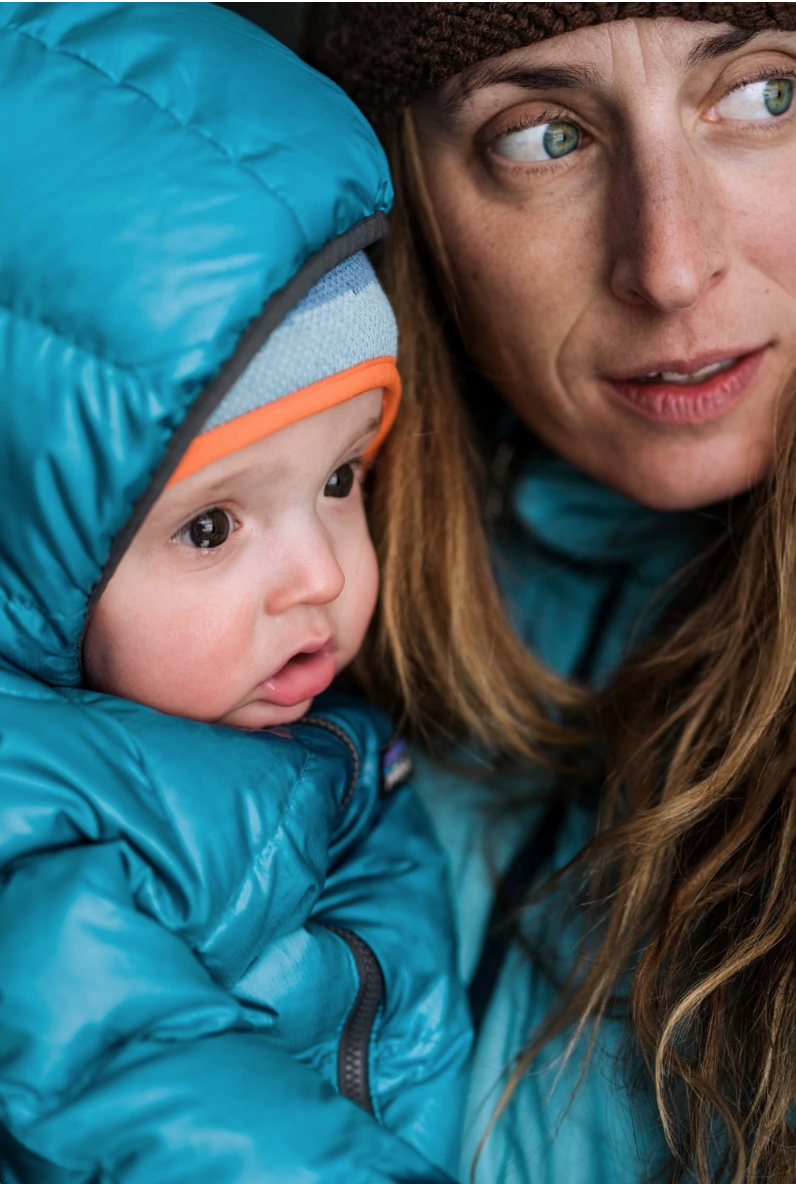
The portrait I took of Stephanie Bennett to accompany her story had to really be powerful. At her house she had a barn that was walled with metal siding so it gave off a metallic reflection, also being an open door it provided us a really great location for the portraits. Holding her young child Robbie, squirming and looking in different directions posed some challenges but to be honest Robbie is very stoic. His eyes have a mature gaze that look deep. Stephanie too, her eyes are beautiful and could pierce your soul. We photographed for about 20 min, having them look out towards the house together and I really did know on this frame it was a special photo. Stephanie was giving me a hard time about not liking her portrait being taken but she really photographed so well and I truly did shoot some of the most powerful portraits in my career I felt.

It’s a monumental moment of resilience, courage, and the full spectrum of life, how did you know when to pick up the camera to capture those moments?

Our weekend shooting at Stephanie’s place was really fun and never felt any moment was forced. We just shot Steph and Robbie doing their thing and had a great time doing so. I also just feel so close to Robbie that any moment with him is a real gift so it’s pretty easy to have the camera out most of the time being an over zealous “Uncle Paris”.

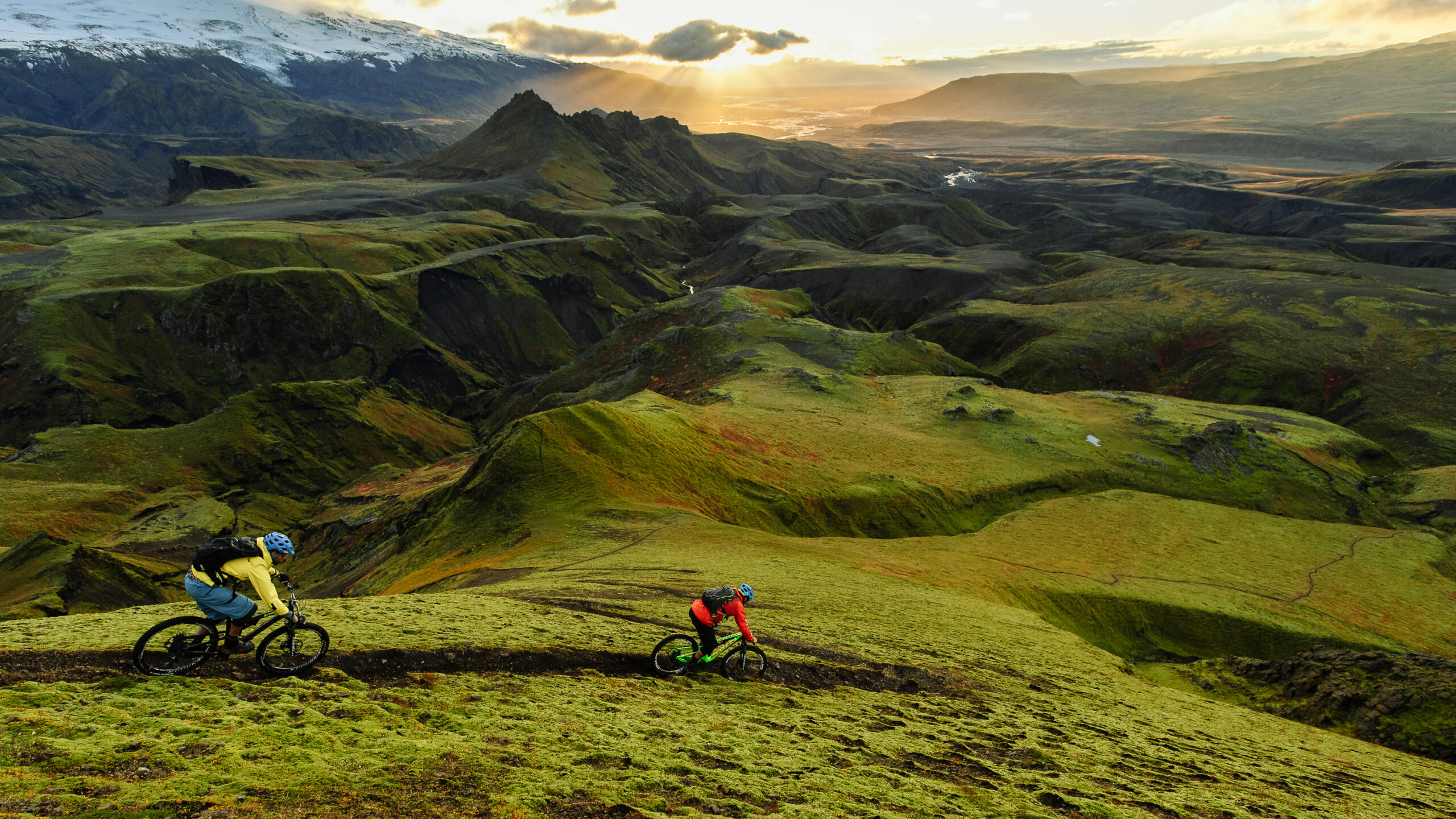
KC Deane and Geoff Gulevich in Þórsmörk, Iceland down a trail that is rarely ridden and never had been photographed for mountain biking. It’s always exciting to be somewhere and know you are one of the first to photograph MTB in the location. We lost the light behind the clouds which I was a little bummed about but it actually turned out for the better.
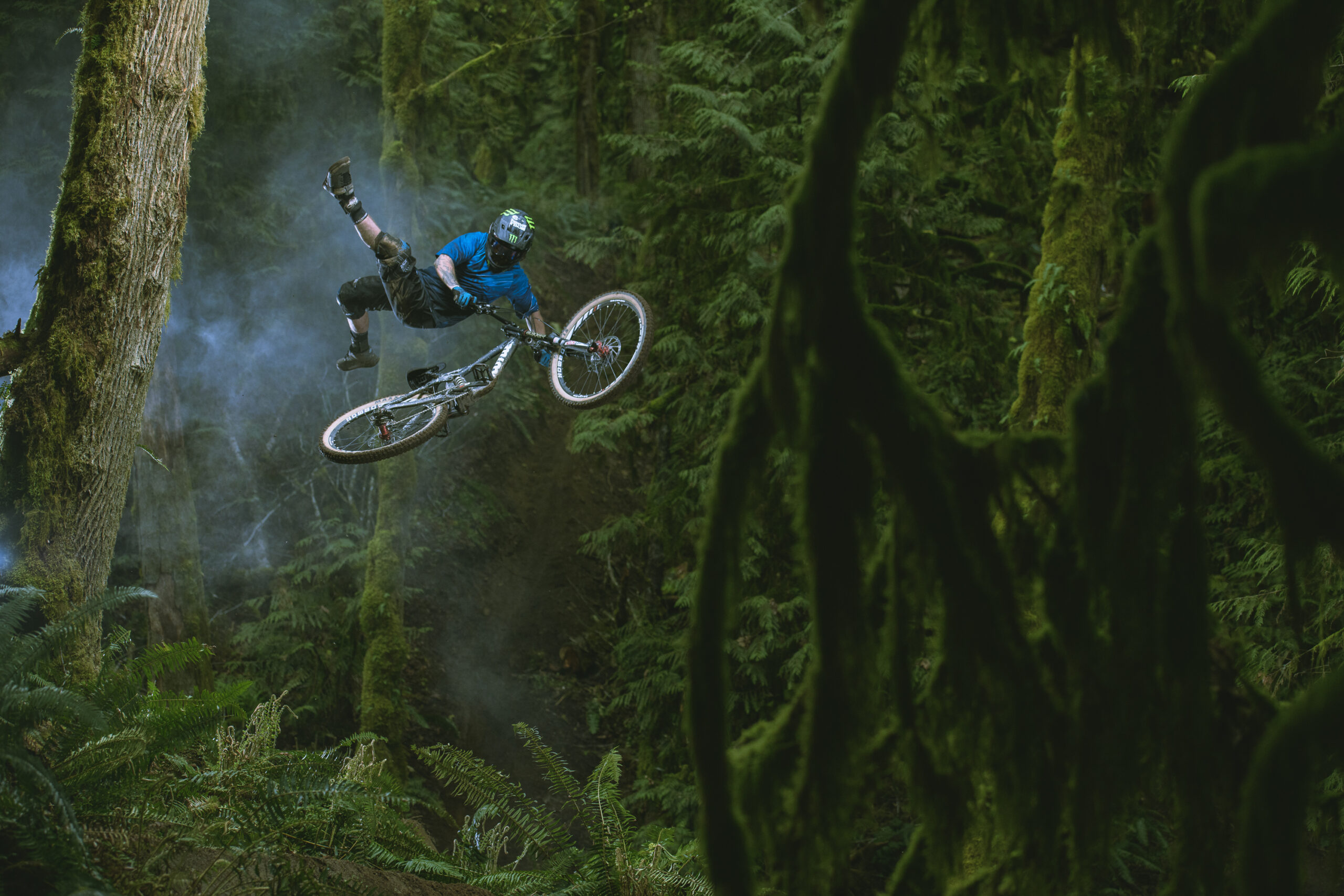
Graham Agassiz in Bellingham, WA during a production for Dakine clothing. This is one of my more intricate lighting rigs that I’ve ever done on a job. We ended up hanging a softbox in a tree to get a top down light affect using arborist gear. Was pretty wild to put together and execute a shot like this deep in the woods where getting all the gear up was quite the challenge.

You were a mountain bike rider that evolved into a photographer, when did you know photography was your path?
I got into photography pretty early on in high school but was mainly focused on shooting content for the yearbook and school sports not really thinking about applying it to mountain biking. Then one day me and a buddy went out to shoot some bike photos and had my a-ha moment. I had so much fun and just realized it was something I could possibly do for a living because at that point in my life there wasn’t much else in the way of a career I would have gone for.

How do you stay stoked and inspired?
A lot of people know me as a bike photographer and I do love it but any advice I can give is to have a passion outside of your work. I really enjoy snowboarding for example and I do photograph snow sports from time to time but it allows me to shoot it with pure enjoyment and not treat it as my “job”. Having an outlet just to go enjoy without the pressure of bringing a camera is so important to me and I work really hard to not taint that. Burnout is real and having the separation has really helped me appreciate the bike world and everything I’ve worked for!


The Daily Edit – Visura.co: Adriana Teresa Letorney

Photo by Nipah Dennis

Photo by Terra Fondriest

Photo by Linda Kuo

Photo by Karen Toro

Visura.co

Founder: Adriana Teresa Letorney
Co-founder: Scout Film Festival

Heidi: How long has Visura been publishing and how has the last two years informed how you’ve run your business?
Adriana: Visura was launched in 2016 as a networking platform for freelance visual journalists to build their online presence and connect with each other from one central place. The tech platform was built from the ground up as an alternative to the traditional systems used by visual journalists looking to connect with the global marketplace. During that time, the main problem we were aiming to address was the lack of platforms for freelance visual journalists worldwide that fostered inclusivity, sustainability, professional skill development, and equal and merit-based access to the global marketplace.

In time, editors wanted to use the platform to search, view stories, and directly connect with freelance visual journalists who were part of the global Visura community. This led us to also create an Editor’s account for visual researchers, editors and buyers to be able to search, connect and manage a growing list of freelance visual journalists and storytellers based on location, expertise, skills, and experience.

Our goal has always been to elevate media literacy by empowering a growing global community of publishers and freelance visual journalists with a central platform where they can connect, share work, and transact. During my studies, I learned how technology plays a significant role in the market of visual content. and ask these questions: Will this tool unite or divide? Is what we are doing fostering understanding and empathy, or inciting division? Is our service empowering or exploitative? Are the resources we are offering solving a problem for our community?

These questions leave room for debate, opportunity to connect with new thinkers, visionaries, leaders, and professionals looking to tackle some of the biggest challenges in media and journalism.

What were your hopes coming to New York from Puerto Rico?
I was born and raised in Puerto Rico. I came to New York with the dream of offering new perspectives about what it means to be Puerto Rican. I thought what I saw in the news or in films was biased and unfair. Never in a million years did I think I would build technology to tackle discrimination in the media and journalism industry. I was just a kid that loved being from Puerto Rico, and I thought, if the world had better access to the incredible work and talent that is being produced in my country, people would change their minds about who we are. I never imagined that my concern was a global problem. As soon as I realized it was—I chose to dedicate my professional career to tackling the systematic challenges that lead to more discrimination, abuse, biases and violence. And since, I have found hope in dedicating all these years to finding ways to empower the freelance community of visual journalists and storytellers, who just like me, want to share their stories and findings to offer new perspectives.

Your site has robust features such as maps and directories. Did you always have an interest in technology?
To be honest, I learned to use tech to solve a problem. And most of what we have developed was created by years of customer discovery. At Visura, our team serves its community. I don’t have a light bulb that turns on with some magic solution. Everything we have built has been the result of listening to understand our community, and their needs, we are thankful for community.

How and when did this idea come about, did the Scout Film Festival come shortly after?
Prior to Visura, I had launched an exhibition space, a magazine, and a self-publishing platform with a goal of highlighting a growing community of freelance visual journalists and storytellers worldwide. By the time Visura.co launched its first version in 2016, I had learned from the community of primarily freelance photographers from around the world that what they needed was tools to build their website and connect with the global marketplace to further their work and career.  So, we worked really hard to build this for them.

Scout founder Anna Colavito and I met in 2014 at an Art Gala event. She shared with me the idea of launching a nonprofit organization called Scout Film Festival that aimed to support teen filmmakers. I loved the idea, and overnight we decided to join forces to realize her vision. When it launched in 2015, I joined as co-founder of the 501(c)3 organization. Throughout the years, Scout has evolved into an international festival supporting filmmakers aged 24 and under with resources, tools and opportunities to highlight their short films and further their careers.

Scout specifically highlights artists under 24, why is that?
That’s a great question! At the time, Scout became the first festival focused on emerging talent. Initially, we began by supporting teens. With time, we expanded the community to include college students because many of the initial filmmakers were aging out, and they expressed wanting to remain a part of the community as undergraduate students. So, we expanded to welcome filmmakers aged 24 and under. In the future, we hope to continue expanding further. Ultimately, the mission of Scout is to support, empower and connect diverse filmmakers worldwide. Throughout the years, the organization has become a premier destination for the professionals in the film industry to find new talent, particularly directors, screenwriters, and producers.

There are several collectives that emerged this past few years, what makes this one different? 
Visura is not a collective. Visura is a market network that leverages technology to empower a growing community of freelance visual content creators with tools to manage their online presence and connect with the global marketplace. The way we envisioned the tech that would power the platform stems from our belief in the power of community. So, we are a media-tech platform that fosters professional development, inclusivity, equal and merit-based opportunities, enabling environments for media and journalism.

At Visura, professional photographers, filmmakers, photojournalists, journalists, arts, and other visual content creators can build their website interconnected to a networking platform that is used by editors, researchers and buyers to discover new work and talent. The platform is proprietary. It is not built on Squarespace or WordPress, or any of those platforms. We built our own technology platform to better serve our international community with the tools they need to connect, collaborate, and in the future transact.

Visura also offers editors access to exclusive stories, lightboxes, advanced search, image briefs, maps, and other tools to search by location, skills, expertise, and experience. More importantly, editors have direct access to a database of over 6000 professional visual storytellers worldwide. Any editor can access the creators’ profile which highlights their bio, contact, website, social media links, clips and samples of their work. They can contact the members or save stories or profiles in lightboxes for future references.

Sustainability goes beyond making lists, how are you creating a sustainable way forward? 
Absolutely it does. I believe that the Visura platform serves to bridge the gap between visual content creators and buyers, and it does so in a way that does not exploit the talent or their work. This is very important. We are also very focused on streamlining merit-based opportunities. Quality is never at risk when you create an inclusive work environment. On the contrary, it elevates and enriches the space. And as a female woman of color, I strongly believe that publishers will further grow engagement if they can easily connect with a global community of professional visual journalists and storytellers ready to be hired.

How can I join as a contributor?
Start with a free account or download the Visura App that is now available on the Apple Store for free. Upgrade if you want to submit exclusive stories to the archive, or build one or more websites via Visura.

How do I join as an art buyer?
Start by requesting an account,  to access the advanced search, exclusive stories, contact info, lightboxes, and brief tools, amongst other things. Then download the Visura App that is now available on the Apple Store for free. In order to protect the community from spammers and hackers, editors need to request an account.

How can access make a difference and what are your hopes for the future of the industry?
There is a lot that we need to do to empower the media and journalism industry with better systems to power the marketplace. Over 70% of visual storytellers today are freelancers, publishers need better access to this incredible talent pool and we need to think carefully about how we approach these issues.

Over time, we’ve seen that relying on social media or spreadsheet lists as the primary solution to highlighting talent is unsustainable and in the long run, ineffective.

We need solutions that unite and foster career growth versus what is a marketing or social media strategy that serves the organizers in the name of “community”.

With a conglomeration of information, audiences demand authenticity and truth in content without being “sold to.”  As a result, publishers are realizing the value of unique, in-depth, and compelling visual stories by diverse visual storytellers worldwide. We learned that in order to facilitate better access to quality visual content, we needed to re-envision the systems that power the marketplace and create access for breaking news, stock, and unique visual storytelling.

90% of the information that the brain retains is visuals; and publishers grow engagement much faster when they feature unique, compelling visual stories. I foresee that freelance visual journalists will hold the power in the future of this marketplace.

We strongly believe that technology can facilitate the tools they need to manage and grow their career. The best path forward is removing the gatekeepers and giving power back to the creators with a toolset to manage their online presence, connect, get hired, and sell their work.

I don’t have all the answers. I have failed much more than I have succeeded. But at this stage in my life and career, I am on a mission to continue finding ways to re-envision the marketplace and future of media and journalism

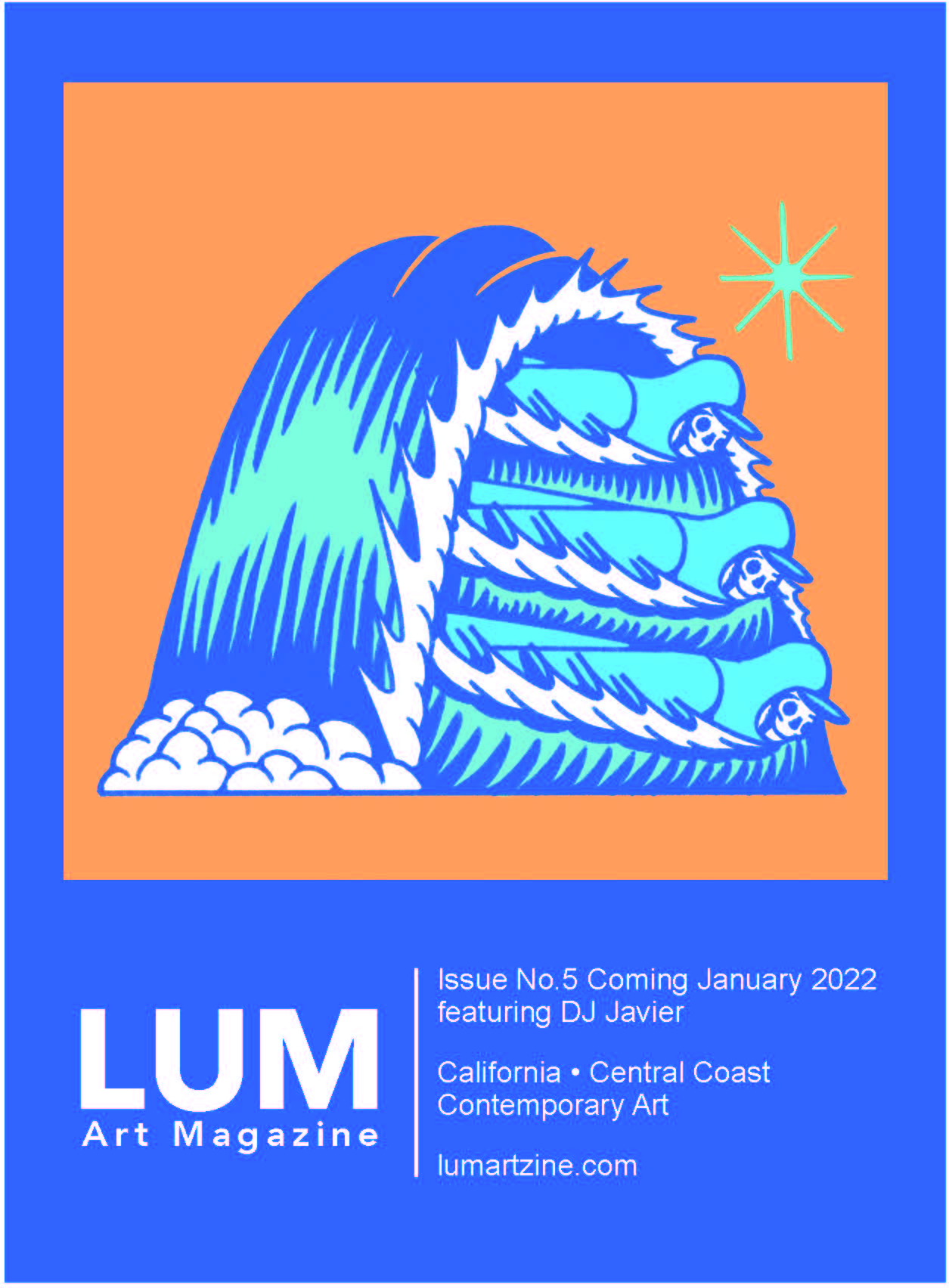
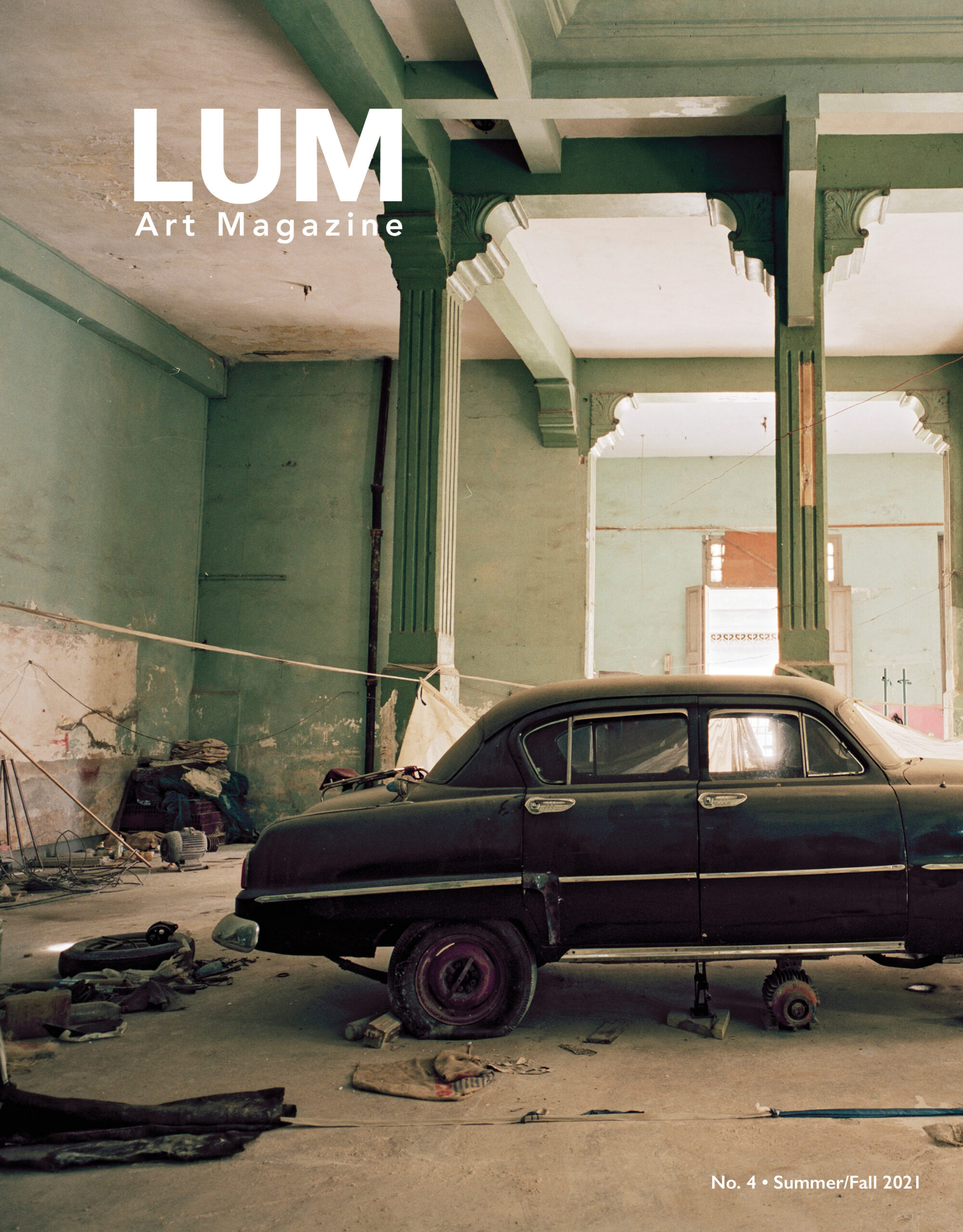
The Daily Edit – Lum Art Magazine: Debra Herrick


Lum Art Magazine

Editor & Founder: Debra Herrick, PhD

Heidi: You’re about to celebrate your 5th year anniversary of Lum Art, how has this project surprised you and what are your hopes for 2022?
Yes, this coming summer will be five years since we started Lum’s online forum, lumartzine.com. We started publishing the print magazine a bit later, in 2020.

Lum has surprised me in the way that it has found a niche in the community where it really resonates; and in some ways, and I hope this is true, this project my husband Arturo and I started five years ago now has a life of its own.

I’ve also been struck by how many talented people have collaborated with and contributed to Lum. It’s been incredible to be a part of a project that brings together so many different kinds of talent. I think I’m also surprised by how much I’ve personally grown in the process, especially as an arts editor and a publisher.

In 2022, I hope to see Lum continue to have a place in the community and to grow with the current moment.

The forced repose of 2020-2021 impacted all of us, did you see creativity as a coping tool info creating hope?
This is a hard question. I think for some artists, creative endeavors were helpful in coping. I think it was also bittersweet for some who were grateful to have more time and less distractions, but also struggled with anxiety or solitude. In our case, having Lum as a creative project was really grounding during quarantine. I think we benefitted from having purpose and goals as well.

We tried to approach our stories last year with an awareness that times were strange. I think that threadline is palpable in each issue. But I think that if Lum created hope, it was through following through with our plans to publish the biannual print magazine. Many projects – especially in the art world – were being shuttered. We published on a shoestring, but we decided to keep going and stay present. We hoped that Lum would be a source of connection and community for people, especially during a time when many were feeling disconnected.

Who was recently awarded from your latest fundraiser in Santa Barbara? The ping pong competition was a hit!
Our first benefit event was awesome. We threw a Ping Pong Paella Party on Dec. 4, and we raised $10,000 to underwrite our print mag and two new programs: a biannual art prize and an arts writing fellowship, both to be awarded to individuals from historically underrepresented communities including BIPOC and people with disabilities.

Our first art prize winner is Vanessa Wallace-Gonzales and the 2022 arts writing fellow is Ryan P. Cruz.

How many times do you publish? 
We publish the print magazine twice a year. The electronic version can be read on lumartzine.com. The print mag is free and can be ordered in our shop (there’s a cost for shipping & handling) or you can email me for a list of where to pick one up in the Santa Barbara, Ventura, San Luis Obispo area.

How do artist and writers connect with you?
Email is usually best, editor@lumartzine.com.

The Daily Edit: Ethan VanDusen


Ethan VanDusen

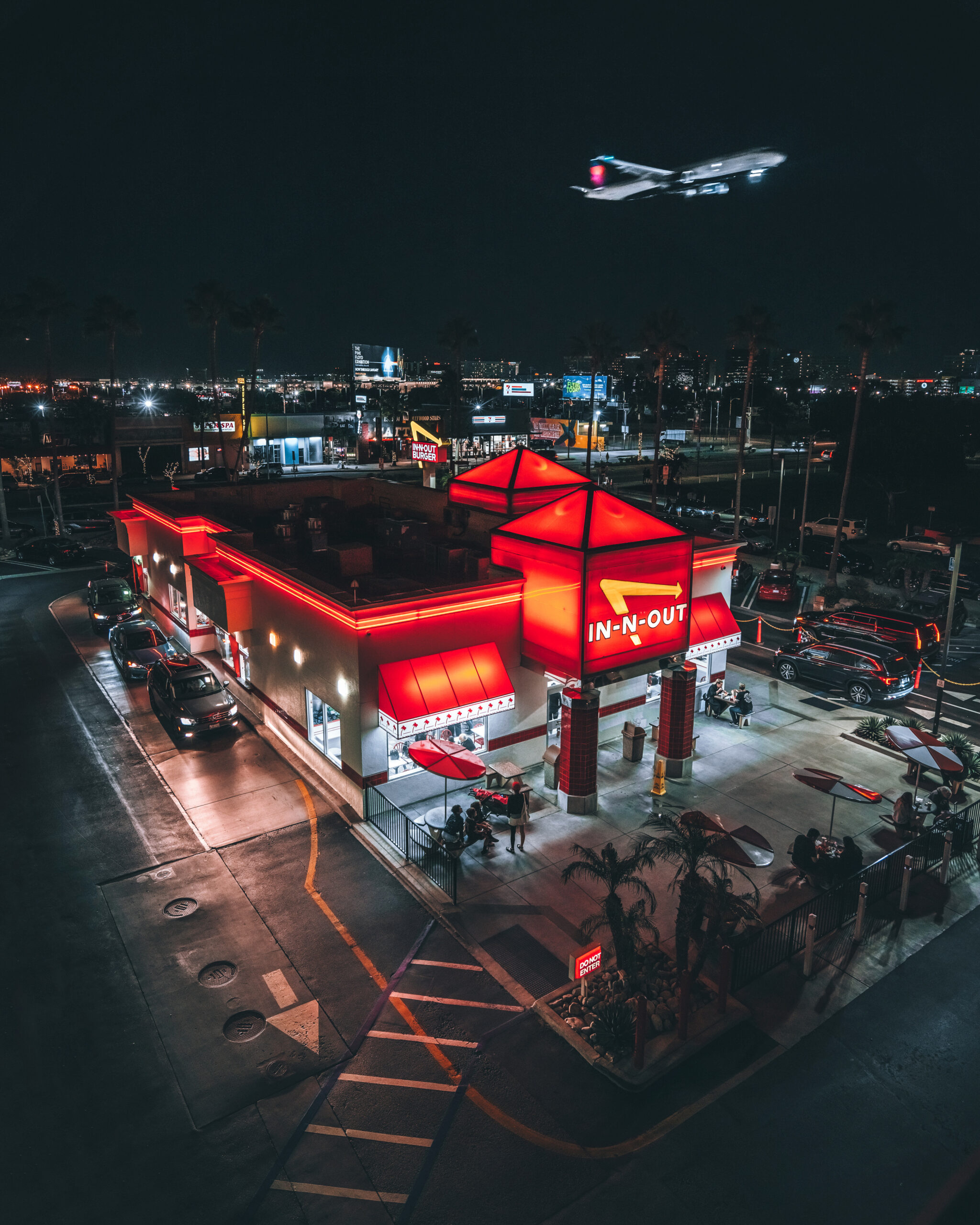
Heidi: For the In n Out image by the airport how much planning went into that?
Ethan: I had seen this image a few times cycle through my Instagram feed from fellow photographers based in the LA area. Growing up in Maine, the possibility of getting a shot like this just didn’t exist. I knew the location of the shot but that was about it. To be honest, not much planning went into this particular shot. It was more just, get there, set up my camera, adjust my settings and shutter speed and wait for a jet to fly over. It took a few tries dialing everything in due to the fact it was well past sunset, getting the jet as motionless as possible was not an option, so figuring out my settings to keep the jet from looking like a blur in the sky took a little time, but I was happy with the result I produced.

What draws you to low light/night photography and who or what are your inspirations?
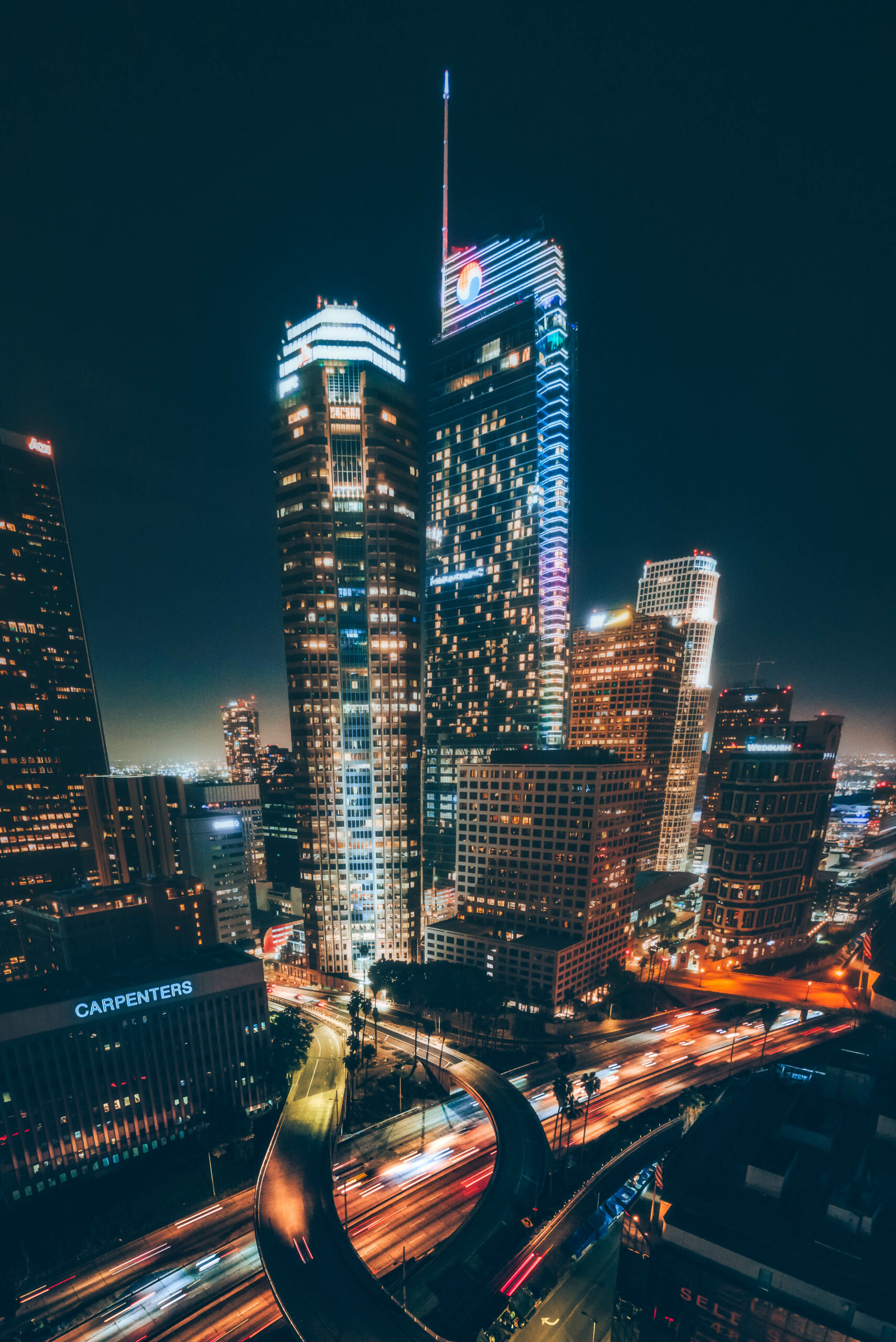
I never really thought of myself as a “night shooter”. I mostly shot landscapes and brand photos before moving to California in 2018. One evening, during the beginning of the pandemic, the cabin fever hit. I needed to get out of the house. I had been to LA a few times before to explore during the day but really wanted to see the city at night. I knew due to the pandemic, the streets would be a bit more calm than normal. So I packed my camera bag, grabbed my tripod and drove down to see what I could find. I got to the heart of Downtown LA right around sunset. There were a few of the classic LA spots that I wanted hit. The Korean Bell of Friendship, the 4th Street overpass and a few others. Upon taking my first photos at a low shutterspeed and seeing the results, I was hooked. The light trails, the somewhat moody, ominous look these photos produced sunk their claws into me and drew me in. I had tried experimenting with light trails in Portland, Maine a few times, but never had much luck. Come to LA and BAM, these were the shots I had always really wanted to take. A few photographers really inspire me in the night photography world, Andrew Wille (@andrewoptics), Kyle Meshna (@meshna), and Mike Will (@m.visuals) are three I think produce amazing content and constantly push me to become a better photographer.

Can you tell us about the lake in Maine water skiing clip, I mean, those conditions…
I was home in Maine for my birthday and was lucky enough to receive a drone as a gift from my family. One night, we were at a rented lake house and there was an absolute banger of a sunset. I hadn’t flown my drone other than a few test flights so I figured I would fly out over the lake and capture the scene from above as the light faded. While I was flying I noticed a slalom water skier being towed behind a boat. I watched for a few moments and as much of the light was gone, the skiers spray was catching all the orange light from the sky, giving a look of flaming water spray. It was the first drone video I ever took, and still my favorite to date. Sometimes things just workout without any planning whatsoever and that was definitely the case that evening.

How did your love of photography come about and how long have you been using drones?
 I took a film photography class in High School. My teacher, Ms. Brown was the first one to really instill that love of photography in me. After that class, I didn’t purse photography much until years later. My dad’s friend gave him an old Nikon D40. It was a pretty old camera, but I loved the ease of digital photography. I shot on that camera for about a year and produced some very mediocre photos. I wasn’t too happy with the photos I was producing so I sold that camera in a yard sale. A few years went by and signed up for a few courses at the Maine Media College in Rockport Maine. One of my professors, Kate Izor (who is now the personal photographer for Roger Waters!) was the one I really credit with putting that deep love of photography in my brain. She taught me some Lightroom basics and showed me how to really use a camera to its fullest potential. I had the itch to start shooting again. I did a little research and decided I wanted to go with a mirrorless camera. The Sony A6000 was my first camera I had since the D40 and that really made a huge difference. I bought Lightroom and the rest it pretty much history. I have been shooting pretty consistently since then and developing my skills over the years.

I have been using drones for only about a year now. That has been a huge help when I’m going through a creative slump. I sometimes get uninspired using my camera but having the option to photograph from a bird’s eye view always re-inspires me. I now like to photograph the same place from both ground and sky, it helps me create different images and sometimes a boring scene on the ground can be stunning from the sky. The water skier is a perfect example of this. From the dock, it looked like every other water skier on the lake, from above, it added so much more beauty.

The drone still that I shared is of downtown LA, it’s a composite of three images taken from different heights. I stitched them together in Photoshop to create a vertical panorama of the skyline downtown. I love this photo just based off the perspective and depth.

What have you learned about the creative journey?
For anyone going through a creative slump, just know we all go through them. I find myself having creative block a lot more than I would like to admit. I always find inspiration from other photographers. It sounds goofy, but when I see creators producing amazing content, I almost get jealous. It drives me to get out and produce content of my own. Just know that everyone experiences these creative slumps, it just takes drive and desire to get back out there and start creating again.

One other thing, nobody picks up a camera and starts taking stellar images right off the bat. Take your time, hone your skills, find a subject matter you love to shoot and focus on that at the beginning. Once you have your skills dialed in that field, branch out and try other styles of photography. Finding a photography community is also a great way to grow your skills, and tips or tricks from fellow photographers are always nice to receive.

The Daily Edit – Ash Adams: Patagonia

Fall 2021 Patagonia Journal

Photographer: Ash Adams

Assistant: Sarah Pulcino

Photo Director: Heidi Volpe
Art Director: Annette Scheid
Editor: Madalina Preda

Heidi: How long have you been living in Anchorage, what brought you there and why have you stayed?
Ash: I  have been living in Anchorage now for a little over ten years, with a brief year a few years before that before I left for grad school. Honestly, I came up to Anchorage because I was burning out working in cities in the lower 48 and wasn’t making the work I wanted to; being a young journalist is such a hectic, yet formative time, and my personality needed to be somewhere where it could breathe. I felt that in Alaska I could work as a freelancer and really sink into a place. Alaska has very few photojournalists who work for national media to this day, and very few women. So it felt like an opportunity to cover underreported stories and also an opportunity to learn.

I’ve stayed for a number of reasons, but mostly I tell people that I’ve stayed because I love it here, and I do. I love how much space is here, how much wilderness. Before living in Alaska, I had almost no acquaintance with the outdoors; I would need to take a minute anytime I came to “You are Entering Bear Country” sign at the start of even the most trafficked trails. Now, it is not uncommon for me to be backpacking for days (and sometimes weeks) alone. I found a place in the world through becoming comfortable in wilderness that I had no idea I needed. My children, now 7 and 9, backpack with me as well.
I love the people here, and many cultures, foods, and dialects. I love how much I have learned from the people here.

Having my children here, and with a person who is Inupiat, is obviously another pull. Making sure that they are close to and connected to their heritage is important to me, as is making sure that they feel that they have a place in the world, which I think comes from being connected to the land.

You’ve obviously earned trust from the community in order to share their stories in a variety of outlets. I would think this is reciprocal, what has the community taught you? 
The communities within Alaska have taught me so much that this is particularly hard to answer, but Alaska has especially taught me about the concept of community itself. Alaska is an island made up of islands, and so every person in a community matters. It is easier to see the responsibility each person has in a small place and to therefore see your own. People see each other here. After one assignment, I was driving at night and the snow drifts were huge and the roads were slick, so even though I was driving carefully and had the right tires and right car for this, I slid into a bank and was absolutely stuck. I had no cell service and my GPS had died a while back. Within about 6 minutes, a truck came down the road, and two teenage boys hopped out, pulled out a tow rope, and just pulled my car out of the snow, with almost no words (and of course they would accept no money). It is this small act that honestly was huge. And teenagers already knew to do that; they’d been taught to see the people around them and acknowledge that they are part of the story of the world. I think about things like this a lot lately; individualism has a very dark and damaging side, and being a part of a place like this gives my heart hope.
And then there’s languages and cultures; the concept of what real family looks and feels like; the tastes of whale, seal, bear, moose, caribou, and so many other flavors I’d never had before; what resilience looks like–the list goes on and on. I am grateful in every way.
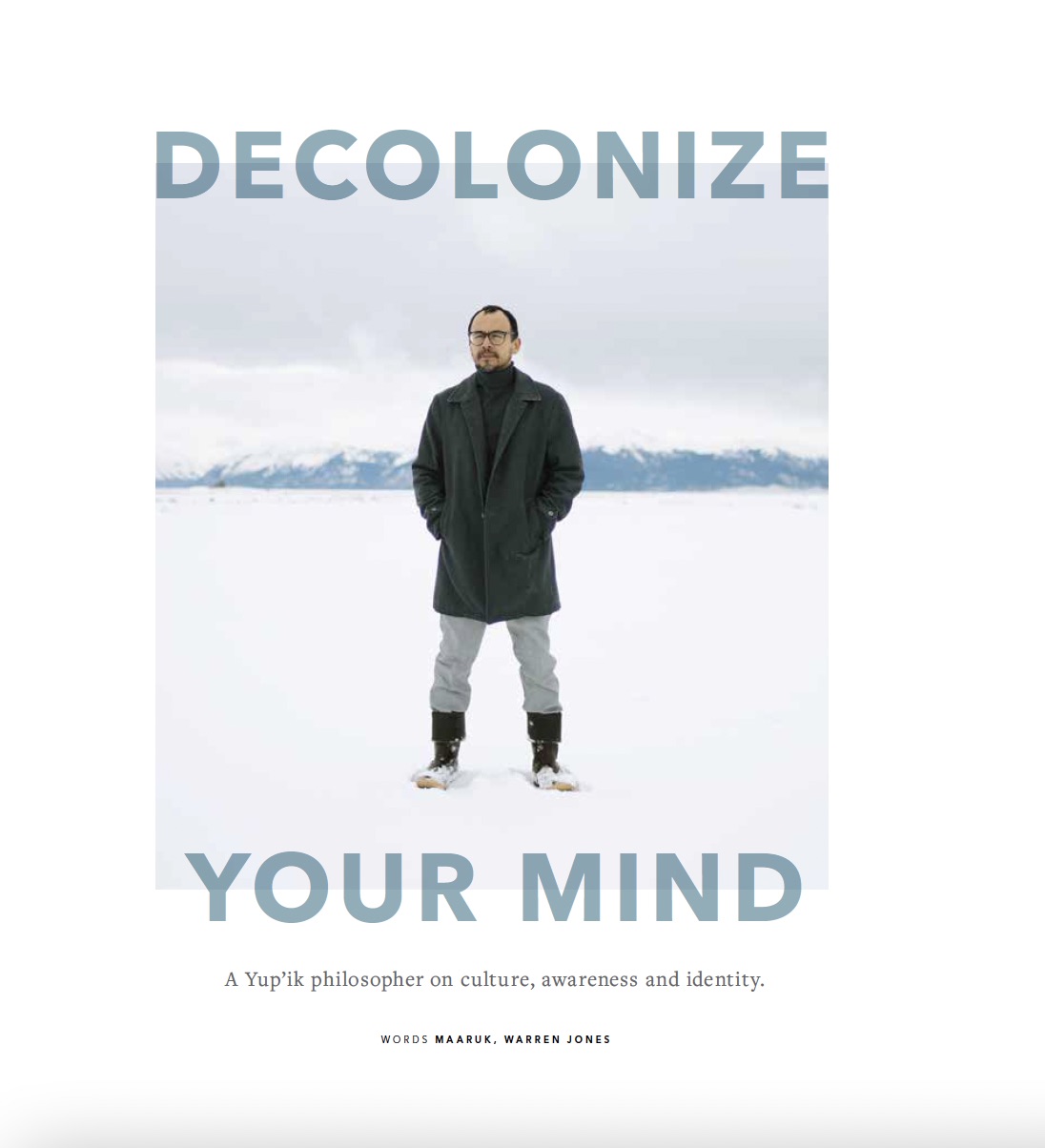
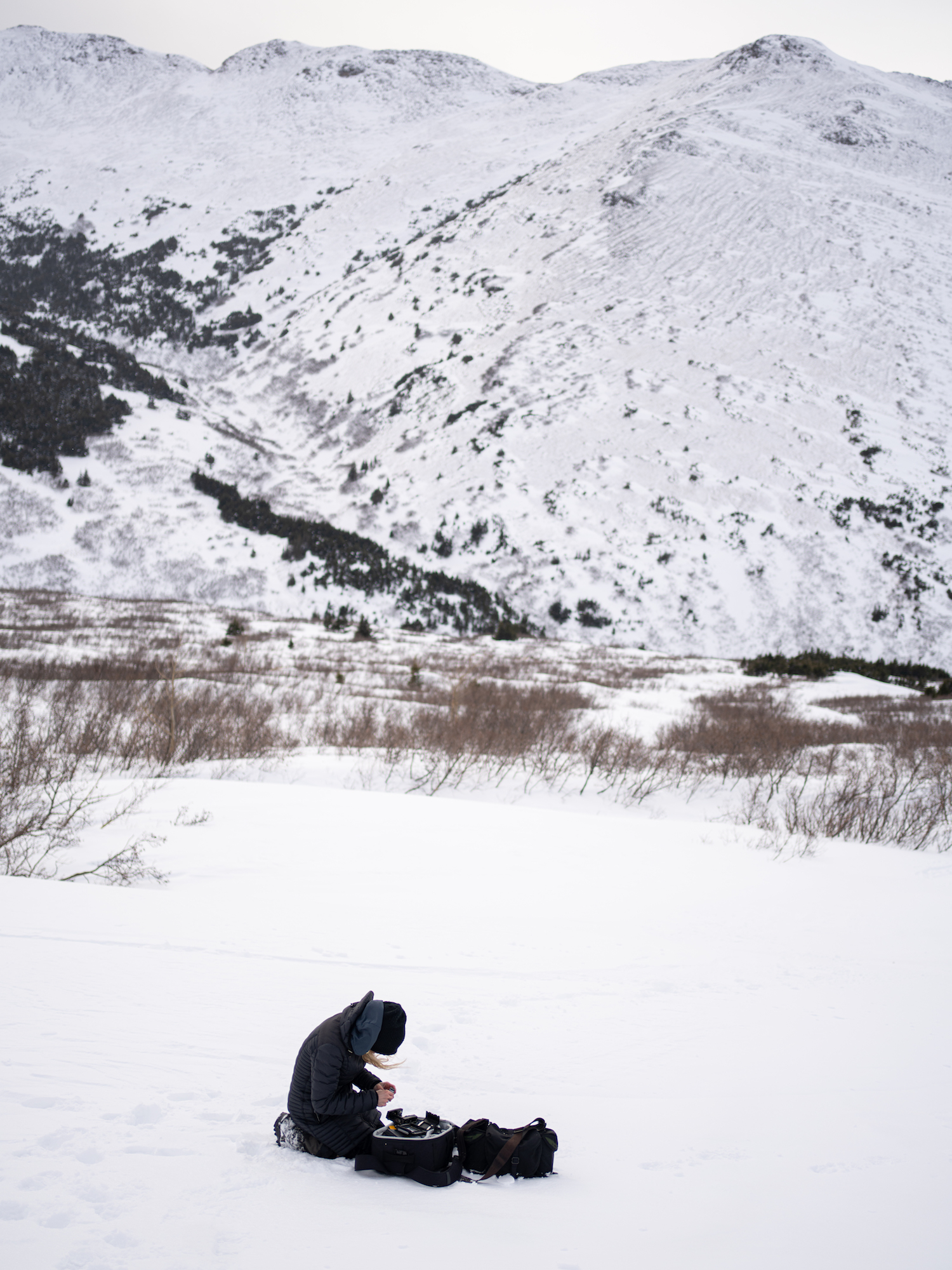
Ash Adams loading film while Photographing Warren Jones for Patagonia./Photo by Sarah Pulcino

Patagonia asked you to find a local assistant for this project, how did that align with goals you already had for mentorship?
Diversity within the photo industry has been a hot topic in the last few years, but it’s been on my mind for well over a decade. I currently am a founder of a mentorship program, Show and Tell Alaska, with my ex-husband and co-parent, Brian Adams, who is both a phenomenal photographer and person, and the program was developed in response to a lack of diversity in photojournalism and in this state. People do not necessarily need a degree to be able to tell their stories to a larger audience, and for many and especially in rural Alaska, that doesn’t make sense; I think aspiring photojournalists need people to show them how to hone skills they’ve already started to elevate their work and then they need contacts within this specific industry that people often come to through educational programs (where people also learn about all of the workshops that will build them up, too). The lack of diversity in the industry is due in large part to just not having access–to mentors, to contacts. There have been many, many photographers who have come to Alaska from outside on $20,000 (or higher) grants to do a weekend workshop on i-phone photography in a village who then use the contacts for their stories and bail, and we wanted to do something that could actually help diversify our industry in this diverse and geographically complex state in a meaningful way.

So, all that is to say that working with Sarah Pulcino (who is currently in the mentorship program, but was not yet at the time), aligns with my values for a number of reasons; there are not many Indigenous female photojournalists in this state, and I want to support her journey in any way that I can. She’s talented and lovely to work with.

Did you know Waren prior to this assignment?
I did, but not well; Alaska is a small-town state, and Warren is a brilliant writer who travels in similar circles, so we had met casually here and there over the years. After this assignment, however, Warren and I (and his family) have become a great deal closer, which was an unexpected benefit from making the work.

You have a love for writing, poetry that come up while photographing Warren?
Warren and I likely talked about his writing during the shoot, though I’m not sure that we’ve ever talked about poetry (in addition to journalism, I publish roughly a couple of poems a year in literary magazines, which is something I started doing in my early 20’s, but it’s such a tangential part of myself that it rarely comes up). We often tend to talk about ideas more than anything, and my recollection of the conversations of the day were no different. His article for Patagonia is a great example of the deep wells that he gets into on his own and that we also get into collaboratively; he is a deep thinker who revels in the way things connect. That we both love words I think becomes a kind of framework but not the subject of conversation. (If that makes sense!)

The Daily Edit – 30 Moons Apart: Hashim Badani

30 Moons Apart

Photographer: Hashim Badani

Heidi: How were the first few months of lockdown in India for you?
Hashim: The initial months of lockdown in India skewed all sense of distance and direction. I was living close enough to my parents to spot their home, but further than I have ever been in every other way. I decided not to visit them through this period, which felt particularly surreal during the month of Ramzan.

How did you cope?
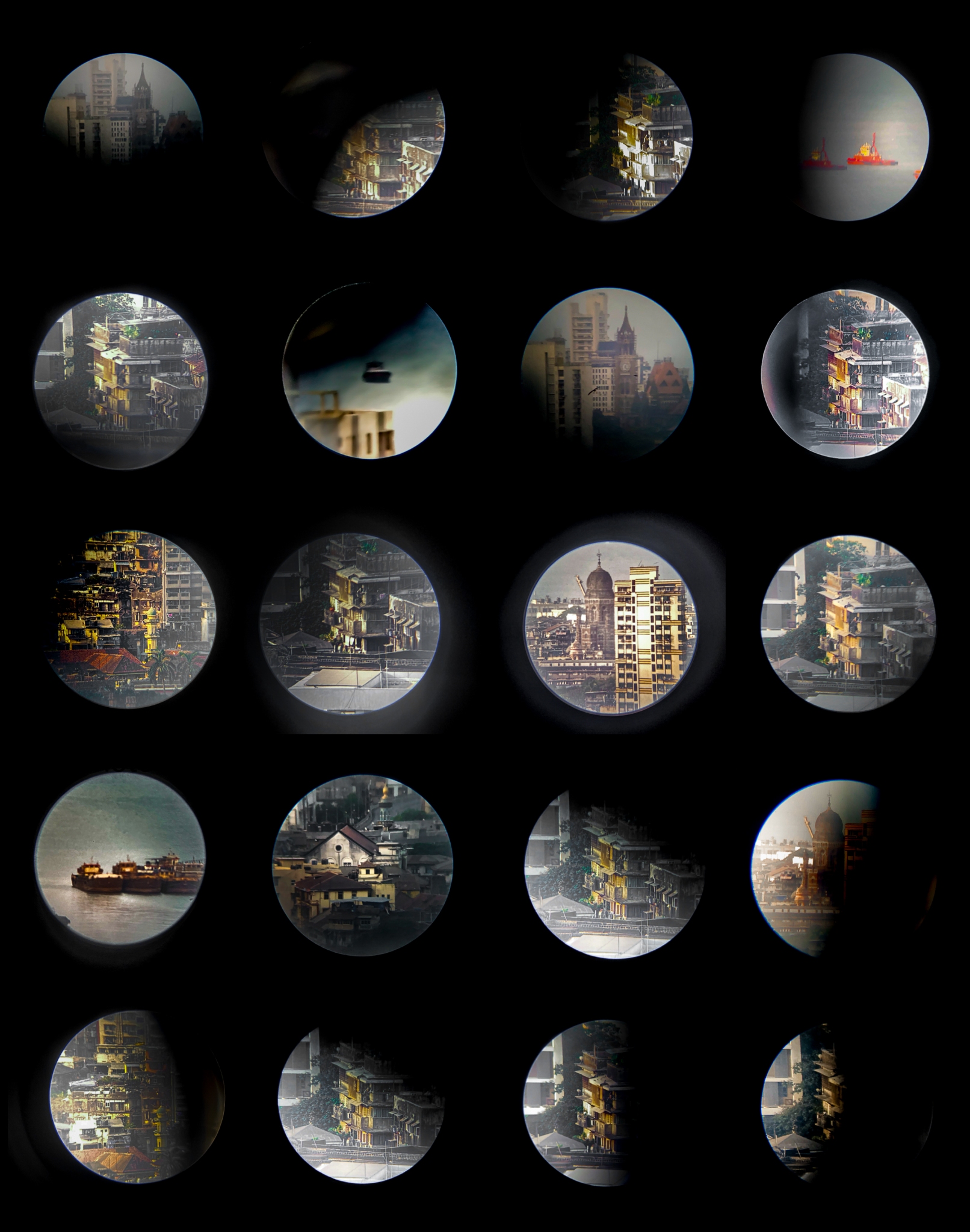
I borrowed a telescope and found it bridged the gap a little. I called Ma and asked her to come to the balcony. I was able to spot her–a white speck. This became a routine, even a strange mode of communication. I would make photos of her through the telescope, and she would make some pictures aimed in my general direction.

In between, I found myself collecting pieces of the city that surrounds us. Otherwise receding images gained focus–the fact that we’re a port, or that the sea is never far. This is where my father went to work; these were some of the places where I grew up. All seemingly unreachable but carrying a sense of familiarity. Much like the moon. The moon that dictates the beginning and the end of this month.

Maybe it is the strange solace we seek from traditions when times are tough. In the end they only fit right, together, in the lunar chart made over thirty days.

This grid of images shot through the telescope is a map of many things, but most of all it is a way home.

How did the pandemic force you to find creative solutions for self expression?
I think when the pandemic began and the world went into various states of lockdown, there was a massive urge for me (and I believe many others) to learn or create something during this period but then the numbers started rolling in and the devastation was extreme. People were losing loved ones. India saw a huge urban to rural migration crisis as the government had left its citizens with few alternatives. At some point we started looking inward and reflecting on what mattered to us. The work borne out of that stems from a similar space.

How did this new act of “seeing”, be it through binoculars or a telescope, push you as an artist?
It made me rethink my relationship with photography. One which had so far followed the more linear approach of having a brief and finding a way to translate it. This was more organic. There was no brief. I was responding to how I was feeling. That in some strange way altered things for me and now I find myself more curious about the idea of photo fiction rather than just documenting.

What made you keep the edges of the images organic?
When I began looking at the images together it was fairly obvious to me what I was going to do with them. The imperfect circles of the images were what got me to that decision.

What are you bringing forward from the last two years, and what are you leaving behind creatively?
A large part of my decade old career has involved traveling. Mostly internationally. The pandemic turned that on its head. I wasn’t certain where my next gig would come from if I wasn’t allowed to travel. It took me a good year to make peace with that and change my approach to make work with what surrounds me. So far it has been rewarding. I am no longer excited by the idea of ‘skimming the surface travel editorial’ type of shoots that I once truly enjoyed. I want to find ways of doing work that is more immersive, closer to home or the idea of home.

Are you still selling prints in order to support those in need?
My print sales are currently not associated with any organisation but please keep an eye on my instagram handle for regular updates.

What projects are you working on now?
I am currently pursuing assignments that I am not certain I would have made the time for in the past. Some perhaps not as much about the images produced but the learnings they allow. I am currently in the process of documenting the palliative care work done in India by the Cipla foundation. At the same time I am quite excited by the idea of photo fiction and the path it allows me to take to narrate certain stories. One of them is called #makingupmanto. The series allows me to relook and document South Central Bombay through the life of a prolific and controversial writer who briefly lived in the city during the country’s partition years. I have also found myself on the other side of the camera hosting and participating in non fiction shows this year and it has been an interesting experience.

The Daily Edit – Fairy Creek: Ola J. Cholewa

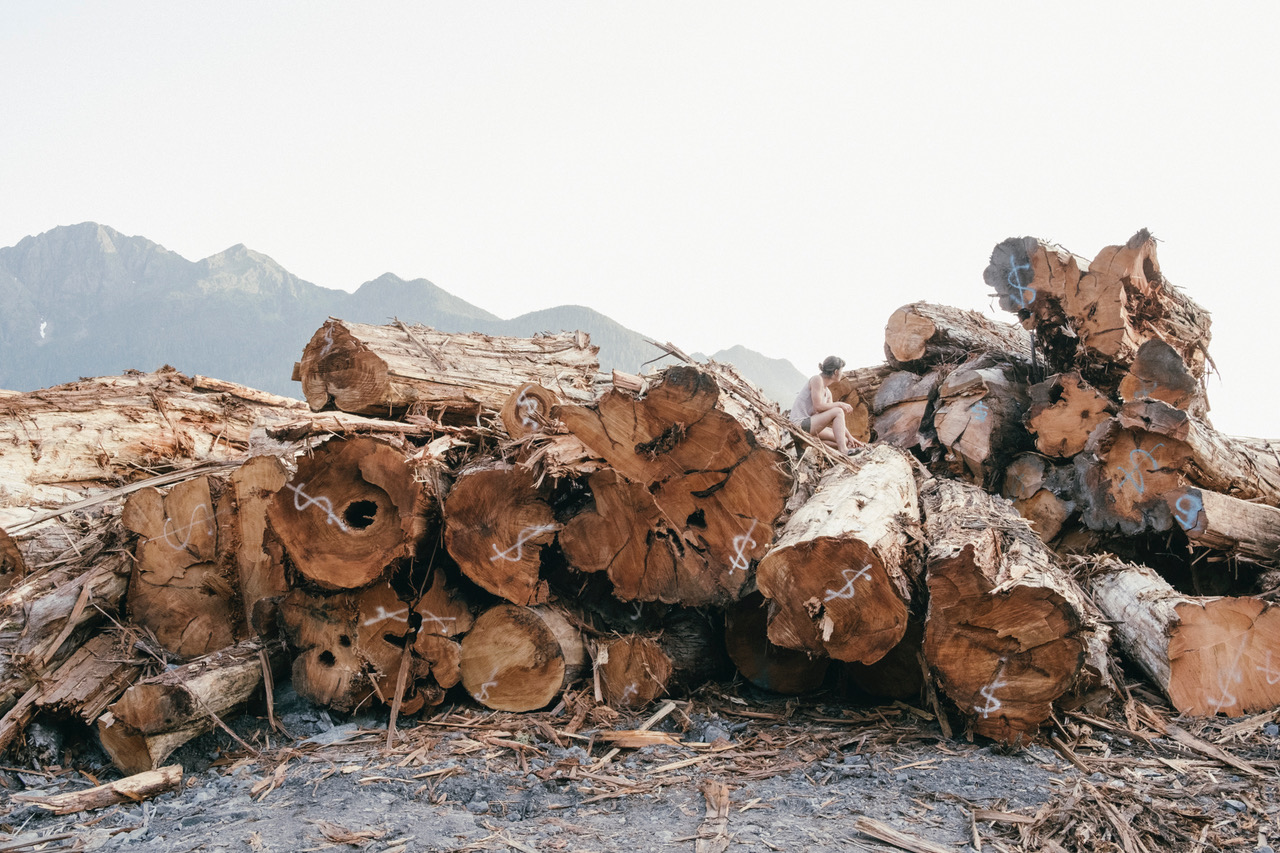
(A logging sort filled with old growth red cedar in Haida Gwaii 2018.)

Fairy Creek, Unceded territory of the Pacheedaht and Dididaht First Nation People

Photographer: Ola J.Cholewa

Heidi: Before joining the protest at Fairy Creek were you involved in other environmental movements?
Ola: I first visited Fairy Creek in early April of this year. Prior to that in 2018 I had the privilege of living in Haida Gwaii for a year. Haida Gwaii is an archipelago off the central coast of British Columbia where Haida settlement has been proven to date back to 13,800 years. Shortly after moving to the island for a new job, I quit my job with certainty, and I found myself participating and documenting a stand where Haida citizens re-claimed the rights to their territories and put a temporary halt to a forestry operation that was expediently harvesting one of the islands last available stands of old growth red cedar.

During this stand I witnessed the approval of an injunction by the B.C. Supreme Court, which granted the RCMP the ‘legal authority’ to forcibly remove Haida citizens off their own land to make way for industry. Shortly after camp was dismantled, illegal logging commenced at St’alaa Kun by the Forestry company, Husby Forest Products.

It was this experience that opened my eyes to the fact that our ancient old growth forests are threatened and endangered. I also learned how the exploitation of land is directly related to the exploitation of Indigenous People’s culture. I was introduced to the complex issues that have arisen out of tensions that sometimes exists between Band Council governance systems and Hereditary Chief governance systems within Nations.

My experiences in Haida Gwaii gave me the initial courage and the motivation to participate in the protests that were taking place in Fairy Creek.

What was your process like in terms of joining and photographing the protest camp community?
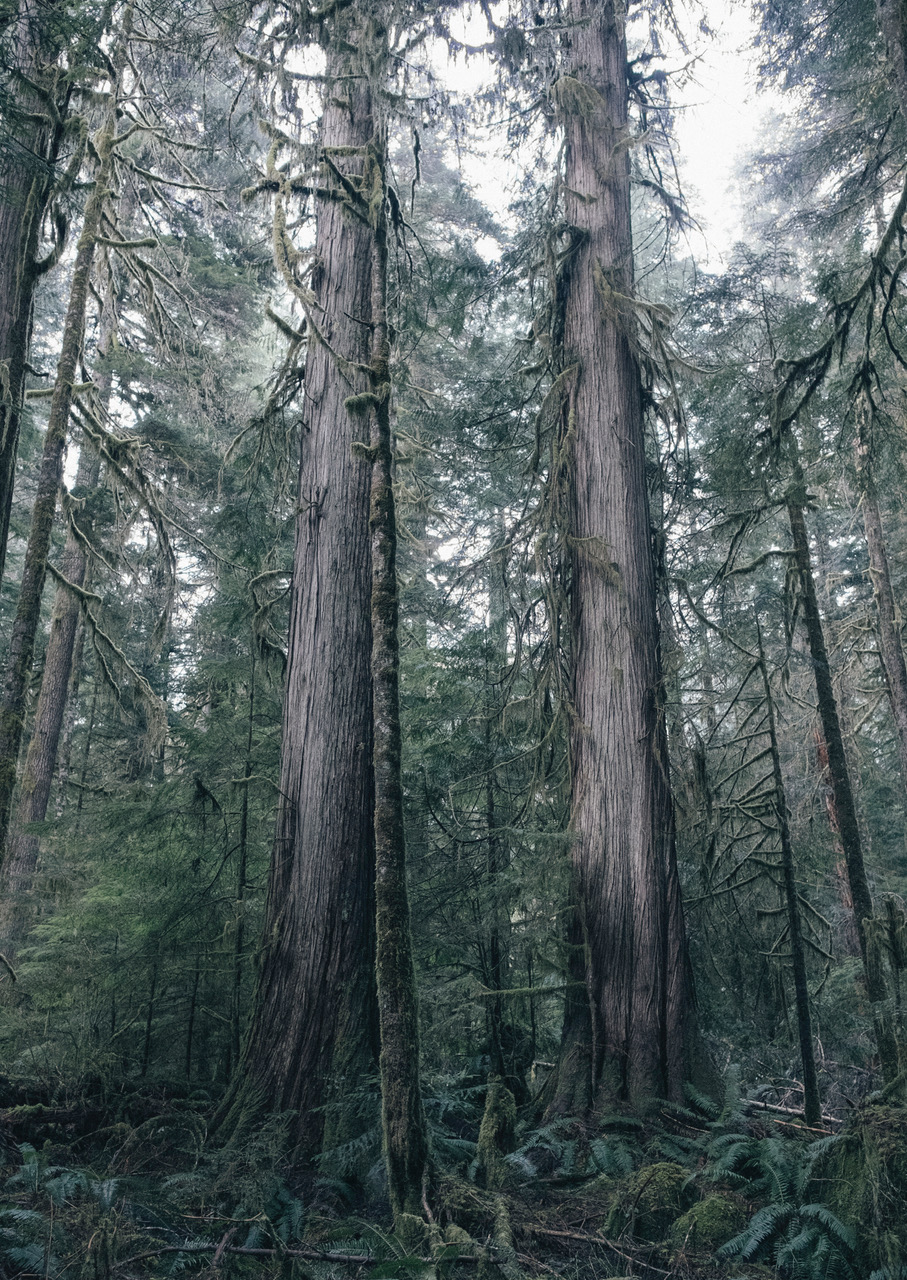
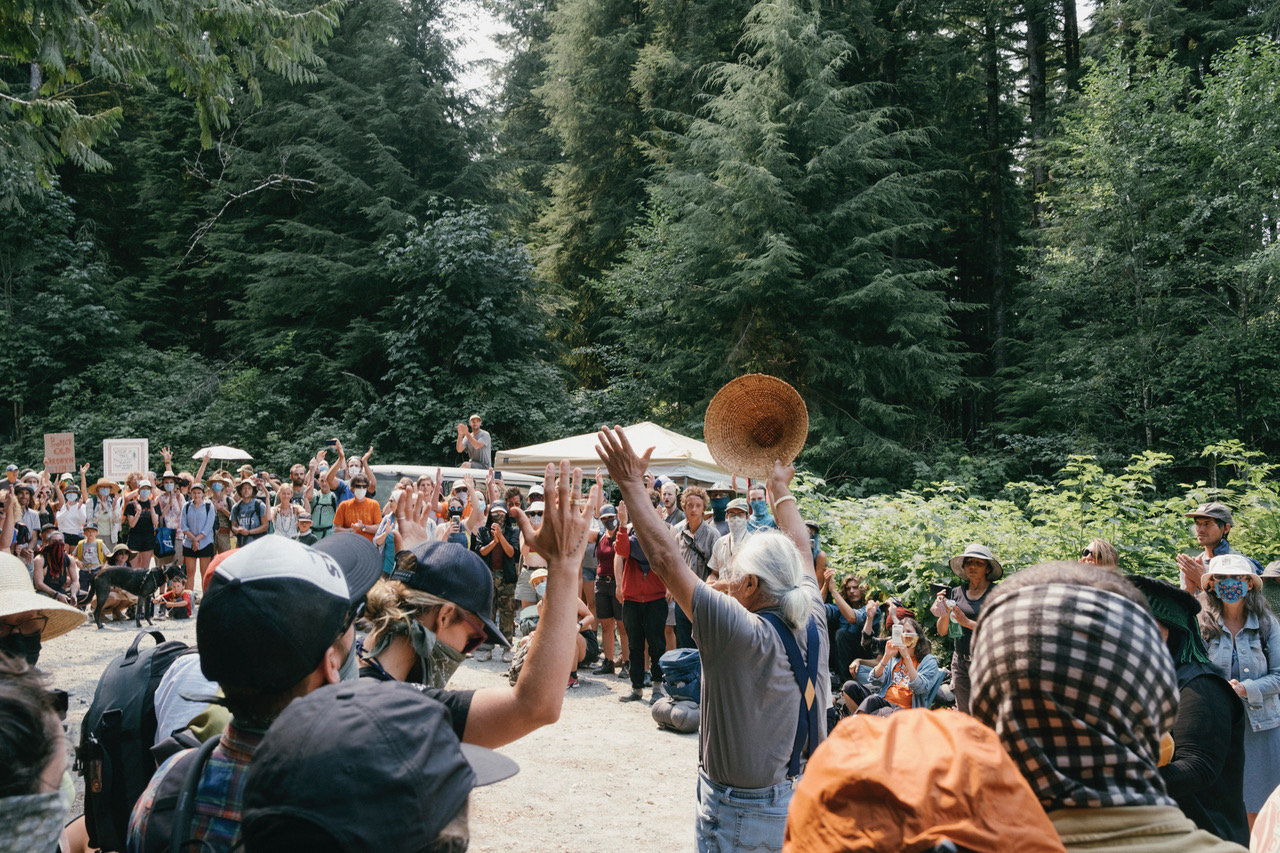
Initially I spent weekends on the mountain, getting a feel for camp. I spent time walking the lands of the Pacheedaht and Dididaht First Nation People, humbled that I had been welcomed by Elder Bill Jones and Hereditary Chief Victor Peters. I sat beneath ancient cedar trees- Grandmother and Grandfather tree up at a River Camp. I walked through mossy groves of lush old growth forest that was left intact along the river during previous logging operations. (The feeling of walking within untouched ancient old growth forest is comparable, I imagine, to the feeling of swimming in water for the first time. Sound, space and time all warp into an unfamiliar feeling. The beauty, balance, and biodiversity are simply too overwhelming to take in all at once).

)Two ancient cedar trees near River Camp at Fairy Creek.)

As I continued to visit on weekends, I could sense the movement was gaining momentum. Shortly thereafter an injunction was granted by the B.C. Supreme Court and on May 17th the RCMP began to forcibly remove land defenders and their supplies off the logging roads. It’s important to note that members of the Band Council did ask protestors to leave and agreed with the planned forestry operations, although, Hereditary Chief Victor Peters and Elder Bill Jones along with many other members of the community did not agree. Their views were ignored by our government and mainstream media.

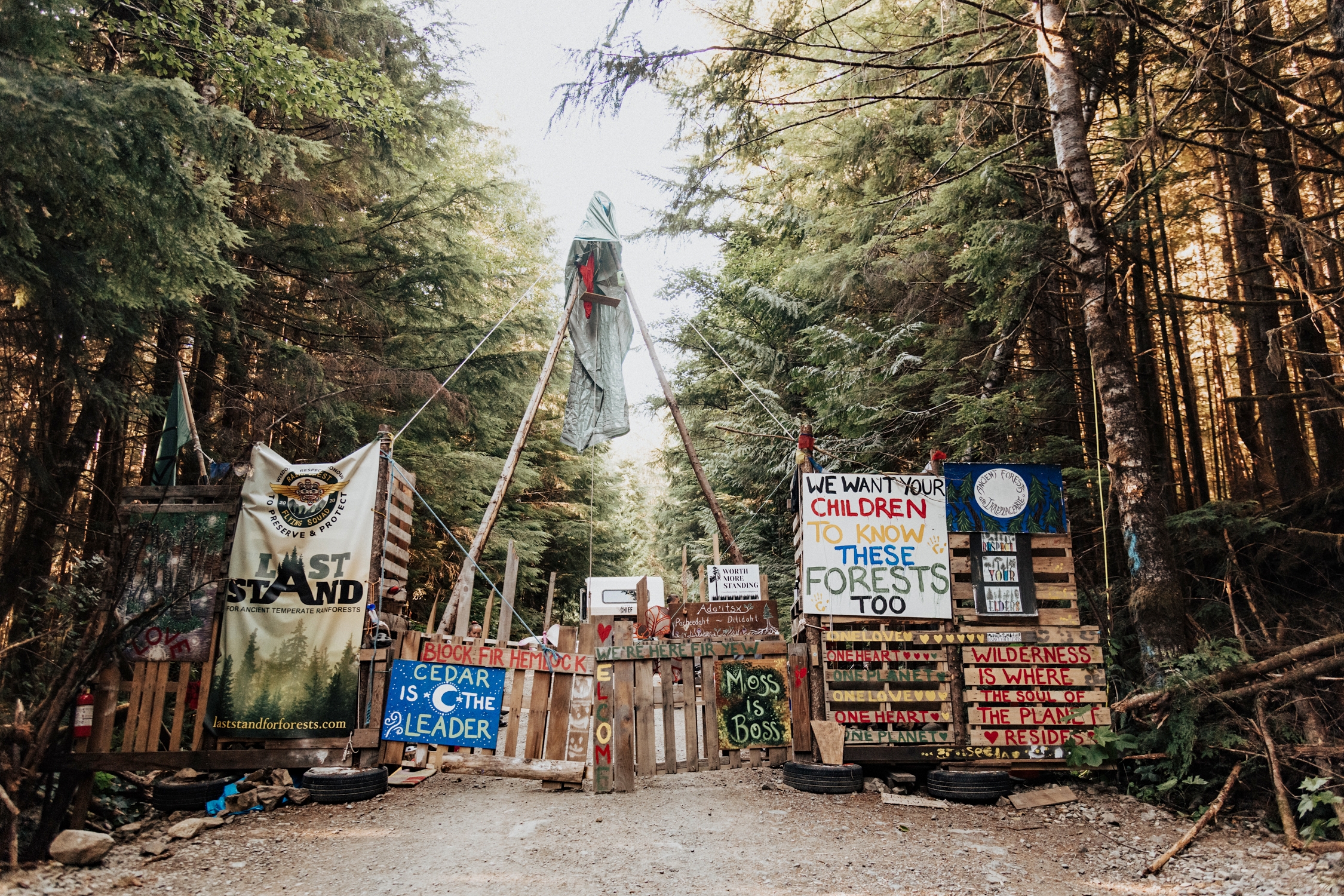
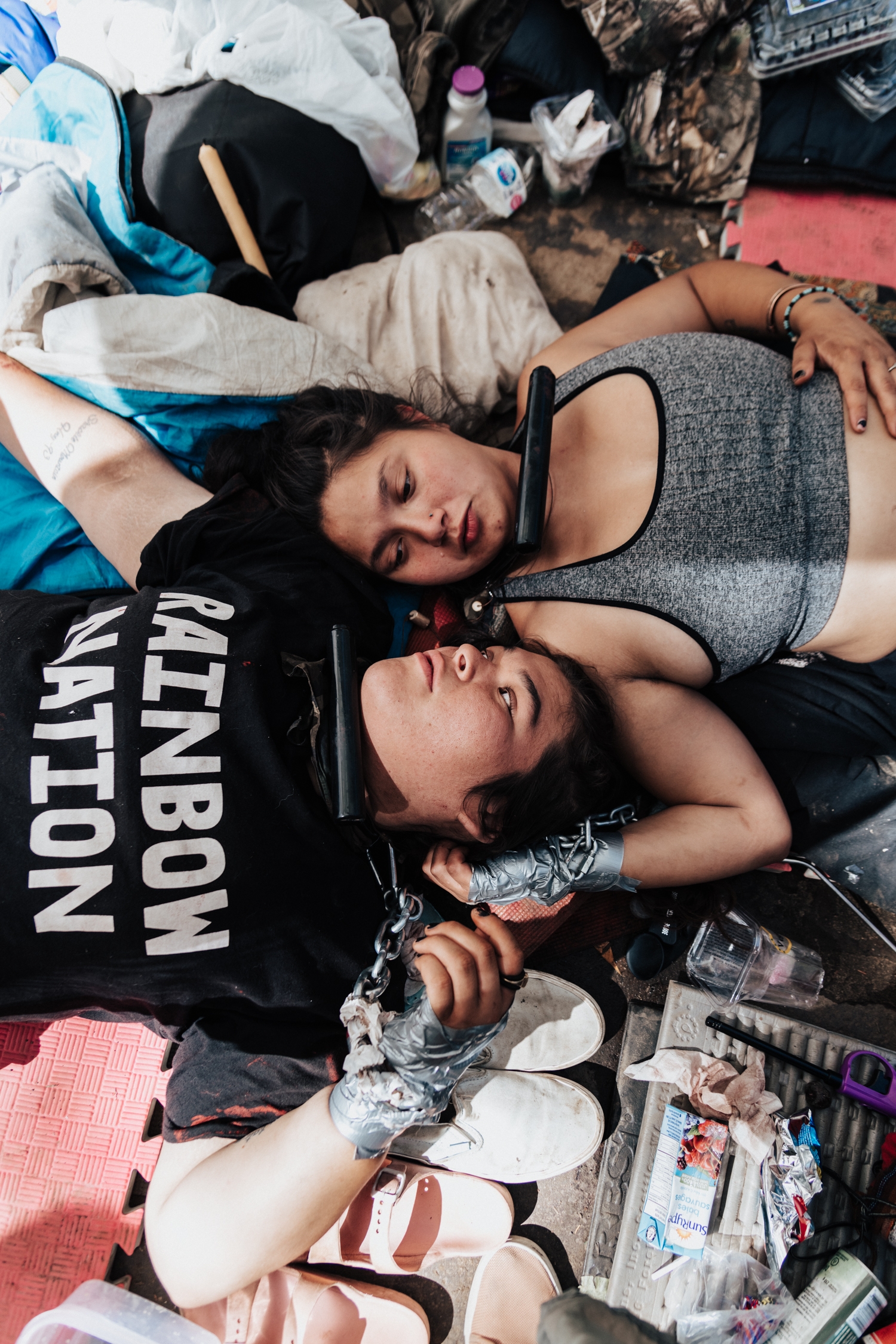
My first stint on the frontlines was a time in which I spent 5 nights up at Waterfall camp. It was an experience like no other. The nighttime missions, the pickaxes, the deep wells and complex hard block devices were all overwhelming to witness. Also, the intense pushes up the hill by the RCMP each morning and their nighttime patrols. I witnessed people chaining themselves into the land to block industry from accessing land deemed to be clear-cut, impeding industries perpetuation of the destruction of ancient eco-systems. The community shared in the knowing that once destroyed, via clear-cutting logging methods, the land would never be the same. No place for natural succession. Forests are planned, planted, and turned into farms. The biodiversity of the land lost forever.

In what ways are you experiencing effects of the ecosystem destruction?
Today the land in our Province is literally speaking. The fires, the floods, the mudslides. Atmospheric rivers and heat domes, unfortunately two frightening terms we’ve become acquainted with this year.

We know that old growth forests are great climate moderators, cooling the air when it is hot, warming it when it’s cold. Douglas Fir stands hold the capability of withstanding fire. Trees are incredible organisms that retain and circulate water while they work to stabilize and create soil. Old growth forests work as giant carbon sequestering machines while tirelessly and simultaneously manage to pump out rich oxygen for us to breath. Ancient old growth forests are also deeply connected to the cultures of many Indigenous Nations in our province. From their arts to their medicines. Also, histories are literally held within the ancient pathways and the culturally modified objects that can be found within old growth forests. Activist and friend from Haida Gwaii Lisa White shared these words with me back in 2018. “Our culture is very, very, dependant on healthy lands.”  Like the roots of the forest- land, language and culture are all deeply intertwined.
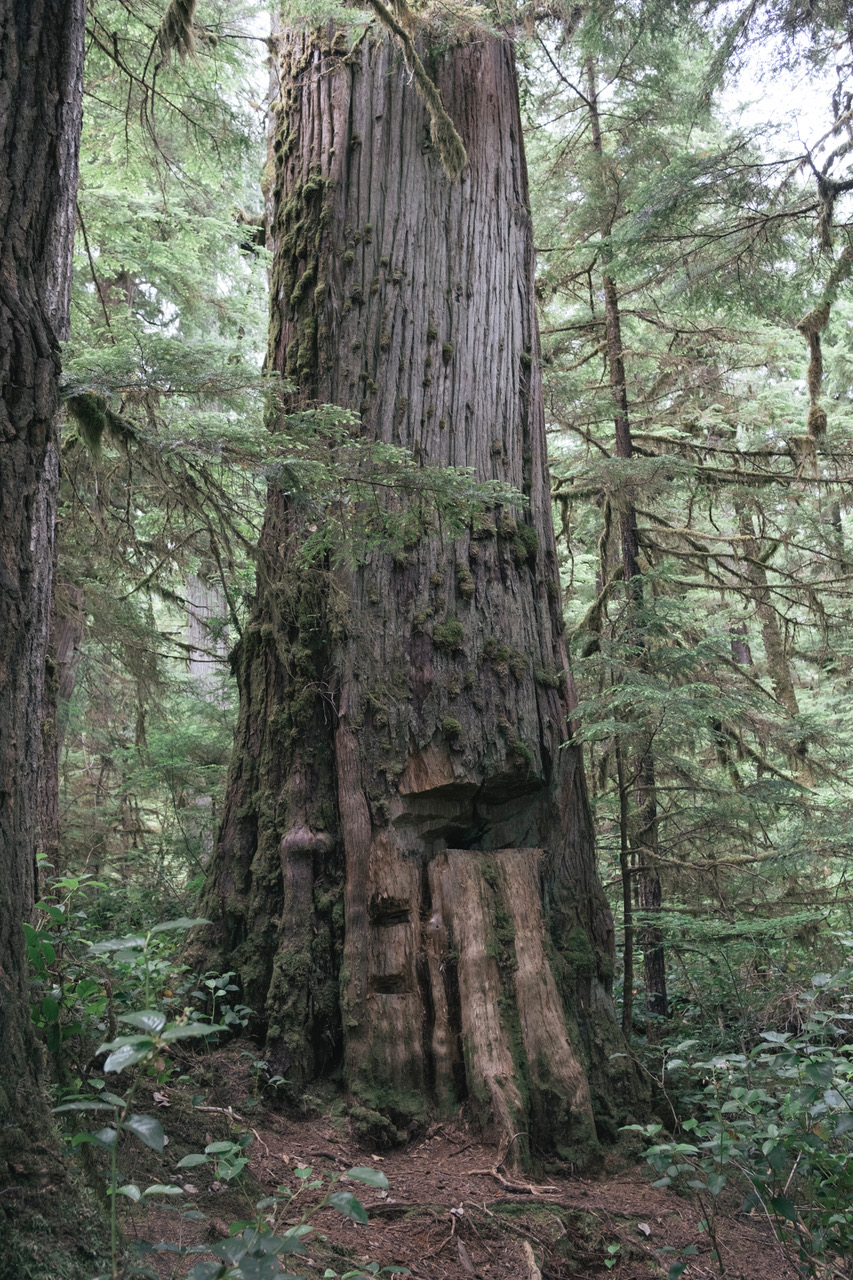
(A culturally modified tree or CMT in Haida Gwaii showing a test hole that was carved into a trunk of a standing ancient tree. Test holes were used traditionally to check if trees were rotten on the inside. A way of avoiding unnecessarily cutting down a tree.)

Joining a blockade is bold action. Why did you choose to participate this way?
I joined the stand at Fairy Creek to support the land and its biodiversity. As Rivers are being granted the same legal rights as human beings, I believe that our remaining Old Growth Forests should finally be afforded the same.

I joined the stand at Fairy Creek to support Elder Bill Jones, Chief Victor Peters, select members of the Pacheedaht First Nation and other individuals who wanted to join forces to stand up for the rights of Indigenous Peoples access to healthy lands and waters. It is time the government offers Nations, Inuit, and Metis, other means of economic gain. Means outside of resource extraction.

I joined the stand at Fairy Creek to do something useful with my time. To be a part of something greater within a wider community. To avoid complacency, comfort, and distraction. To take the feelings of overwhelm I was feeling and transform them into some sort of meaningful action. In my journal I wrote, “Uncertain of what else to do but travel to the Ancient Forests to congregate with like-minded humans.”

I joined the stand at Fairy Creek as a supporter of the movement and as a professional photographer. My camera, a tool that could capture both the light and dark. A tool that documented the hard work of a community that had a unified sense of purpose in protecting the forests and standing up for Indigenous rights while also documenting the violent actions of the RCMP and their escalating tactics while they enforced the injunction over time.
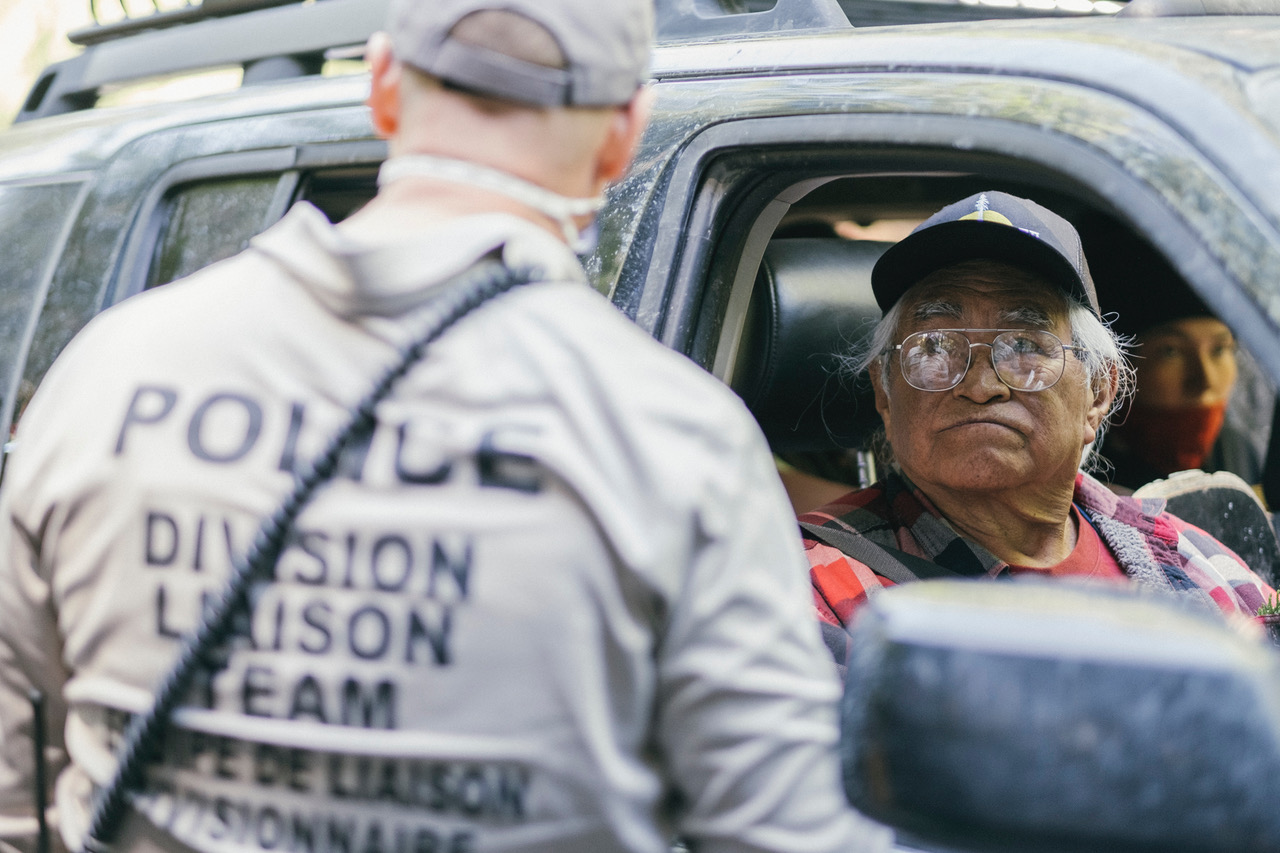
(Elder Bill Jones had to negotiate permission to enter his own territory at the RCMP exclusion line blocking the road to Waterfall Camp.)

In May I witnessed Elder Bill Jones and Chief Victor Peters having to negotiate the rights to access their own lands with the RCMP. This was just days after there was a discovery of 215 bodies of children found within the grounds of a former residential school in Kamloops which closed in 1969. (The last residential school in Canada closed in 1996, just 25 years ago). How was it that a respected Elder and Chief were being blocked from entering their own unceded lands? How did industry have so much power over the land? Where was the Reconciliation that our government has promised for so long?

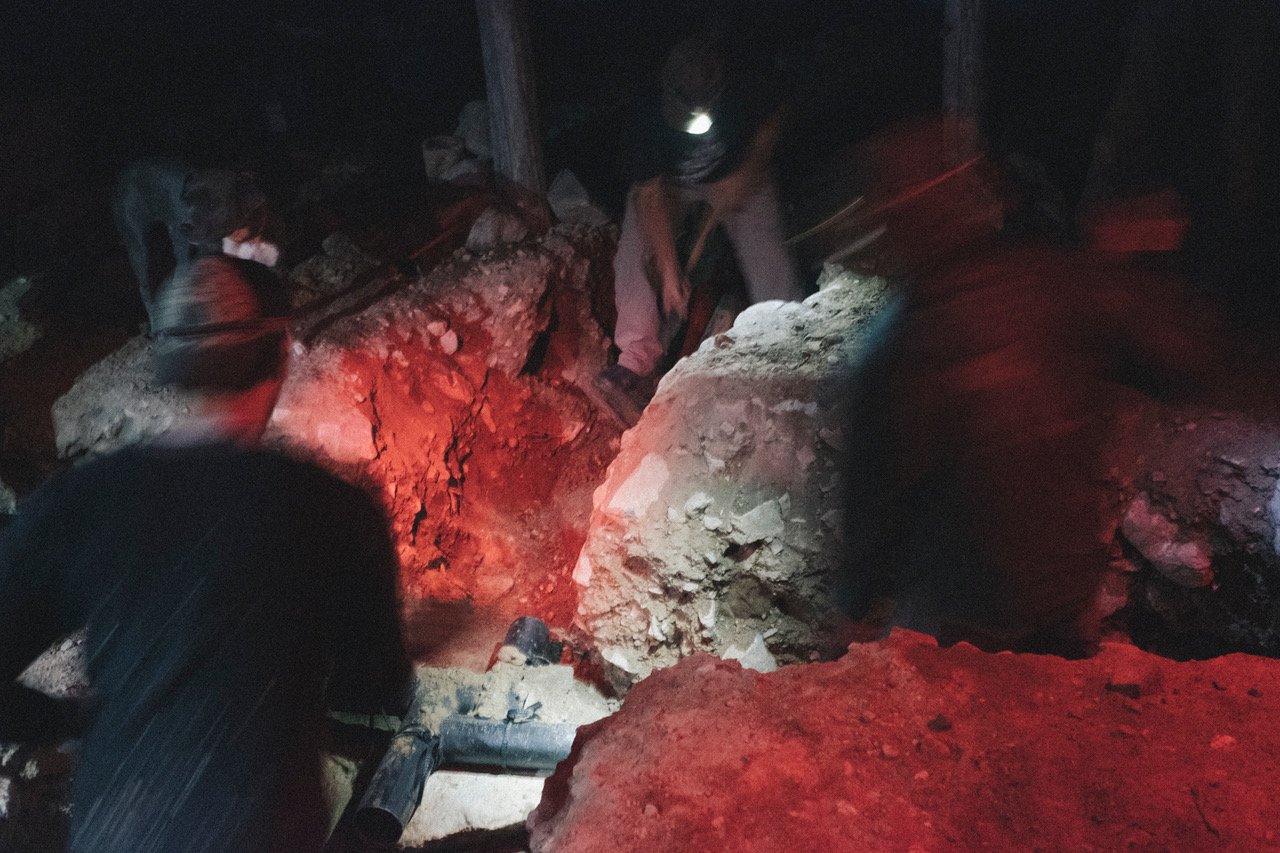
(Pictured here is Skunk in ‘The Well’. This is deepest hard block I have witnessed to date.)

(Front liners working through the night. This device created a 5-person hard block. An 80 year old man helped with the dig that night and also proudly took it upon himself to chain himself into it the next morning.)

It was recently published that 5 months of enforcement up at Fairy Creek cost the RCMP $3.7 million dollars.  But still, the heavy machinery and fancy equipment could not outsmart the creative human minds on the frontlines. It was in the middle of August when enforcement really took a turn- there was a shift in the teams and tactics that were utilized on the ground.

As we know peaceful protests can turn violent. Did you ever feel threatened or experience aggression here?
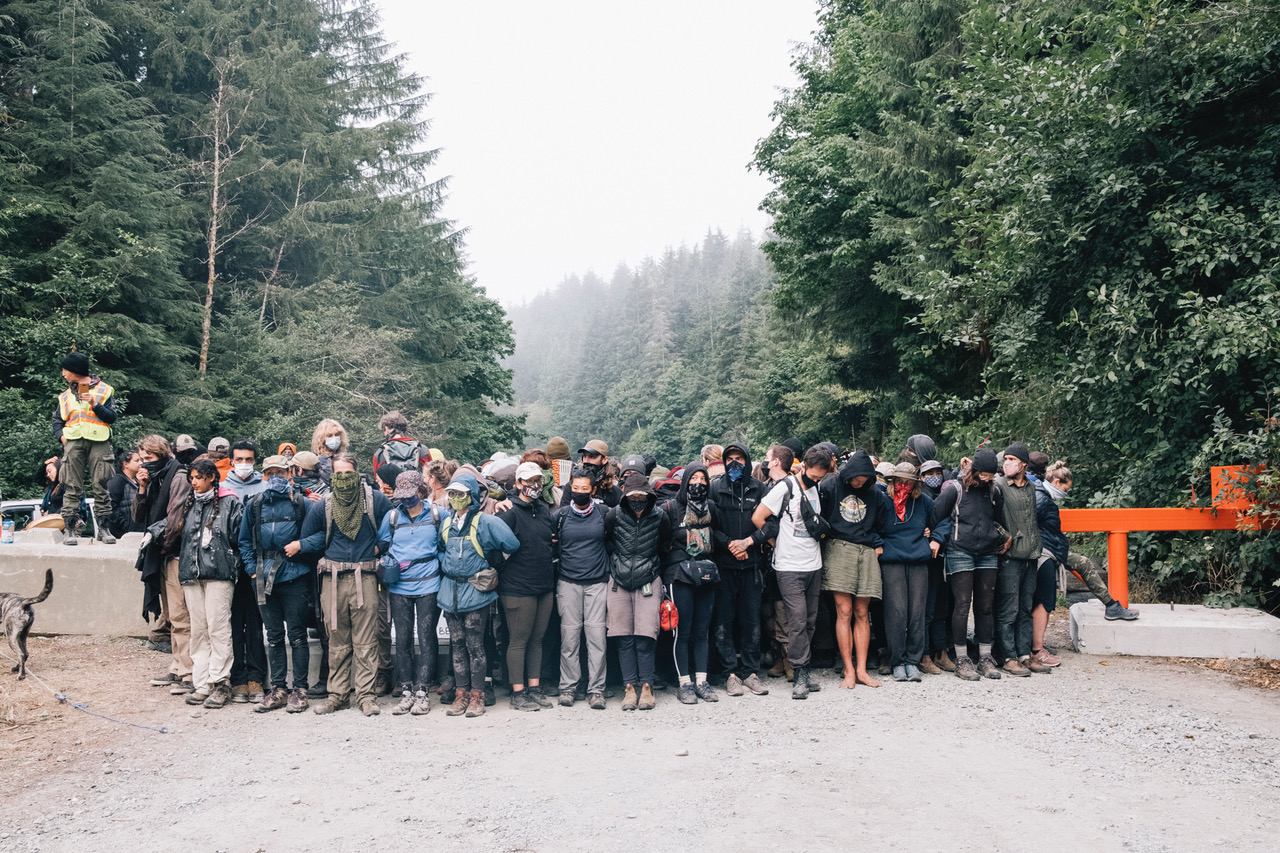
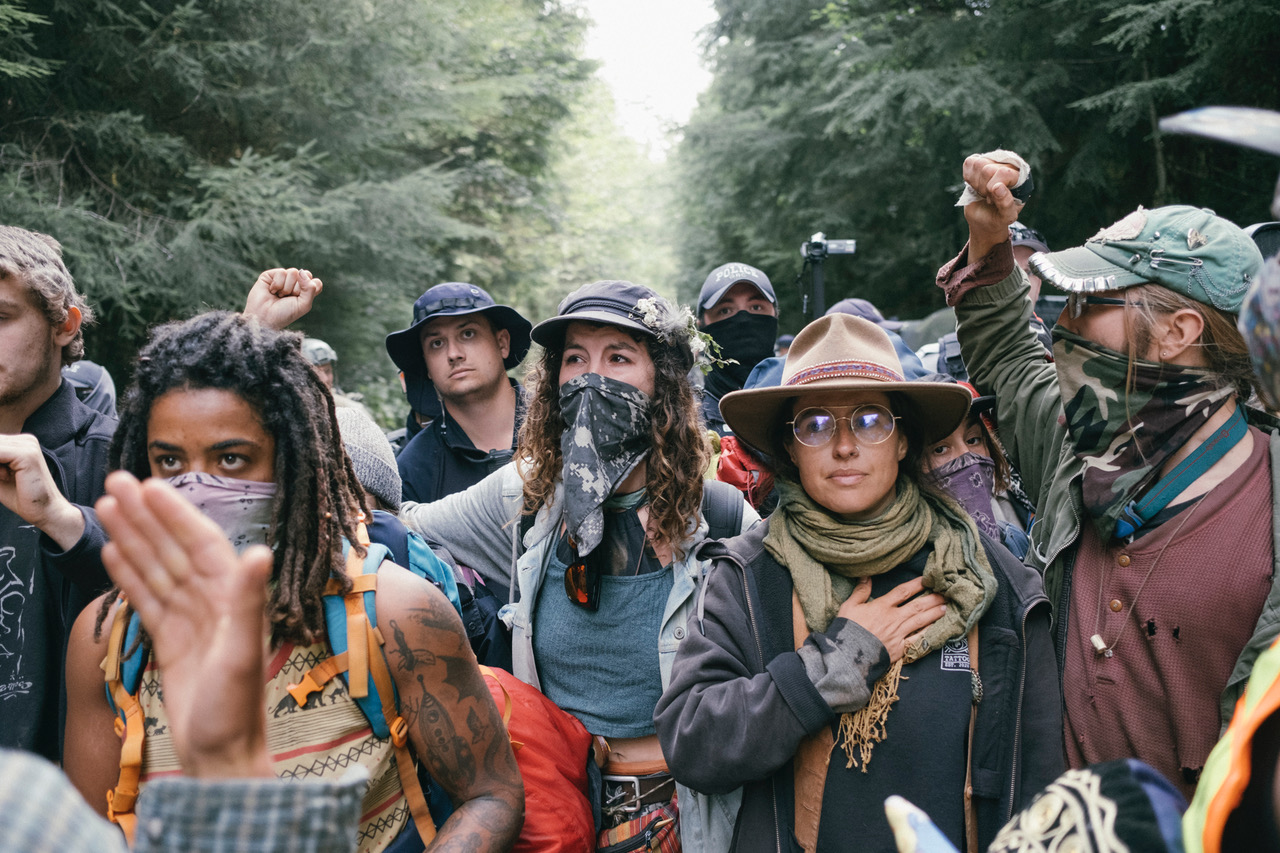
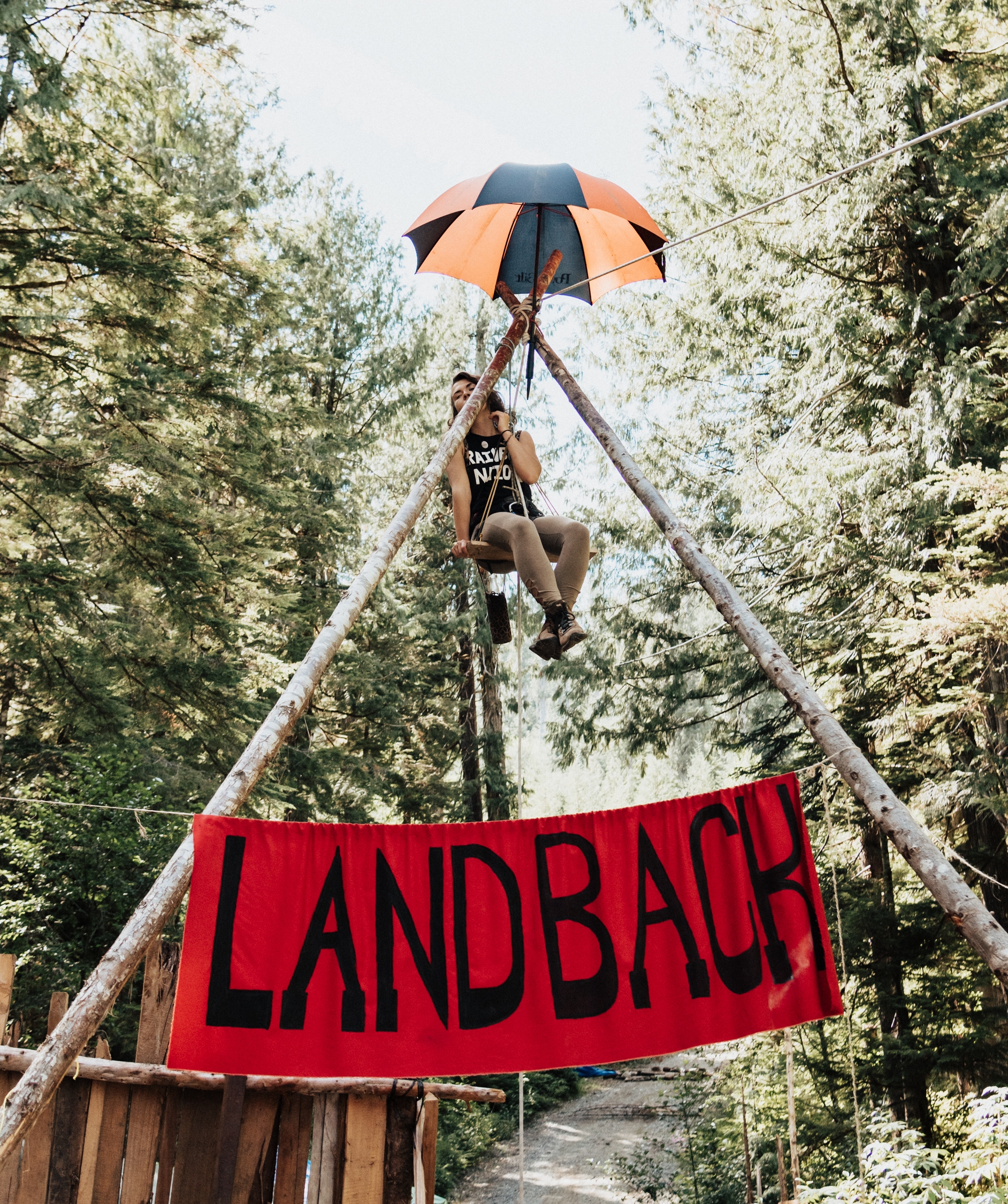
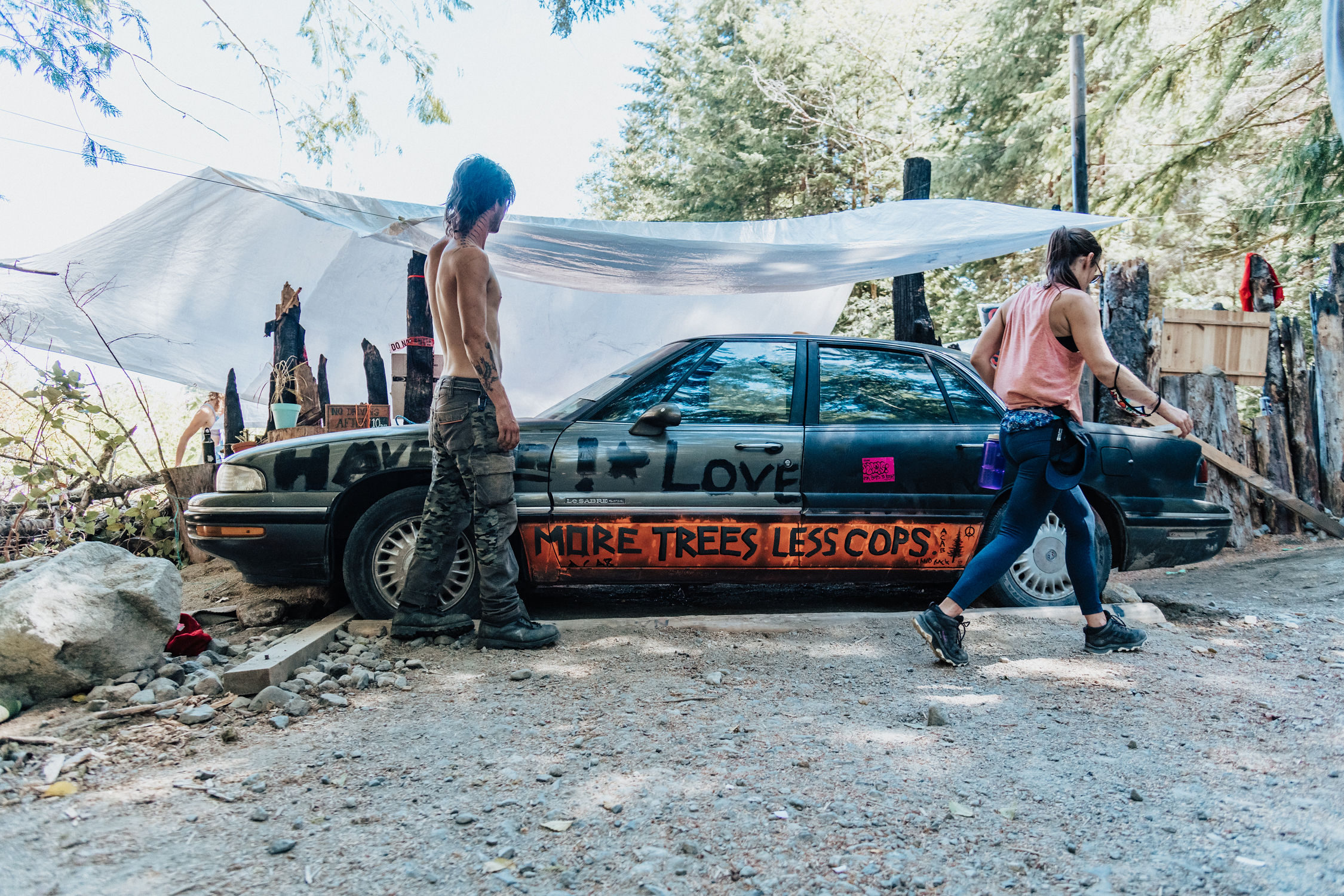
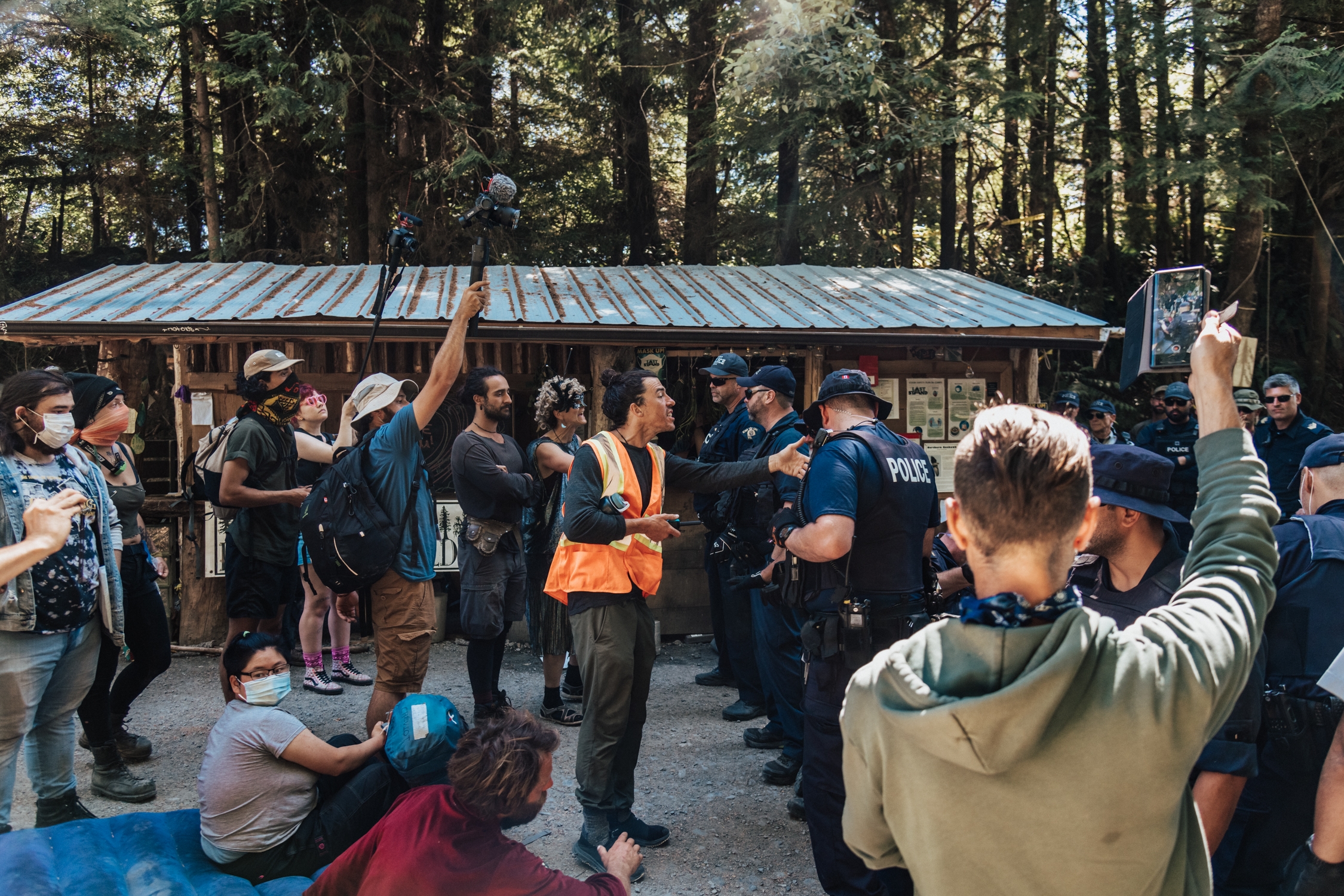
On August 19th and 20th I witnessed an extreme escalation in the violent behaviour that came from the RCMP and Paramilitary. They pushed and aggressively rushed land defenders on the frontlines of Fairy Creek back towards the very last stand at Camp Landback where Indigenous Matriarchs were stationed. The intense movement tripped up land defenders and they toppled on top of one another. The RCMP and Paramilitary officers took this opportunity to tear and drag individuals out of the crowd to make violent arrests, some of which were clearly targeted because they were BIPOC. The violence and aggression was unnecessary and unprovoked. During these two days I also witnessed media presence on the ground being denied access to document the RCMP’s operations. On the night of the 20th there were only a few hard blocks remaining.  On the morning of August 21st , RCMP enforcement was present at the front lines for a total 97 days, they were almost at the last hard block at River Camp which would clear the road for industry. The RCMP was desperate, especially given that the injunction was soon to expire. It was on this day that I again witnessed an unprovoked attack on a group of 60 protestors who were participating in their civil right to peacefully protest. This occurred after the movement in which land defenders enveloped a gate in the formation of a human blob.

What commenced from the side of the RCMP was excessive use of pepper spray and force. Meanwhile some of the land defenders were bare-foot. Others yelled out, why are you doing this? We aren’t doing anything wrong? I saw my friends in the crowd and I saw youth. I witnessed honourable humans putting their bodies on the line in hopes to create a more sustainable and ethical future for us all. There was no retaliation from the side of the protestors. One voice could be heard calling out, pull back, pull back. The group remained peaceful.
(Land defenders on the morning of August 21st 2021 just before being pepper sprayed and attacked by the RCMP.)(The intense push by the RCMP and Paramilitary on August 20th which led to violent arrests.)

The RCMP’s frustration in failing to remove land defenders in what was nearly 100 days of enforcement might have had something to do with the officers violent actions that commenced that day. The alternate option could have been to peacefully wait out the blob, but with being so close to the end of the line at Camp Landback I believe the decision was made out of desperation to clear the road.

With your intense experience and coverage what impacts do you hope your imagery will have?
I hope my photos will emote a sense of community and unification and inspire others to get involved in the experience of participating in meaningful action within their own communities. Experience is always more transformative than reading about other people’s experiences.

It’s difficult to know what to do with all the footage I gathered, I can’t help but feel a sense of urgency to share out and amplify the truth of what I’ve witnessed over the last 8 months. I was relieved to hear Patagonia was publishing a story about Fairy Creek. We are so infiltrated with media these days and it’s hard to know where stories will make the biggest impact. I felt grateful that Patagonia, with such a large following, is amplifying the truth of what is happening here on the Pacific Northwest Coast of Canada.

I also hope my photographs illuminate how Indigenous Communities are being treated by the RCMP and our government right here, right now in Canada. The government has recently claimed that there is no old growth logging taking place in Fairy Creek, a classic play on words to appease the public. Although a two-year moratorium has been placed on the inner portion of the watershed, logging all around the outer edge continues. For example, in an area where a friend and artist discovered a rare speckle-bellied lichen on a stand of ancient trees at Heli Camp is now gone, diminished to nothing but a clear-cut.  If we continue to turn a blind eye there will be nothing left for our future generations.

I’ll end with the words of Elder Bill Jones which he shared during a speech back in August. He said, “We will indeed tell all those who are in power that we are here, that we are standing for our old growth and that we will not back down.”

(Elder Bill Jones welcoming a crowd of his supporters.)


The Daily Edit – Fairy Creek: Agathe Bernard

Cree Land Defender Lady Chainsaw Lady Chainsaw, chained to another wheelchair on the river camp bridge ready to confront the RCMP. Her fierceness is contagious, arrested more than 60 times

The Cleanest Line: Dispatch from Fairy Creek

Photographer: Agathe Bernard

Heidi: Fairy Creek is located on the territory of the Pacheedaht Nation, RCMP began enforcement of an injunction to clear forest defenders out of the way of logging company Teal Jones. The battle to protect this area is still ongoing, what drew you to this protest?
Agathe: In all honesty, when things started intensifying at Fairy Creek, I was swamped. I was working on a film about a double amputee going to the paralympics, pushing for the Sinixt (some of the Columbia River indigenous) to retrieve the rights back to their territories and get their voice heard through another film. I was working on a massive coastal cleanup. I didn’t have a lot of personal time then. I felt very isolated from the pandemic and in need of some girl time and community connection. So when Marie-France texted me to join her and Leah and a few other girlfriends, I knew deep down I had to show up, for the ecosystem, for the forest who gave me so much peace and to connect with the girls.

There were several female activists in your images; of course, men were present but was there a sisterhood afoot?
Definitively! It’s actually quite fascinating how Fairy Creek gathered so many caring women. When the police force was so intense, knowing that we had each other and could take care of each other and laugh, sharing food or resources was an absolute force. These friendships are forever changed and so much stronger because we shared that experience together. Building community, in this case, a sisterhood around the things you love and care for, I think is the key to flight for environmental and human justice.

The violence against Indigenous women appears to be much more pervasive than publicly available data would indicate. This suspicion was confirmed in 2013, when the RCMP released a report revealing 1,181 cases of missing and/or murdered Indigenous women and girls. The 2015 update document now unavailable on the RCMP’s website added 19 female Aboriginal missing cases, for a total of 174 Aboriginal females missing for at least 30 days as of April 1, 2015.

Missing Murdered Indigenous Women MMIW is an essential and necessary movement that gives voice and raises awareness for mothers, daughters, sisters, wives and friends that have gone missing from reservations. What did you want your images to say and or how did making those photos hit you as a woman?
I was quite intimidated to take photos of these incredible indigenous women. Knowing how much they had been through and suffered and how hard it was for them to show up for their right in hopes of a better future for their daughters, sisters and grandchildren. That was a very humbling experience! In these images, I was trying to convey their fierce and strong nature, that enough is enough, and you just don’t mess with indigenous women, period. In each woman I could see a set of Russian dolls standing, lineage of generations standing into each woman and saying: “No more, we have had enough, and we will not put up with the abuse anymore”.

It was like drawing a clean line with the past, acknowledging the intergenerational trauma and choosing to end it at all cost. I still have shivers going through my body when I think of how I felt taking these photos. I still feel so much shame for our society to have allowed that to happen and so much anger when I look around and see how people keep ignoring the harm. Some photos will change you forever.


When you are in the forest, what type of energy or messages do you get from the trees?
The forest is hands down my favorite place to recalibrate. Bathing in big trees sparks my senses so much. I love observing the leaves unfolding and the sun sparkling through the branches, hearing the sounds of the wind passing through…I grew up playing in a forest every day and visited the big lumpy tree daily, wishing it well. That tree had motherly energy to it; it was comforting, safe, always there for me until they built the golf course. I still go by that same place when I go back East, and it’s sad now, endless rows of suburban houses that look all the same.

I was given my first film camera at seven, and the trees were the first thing I photographed. I feel like I still haven’t broken down the code to give them justice. I never thought of them as male or female; they are the perfect balance between standing solid and sturdy yet swaying with the wind and adapting beautifully like a gracious feminine dance. It’s the ideal mix between the feminine, caring quality of nurturing and community and the more individualistic strong male nature of pushing upward towards the light.

How has the environment and or the outdoors informed your work?
I grew up in nature between a forest, a river and a lake that was the city water reservoir. The environment was always everything for me. I was a little bit of a black sheep and felt quite lonely at times with all my passions and big dreams; nature was my safe place.

I was stealing my dad’s Handycam daily, wrapping it in my sweater on my way to school and making movies secretly. I stormed into the minister’s office at 13 with it and my concerns about pollution. I wanted answers because it didn’t make sense that we were polluting our planet with aerosols.

I brought one film to show my school. It was about the seal massacre in northern Quebec (my mom and sister had agreed to play the dead seal covered in ketchup). My parents were teachers, so they explained everything we saw: how the glaciers formed, the river flow, how everything evolved through time. I was raised with curiosity and a thirst to explore.

When I went to BC for the first time at 19th years old,  I felt like I didn’t deserve to be enjoying the mountains. I didn’t understand why there were volcanoes amongst the coastal mountains, so I went to do a geology degree. That was a first-hand experience in seeing the inside of “the industry” that didn’t feel good. When I graduated, I worked in Peru, and our team was kidnapped. That experience was eye-opening, I was so naive. Eventually, I went to work as an environmental scientist specializing in contaminated soil and water, knee-deep cleaning up the industry’s pollutants. Unfortunately, because I was on the front line there, my health took a hit. I went back to school to do a graduate certificate in environmental education and communication. I feel like I am finally finding where I belong, bridging science and storytelling to show up for what I think is the most important. An incredible editor (you) told me once “you can express those motherly caring and loving qualities towards the causes you care for” and that is how I have resolved my own life purpose. Hopefully, seeing my work published and creating tiny ripples of change has brought me to hope that love, perseverance, and trust can do anything.

What message do you hope to share?
The balance with our environment is very fragile. Ecosystems are getting affected to a level they may not be able to recover, and I hope to help people understand we need to take better care of our mother. We need to look after her rivers, bring salmon back, leave the glacier alone, forbid development that brings crowds of selfie sticks, have the cruise ships gone so that whales can communicate, and regenerative design systems that prevent single-use plastics, hold industry accountable for ghost net and contamination, to name a few solutions.

Healing our mother comes hand in hand with healing social justice issues and healing ourselves because consumerism is a bandage. How much do we really need? What if we gave back the love our mother gave us?

Follow
@fairycreekblockade@rainforestflyingsquad and @camplandback on Instagram, and visit facebook.com/FairyCreekBlockade for daily updates from the front lines.


The Daily Edit – Alex Farnum: Lina Prairie


Photographer: Alex Farnum

Heidi: Where is this artist based and is this a long term project?
Alex: Yes, great project and still on-going, in fact I’m working on a short film about Lina Prairie this week! She is an artist based in Point Reyes National Seashore. She collects kelp, bones, and other coastal artifacts, then uses the material to weave intricate baskets, wall hangings and other sculptures.

Was this a brand project or personal project?
Personal project.

Did you spend a day with her in the studio? Did you forage together?
I’ve spent multiple days with Lina in her studio and foraging along the coast. We are in the process of writing a monolog for the film and still have two more days of shooting together.

What was the art direction for the images?
I wanted to tell her story is a beautiful, cinematic and artistic way. Less doc style and more conceptual since her work is highly conceptual. The material she uses also has a life of its own and a beautiful all onto itself. It almost reminds me of lines in a midcentury drawing.

Your body of work ranges from stills to lifestyle, and portraits. How does one inform the other, or what is the common thread you are looking for in all three genres?
Good question – People, landscape, still life form a triangle to me. They are the language of the world and also the buckets that help me round out my stories. People and lifestyle is the humanity, still life helps the viewer understand the details of the story and the landscapes drive a sense of place. The landscape or environment is the cradle that holds it all together.


What have you been shooting more these days?

I’ve been shooting a lot of travel and hospitality lately. One project I did was for SENSEI, which is a new hotelier concentrating on full approach to wellness travel. The project is a great example of giving me the freedom to express my photographic style while being in-line with the clients needs.


The Daily Edit – Graeme Jennings: Time Magazine

TIME Magazine

Photographer: Graeme Jennings

Heidi: Did you know that image was being used for an editorial cover?
I was not aware of it until TIME tagged me on Instagram.

When you saw the composed cover, describe your reaction.
Delighted and very surprised. I have not been published on the cover of TIME before, so it was certainly great to see!

What was the original scenario around that image, before it was part of the getty collection? Was it the from the testimony before the House Judiciary Subcommittee on Antitrust, Commercial and Administrative Law?
Due to the pandemic, there are restrictions on the number of photographers who can photograph certain events at one time. There is a pool duty rotation on Capitol Hill that was put in place to accommodate this. I was on pool duty the day of the House Judiciary Subcommittee Hearing on Antitrust, Commercial and Administrative law. I knew ahead of time that it was a virtual hearing. As a prelude to this, I feel I should include a long back story…..

I have photographed Mark Zuckerberg before. In 2018 he came in person to Capitol Hill to testify before a joint hearing of the Senate Commerce and Judiciary Committees, about the use of Facebook data to target American voters during the 2016 election. I have photographed many important figures before, including the president, but I will admit that seeing Mark Zuckerberg in person had me just a tad star struck. Zuckerberg was wearing a perfectly tailored suit, he had a rather strange, generic haircut, perfectly manicured nails, and very pale skin. During this hearing, Twitter was going crazy with tweets. People were commenting on his somewhat robotic appearance. There was also a meme going around comparing Zuckerberg to the android character, Data, in Star Trek. All of this sparked my interest in him further.

After seeing all the reactions on social media, I started to think about a film I saw as a kid in the early 90s called The Lawnmower Man. It’s a movie about an experiment on a man to enhance his intelligence through virtual reality. The experiment goes wrong, and he becomes completely obsessed with evolving into an electronic being. I wasn’t quite sure what to make of Zuckerberg in the flesh, but I was starting to think of him as someone who exists in digital form, in a sort of electronic ether. Or as Zuckerberg himself has referred to it as the “metaverse”. Essentially a virtual reality world where people would interact just as they do in real life.

All of this brings me back to that hearing where Zuckerberg was in attendance via video. A virtual hearing. I saw Zuckerberg’s face on the multiple tv screens in the room, flickering, pixelated, flat against a plain white background. It made perfect sense. During the hearing I took many pictures on the large screens, including one of Zuckerberg on a screen in front of the dias where the members of Congress sit. This picture was used the following day by The Washington Post and The New York Times.

How did you start your photo journalistic career and why an interest towards post conflict societies and reconstruction?
I started my career back in my home country of New Zealand. After finishing college, I worked freelance and was part of a book project about New Zealand going into the new millennium. I later moved to the UK where I continued to freelance. I worked with NGOs in Russia and the former Yugoslavia. My interest in post conflict areas began as a young college student where I took an interest in the work of many photographers such as Don McMullin, Ron Haviv, and Susan Meiselas. I also looked at images in magazines such as TIME, from the war in Bosnia and later Kosovo. I wanted to see these places myself and was curious what was happening in these parts of the world after the news media had left.

Do you remember your first assignment or when you knew this was the kind of work, you’d dedicate yourself to?
When I was in college, I spent time reading about these places that I would later go on to document – post conflict societies such as Azerbaijan, Chechnya, and Bosnia.

Once I moved to the United States, I started to transition into covering politics and daily news in Washington D.C and other part of the U.S.

How long have you been at the Washington Examiner? 
I’ve been staff with the Washington Examiner since 2011. I also work with other corporate and news clients. I cover Capitol Hill regularly. Coming from New Zealand, a relatively quiet place politically, covering American politics over the last 10 years has been a chaotic whirlwind for me. In recent years, I have become more and more interested in portraiture.  I draw my influences from various fields – television and cinema, pictorialism, chiaroscuro art, many, many photojournalists, and well-known portrait greats such as August Sander, Diane Arbus, and Yousuf Karsh.

The Daily Edit – BIPOC Photo Mentorship Program


Janice Reid (Mentors: Wade Hudson and Kristin Sjaarda)
Marc Santos @marcsantosphoto (Mentor: Steph Martyniuk)

Sumi Siddiqa @sumisiddiqa (Mentor: Mark Binks)

Sumi Siddiqa @sumisiddiqa (Mentor: Mark Binks)

BIPOC Photo Mentorship Program

Founder: Heather Morton

Heidi: How did this idea come about?
Heather: The idea originated from a conversation I had with Toronto photographer and long-time mentorship advocate May Truong in the summer of 2020. She had just offered a residency for emerging BIPOC/LGBTQ BIPOC photographers and had an overwhelming response – over 50 applications in the first 48 hours. So there was clearly a tremendous need for these opportunities, while at the same time, there was growing awareness in the industry of the layers of systematic inequality and barriers to entry faced by young racialized photographers. I tested the waters by approaching my local contacts in the community and the response was super positive so BPM was launched.

How do the relationships work; what are the expectations?
BPM is simply one big, evolving list of mentorship opportunities; we don’t “accept” mentors or provide a structure. Rather, we encourage any type of engagement that works for the mentor – it might be one phone call a month or it might be occasional visits to set. Some of our mentors have even formed small critique groups with multiple mentees that regularly share work and feedback. Many participants have likened the program to a type of photo-making therapy, but mentees and mentors are on their own to make sure that the offering fits the need and vice versa. So it’s simple – on both sides we expect the mentor and the mentee to communicate their own expectations and then commit to the relationship and the mentorship agreement that they make with each other. BPM has a very basic structure with lots of individual agency on the part of both mentors and mentees to do the research, decide what works best for them, and to act on it.

Having said that, our website and networks have been able to provide additional supports – we provide lists of best practices, and we have a resource section on our site as well as a growing suite of opportunities (outside of the mentorship itself) for our mentees. For example, the mentees have a Slack channel which they use to organize their own critique groups and share opportunities.

Where does the work get published?
At this point, we’ve only occasionally highlighted mentee participants on our Instagram feed, but in the future, we are exploring partnerships with publications to share the work much more broadly. We have an ongoing relationship with Gallery 44 in Toronto who have generously offered free memberships and access to studios and gear to our Toronto-based participants. So there are lots of opportunities in the works but, being very grassroots, our ability to actualize the interest we’ve garnered takes time.

How do people get involved?
It’s simple – both mentors and mentees just need to fill out a short survey on our website. The mentors are asked for a few details about their practice and their offering; the answers to the survey questions become their listing. The mentee survey basically “registers” them so that we can continue to communicate directly about other opportunities that come our way. But to secure a mentorship, a would-be mentee just needs to go to our site, peruse the list, and then reach out directly to the mentor that they are interested in. And so it’s a very fluid list – opportunities get filled up and new mentorships are added regularly.

What gap is this filling and how successful has it been?
Our program has been tremendously successful – in the last 12 months, we’ve offered over 190 mentorship positions with over 90 mentors! Though most of our mentees come from Canada and the US, we are truly international, and have participants from Brazil, Australia, Sudan, India, etc. There are no geographic boundaries for participation, so our mentors also come from North America and further afield.

We know there is a lot of willingness to support emerging BIPOC photographers who might be existing outside of a more “typical” photo career trajectory – many of our mentees haven’t studied photography and may not live in an area with a thriving industry or photo scene. Additionally, we have mentees who have faced real racialized barriers to their participation in the industry. So we are open to whatever a photographer (or photo editor, curator, photo producer etc.) have to offer – even an hour phone call once a month can offer a huge amount of moral support and real concrete advice to an emerging photographer.

And the response from participants has been amazing.
Here are a few quotes (more on our Instagram):

“I never had the chance to assist EVER before and I’m happy through this program that I’m able to gain this experience”.

“It’s definitely really helpful to be able to turn to someone who is willing to share their experiences, learnings, and resources simply to help you thrive as a creative.”

“[My mentor] has really encouraged me and my ideas, while letting me do things at my own pace at the same time. Because of this mentorship, I have started to take my practice as an artist a lot more seriously.”

“From building strong concepts to creating a book, this mentorship ultimately ended up being a way for me to become more confident in myself as a photographer by challenging myself, and dealing with expectations regarding my work, through the many resources that [my mentor] has shared with me”.

“From lengthy analytical discussions on technical and artistic abilities to in-person collaborations, I have learned so much invaluable information in a short period of time”.

“It’s very liberating to ask questions freely and without judgement, and to be assured that someone has most likely had the same questions or faced similar obstacles as you at some point in their career”.

There are quite a few collectives that have formed in the last few years, what makes this program different?
The major difference is that there is no barrier to participation. Any amount of experience in the industry is welcome (and disclosed of course – some of our mentors are newly-emerged themselves but know the difficulties a racialized photographer might face when just starting out), and all areas of photographic practice are represented. Plus, as I’ve said above, we do not pair up mentors and mentees, we merely facilitate the match by amplifying the offering. BPM is a clearinghouse of opportunities with no restrictions to what is offered or what is accepted; it has been a very powerful way to galvanize nascent opportunity and share it. This makes us quite different than the more structured, curated, and competitive mentorship programs.

To see the list and for more information, please visit

@bipocphotomentorship
You can join as a mentor here. If you’d like to register as a mentee, please click here

The Daily Edit – Cubaseen


Cover Photography by Tynan Daniels

Photograph by Donna Kross

Photo Essay by Luidmila and Nelson Ramirez de Arellano Conde
Photo Essay by Arien Chang Castán

Photograph by Debra Wells (Left) and Sandor Rodriguez Castro (Right)

CubaSeen

Co Founder and Publishers: Jennifer Spelman and Andrew Child

Heidi: How did this idea come about, did the pandemic have an influence?
Jennifer: After travel came to a sharp halt I started teaching online courses with Santa Fe. One was on creating Zines – lots of fun to deep dive into projects, sequencing and designing after so many years just focusing on capturing images.  Somewhere mid-pandemic a friend and fellow photographer, Andrew Child approached me with an idea of co-publishing a zine showcasing Cuban and US photographers together on one platform.

Why Cuba?
Cuba is a place it’s hard to visit and not genuinely get attached to the people.  It’s also a place it’s hard to understand through simple news headlines.  It’s culture is layered in complexity, due to both politics and isolationism.  We appreciate the strong commitment to the arts and music Cuba has always held.  Our magazine is trying to provide a deeper lens into the happenings on the island and testing whether art and written words can actually help broaden perspectives.  There are countless photos of Cuba sitting idle on the hard drives of talented photographers who have visited the country through people-to-people and support of the Cuban people programs.  We provide a unique platform to share those photos and pair them with the work of Cuban photographers in a way that is thoughtful, creative, and exposes truths about both our cultures.

Is there any call to action for the magazine?
CubaSeen exists at the intersection of both U.S. and Cuban governments recognizing the value of artists connecting across national boundaries. Distribution includes key members of the U.S. Congress and Biden Administration foreign policy officials.  “We’re not political but we do want decision makers in Washington to understand the value of people-to-people interactions between artists during this time of strained relations between the U.S. and Cuba. CubaSeen is not just about beautiful photography, it’s about people forming friendships, the cross pollination of creative ideas, and debunking the myths we hold about each other in both countries.”  Andrew Child

We are hopeful people will share the magazine with friends and fellow photographers and that our magazine can achieve what news headlines are often unable to do – giving a face to the people. Our distribution also includes a range of galleries and curators within the art world in hopes that the exposure will lead to other exhibits and more traction for the artists collectively.

How did you spread the word for call in to entries in both countries?
So far everything has been by word of mouth and social media.  We’ve reached out to photographers from Cuba and the US for entries and all have been eager to participate.  We’re encouraged by the range of visual voices – from amateurs to professionals.  We’ve now started getting submissions from all over the world and are excited by the depth in perspectives.  It’s fun to see the difference in work that comes from outsiders looking into Cuba and insiders looking out from Cuba.

Are you creating diptychs with US based images and Cuban images? 
We put a lot of focus into crafting the most dynamic page spreads we can – creating unexpected relationships and challenging juxtapositions between images.  We understand that the meaning of an image can be influenced by what image it appears next to it and are enjoying editing the work to create these types of pairings.  We are letting the imagery drive these relationships – sometimes they are between a Cuban and US photographer, sometimes two Cubans, sometimes work from photographers in other parts of the world. Andrew shared with me, “I see  reactions from people who have not been to Cuba, I get the sense that those pairings and juxtapositions which Jennifer describes still resonate. The subject is always Cuba, but there’s plenty in the zine for anyone who just appreciates great photography.”

What are the themes based on?
The themes are meant to encourage imagery beyond the standard cliches of Cuba.  Our first theme of LAYERS was a tribute to the long history of powerful street photography in Cuba and the complex cultural layers within the island.  Our next theme of PERSONAS was meant to amplify and personify the voices of the people of Cuba during a summer of incredible internal and external political unrest.  Our current theme of “UNEXPECTED CUBA” is about celebrating the moments that delight, surprise and endear us to the island.  We are excited to see what kind of photographs it yields.

It’s so inspiring to see all these collectives popping up.
We agree-it’s been beyond cool to see the cooperative endeavors that came out of us all having a little time to slow down and actually talk about ideas together.  The very best part of CubaSeen has been working together with the most dynamic team Andrew and I could assemble.  We have a copy editor/translator who brings extensive experience in publication, two Cuban designers who’ve helped craft the CubaSeen brand and weave the Cuban aesthetic into each page and a dynamic Cuban writer and US writer.  Those folks combined with each of our rotating photo essayists and the over 100 photographers who’ve submitted work to each issue creates a synergy of visual thoughts far beyond what any individual perspective could do.  Many times throughout the last year Andrew and I have remarked on the collaborative part of CubaSeen being the most fun and powerful part of the project.

Our next call for entries is on “Unexpected Cuba” and submissions are due by November 9th.  Anything we can do to encourage submissions from folks who have visited Cuba would be great – https://cubaseen.com/submissions-03/

The Daily Edit – Artist Management Association


Artist Management Association

AMA President: Kelly Montez
AMA Director at Large: Carol LeFlufy

Heidi: The forced repose of the pandemic allowed us to take a collective pause and access our present and hopes for the future. How much did the hard costs of the pandemic overhead come into play for this, or was it simply a matter of time and space to think?
Kelly and Carol: The idea of the AMA was a conversation that had taken place within the industry for years. Many different groups of artists representatives, on both coasts,would come together and discuss the need for a trade organization for our industry, but it was always difficult to get off the ground considering how hectic a typical work week had become. The silver lining of the pandemic was the opportunity to have the time and space for a few of us to really focus on the administrative aspect of developing a trade org. Those of us who could commit the time began to gather over zoom and discuss what the future held for our business and dig into the ground work of creating the organization.

What inspired this group to mobilize? Did the momentum of youth activism and the future of our photo industry sustainability come into play?
The economic recession of 2008 greatly affected our industry. We all saw significant economic pressure on our businesses, as longer hours, higher shot counts and  broader rights became the expectation of clients. An organic group formed from the west and east coasts, sharing the fears of a repeat from that time period as well as a discussion as to how these new trends weren’t sustainable for our business.

The events of the social justice movement during the summer of 2020 definitely inspired us to look at the lack of diversity within our industry as well. One of our intentions is to create industry standards for the next generation of agents and photographers, which will help those who are most marginalized. We have a diversity committee working towards connecting underrepresented talent with artist managers to increase representation within the industry.

Our hope is to also bring the conversation of sustainability forward in our industry. Part of our goal is to create educational initiatives around sustainability so that we are providing our members and partners with resources that can help them run “greener” productions. To that end, we have a webinar on sustainability in the planning stages.

How many new, younger agents are entering the market?
We see that many new agents are entering our business and the AMA can really help them build their business on a strong foundation. We have many shared legal resources; from terms & conditions to NDA’s, as well as a usage glossary and definitions for common legal language found in contracts. It’s a great resource that can help launch a business.

WIth new media developing, how has the rights and usage flexed and before AMA? 
The AMA has developed a usage Glossary to help define existing and emerging media. While we can’t give direction on pricing, we can offer the industry education around developing media that will allow for informed estimating by artists agents.

Has there been any one governing body formed prior to this?
SPAR (Society of Photographers and Artist Representatives) was one organization that existed. The APA and the ASMP have helped our industry greatly. Our main reference for the work the AMA is developing is the Association of Independent Commercial Producers (AICP). As we developed the National Guidelines for Photo Production, we found alignment with the AICP, which also helps our clients since these are the standards offered by our live action counterparts.

With budgets changing, more people are being asked to take on more than one role. This “omni role” forfeits expertise in one given area, have you seen a shift in the who and how images are being assigned value?
Yes we are seeing budgets changing in terms of fees, rights and expenses. New common occurrence is the all in budget which compromise production values as well as artists’ worth.

One other alarming trend is around payment schedules. Artists agents and photographers are small businesses and are being asked to carry large production debt while we wait for payment for 90-120 days, as well as advances that come post shoot. We’re working to educate our clients on why that is such a hardship and provide templates for payment models that are more in line with the standard in the live action world.

The elephant in the room is the tsunami of imagery available and its consumption rate. This creates an erosion of value.
While there is a plethora of imagery available, from influencers to iphone photos, there is still a need for that subset of professional photographers that can make truly iconic imagery. Valuing their talent and the work (and crews) involved in that process is our focus.

For many years the internet and social media was considered a bit of a throw away, but now paid digital campaigns are the main form of advertising and amazing imagery is needed to break through this clutter. Additionally, Social media can often become the new catalog of retail sales, with click to buy offers embedded in the posts. Through education we are trying to change the mindset of “it’s just digital” and also awareness that you can’t just repost an image – that can equate to the illegal use of imagery.

How are you trying to educate and empower art buyers to create guidelines and best practices?
The AMA has created the National Guidelines for Photo Production. Since the 1970’s, the AICP has been setting standards for the live action production industry. While many of us adhere to those, there are unique differences between live action and photo production. The AMA’s guidelines address those differences as well as areas of alignment with the AICP.  These guidelines were created to support, educate and advocate for the interests of our members in the photo production industry.

The AMA developed a Usage Glossary which is a collection of terms and their definitions. The glossary is provided as an educational resource for our members and their clients to better define the terms commonly used,and assist agents in negotiating on behalf of their artists. The glossary outlines the standard understanding within the industry, and as new types of media enter the market, it can help to provide clarity within the bidding process.

There are also a variety of shared legal resources available to our members, such as templates for Terms & Conditions, a Mutual NDA and other confidentiality agreements. Each of which can be customized to serve the nature of the representative and their artist’s production, but gives them a strong foundation from which to start.

We are also in the process of developing a Universal Bid Form to serve as a platform for bidding. While the AMA can’t advise on pricing, it does create standards for categories that can be utilized when bidding. It’s up to the individual member to set prices for their services.

How can we retain/create value in the practice of creating and buying photography?
We’re hoping to educate our community that photography lives on many different revenue generating platforms. Agreeing to broad licenses or rights buyout for current or future media can do a disservice to how an image is valued. Through education on the various types of usage rights and partnering with our buyers on the agency and client sides, we hope to protect our artists’ work and change the conversation.

What are your hopes for the group?
Unlike the commercial production industry, which set standards years ago, the lack of leadership in our sector of the visual arts industry has led to individual terms & conditions and a lack of standards that has resulted in inconsistent business practices across our industry. With the emergence of new media platforms; the integration of stills and motion; and lack of standards around payment terms, image usage and copyright; our hope is that the AMA will play an optimal role in advancing the interests of its members, building a solid framework of best business practices and promoting expansion of the industry for years to come.

Where can I sign up and get involved? https://www.artistmanagementassociation.org/