Silver represents a new breed of journalist who can pick and choose where to work, and who can move at will when someone makes a better offer. This isn’t about being a freelancer. It’s about creating a platform and then connecting that platform to whichever partner you like.
The assignments were far from glamorous
“The manager of Pizza Hut shaking hands with a prize college athlete: I did that sort of thing for 10 years” – but she scraped a living from them and nurtured more experimental work on the side. Then came an exhibition, a book called Second Sight, and fellowships from the Guggenheim Foundation and National Endowment for the Arts.
via Sally Mann: The naked and the dead | Art and design | The Guardian.
Art Producers Speak: Hollis Bennett
We emailed Art Buyers and Art Producers around the world asking them to submit names of established photographers who were keeping it fresh and up-and-comers who they are keeping their eye on. If you are an Art Buyer/Producer or an Art Director at an agency and want to submit a photographer anonymously for this column email: Suzanne.sease@verizon.net
Anonymous Art Director: I nominate: Hollis Bennett. Hollis is a well-established and up & coming shooter in Nashville TN. I’d say he’s fresh, but oftentimes he’s straight off the grubby rugby pitch or an international flight from a less than sanitary destination and is a little less–fresh. But Hollis has a no-doubt knack at portraiture that just mesmerizes me.


How many years have you been in business?
I’ve been shooting for about 3 years now. Prior to being behind the camera I came up through the ranks as PA, 1st assistant, digi tech, retoucher, etc.
Are you self-taught or photography school taught?
I have a degree from an art school that will remain nameless so, technically, Im school taught but really it was all self taught and learning on the fly.
Who was your greatest influence that inspired you to get into this business?
I really find the work of Dan Winters and Andy Anderson to continue to push me and challenge me. Jack Spencer really taught me the power of narrative and digging deeper. As for a specific time/place/photo that pushed me towards photography, I couldn’t tell you.
How do you find your inspiration to be so fresh, push the envelope, stay true to yourself so that creative folks are noticing you and hiring you?
I hold dear the idea that no ‘photo’ can ever happen more than once, so you need to be out there with your eyes wide open and mind receptive to all sorts of influences. Understanding and interpreting all that stimulus is another story and therein lies the biggest challenge.
Do you find that some creatives love your work but the client holds you back?
I don’t think that I’ve bumped up against this yet but I can see there being some friction when it comes to things like using ‘real’ people vs. hired talent and that sort of thing. I see a lot of images fall on their face when you try and coax something that just isn’t true out of a situation.
What are you doing to get your vision out to the buying audience?
I shamelessly self promote through the standard outlets (email, print, etc.) but there is no substitute for a face to face meeting. I get my books in front of as many people as possible. Also, shooting something ridiculous every now and then helps as well.
What is your advice for those who are showing what they think the buyers want to see?
You have to target images to the audience so as not to waste anyone’s time but the images have to be unmistakably yours and have your own aesthetic and narrative to them.
Are you shooting for yourself and creating new work to keep your artistic talent true to you?
Yes, constantly. I have a bruise around my eye at the moment from so much camera action these last few days. Spring and Summer are tough because the weather and light are so nice all I do is shoot and the editing always falls by the wayside.
How often are you shooting new work?
See above. This time of year, probably about 3 days a week, sometimes more. There is a delicate balance between shooting, editing and running a business – all of which are equally important.
Hollis Bennett is an award winning photographer based in Nashville Tennessee. Originally from Knoxville, he has lived on 3 coasts (E, W, and Alaska) in the largest cities to the smallest remote communities.
APE contributor Suzanne Sease currently works as a consultant for photographers and illustrators around the world. She has been involved in the photography and illustration industry since the mid 80s, after founding the art buying department at The Martin Agency then working for Kaplan-Thaler, Capital One, Best Buy and numerous smaller agencies and companies. She has a new Twitter fed with helpful marketing information. Follow her@SuzanneSease.
The True Cost of Filmmaking in the 21st Century
“Here’s a surprising fact that independent producers may want to consider before they write off film as “too expensive”: There were 120 films in competition at Sundance this year. Based on our research and conversations with Kodak and Fuji only 5% were shot on film… and yet that small minority took 100% of the most coveted Jury and Grand Jury prizes in the US and World Dramatic competitions, as well as winning the Excellence in Cinematography Award in the US Dramatic category. It’s true that producers of sub-$1M independent film need to watch the bottom line… but isn’t the ultimate goal to win awards and thereby sell the movie?”
Photography Is A Passport Into Any Social Situation
The most brilliant thing about photography is that it’s a passport into any social situation whatsoever,” says Nick Knight. “It’s a ticket to photograph the President of the US, or a heroin addict in Camden, or a prostitute in Paris, or the biggest recording star in the world. Becoming a photographer is a way of finding out about people – finding out about life – and experiencing what they experience.”
via The fabulous world of Nick Knight – Features – Fashion – The Independent.
Photographs Show Us A Version Of What May Be Happening
Photographs need to demand the viewer’s attention, often implicitly, posing questions as to the nature of what is being depicted. Photographs are not there to show us the world, but to show us a version of what may be happening. The ideal scenario is one in which the reader is motivated enough to become actively engaged in establishing the meaning of the imagery.
via Can Photojournalism Survive in the Instagram Era? | Mother Jones.
Can Photojournalism Survive in the Instagram Era?
Photojournalism has become a hybrid enterprise of amateurs and professionals, along with surveillance cameras, Google Street Views, and other sources. What is underrepresented are those “metaphotographers” who can make sense of the billions of images being made and can provide context and authenticate them. We need curators to filter this overabundance more than we need new legions of photographers.
via Mother Jones.
Art Producers Speak: Joel Slocum
We emailed Art Buyers and Art Producers around the world asking them to submit names of established photographers who were keeping it fresh and up-and-comers who they are keeping their eye on. If you are an Art Buyer/Producer or an Art Director at an agency and want to submit a photographer anonymously for this column email: Suzanne.sease@verizon.net
Anonymous Art Director: I nominate: Joel Slocum. “ Joel has an incredible eye and fastidious work.”


How many years have you been in business?
I guess it would be just around 2 years at this point. I’m a baby! Oh man, and I look it too. Is that good or bad? Important at all? Infuriating that I’m answering questions with questions?
Are you self-taught or photography school taught?
Does one count a singular attendance to the first class of Intro to Photography? I only enrolled to convince my parents a camera was a necessary and solid investment (I was tired of playing around with my dinky point and shoot, and couldn’t afford one at the time)… Really though, how about peer taught? I learned everything I needed to know in one hour sitting down with a friend of mine, Lei Gong, an incredible photographer in his own right (does this count as an anonymous recommendation?).
Who was your greatest influence that inspired you to get into this business?
I’m not sure if I’m actually in the business or not. I feel like I’m an outsider dipping his toe in and scraping the edge, tracing the pool of some elusive pond, trying to find the right point of entry for a full-on swan dive. I think though, inspiration hit me hard with Richard Avedon. Even in his fashion images there was a semblance of humanity, and as I started to be inspired by these images, photographers struck me for different reasons, Steven Meisel for his story telling, Tim Walker for his fantasy, Ismael Moumin and Paolo Roversi for their austerity. I find literature, art and science just as compelling. Surrealism being a fundamental structure in my work, I look to creators such as Eduardo Berti, Gabriel Garcia Marquez, Salvador Dali, Luis Bunuel and Georgia O’Keeffe to challenge my way of seeing through the lens. Meanwhile, I dissect the surreal with the absolutism of biology and hyperrealism, encouraged by the works of Albert Camus, Darcy Thompson and Péter Nádas. I think we see this dichotomy most in architecture, which is my ultimate visual inspiration. Conjectures of space, they can’t be beat! Summation: creation inspires creation.
How do you find your inspiration to be so fresh, push the envelope, stay true to yourself so that creative folks are noticing you and hiring you?
Well, I think getting hired has more to do with whom you know, but that only goes so far as how much you know. In order to keep challenging my work I keep myself visually overloaded. I run my own blog Harold + Mod (haroldnmod.tumblr.com), which is my inspiration feed and also a useful tool to spread my work. The fact that a single photo of mine has been seen by thousands of people around the world really is overwhelming. I think this constant influx keeps me thinking of new ideas and mulling on reinvention, which has helped my work tremendously in being innovative.
Do you find that some creatives love your work but the client holds you back?
Hahahaha, how to answer this without alienation? Actually, clients have really developed my technique. Their demands have required me to progress my skill set, and a vast majority of them are actually looking for something gripping, eye-catching, innovative… it’s all just a matter of paradox, of how you present an idea as collaborative and shared. No one wants a tyrant; we’re all here to be part of something.
What are you doing to get your vision out to the buying audience?
A lot of getting people interested in my work is dependent on getting people exposed to it. I try to open as many avenues as I can for exposure. For instance, my work with Major Models, was spurred by doing a test with an unsigned guy. When Major picked him up my work stood out in a novice portfolio and I was contacted for tests. They now supply me with faces for my personal work, which I help to fuel content for my professional goals. This means access to agency models for editorial shoots, a precursor for getting your story run as a novice.
What is your advice for those who are showing what they think the buyers want to see?
Buyers aren’t going to be interested. If the work isn’t for you, it’s obvious. I recently did a shoot that was completely against everything I wanted and it pleased the client, but it is the worst work I have ever turned out. It was disingenuous and insubstantial and in the end won’t bring the client money. That said, not all work you produce under your own creative direction will be viable. There are factors of taste, trend and precedence that dictate more than art for art’s sake (at least coming from a fashion standpoint) which is why I study before any shoot. Consider each shoot an essay. You do have to know the facts… it’s just a matter of how you present them that counts.
Are you shooting for yourself and creating new work to keep your artistic talent true to you?
Funny you should ask. I am indeed, haha!
In February, I started what I’ve come to call Facing Fiction (facingfictionproject.tumblr.com), a 100 portrait series that will take approximately 2.5 years to complete. I’m already over 1/10 of the way through shooting these portraits and still going strong.
It all started after that recent mishap of the aforementioned shoot. I felt detached and uninspired and I needed a reminder as to why I was interested in all of this to begin with (cue the melodramatic refrains of some nihilist concerto). Anyway, I reconnected after shooting two portraits. I was reminded of the rare intimacy a photographer has with a subject, much in the same way a priest has with a parishioner. The confession as it were is a capture I take with me in a frame.
But get this, I decided I wanted to make this a global project and involve more people than can just be included in a one-on-one sitting; and this is where fiction comes in.
The series has become a social involvement project, where I post 4 captures from a session and allow the public to decide what this individual’s portrait will be. After that, the final composition is posted and used as visual inspiration for a fiction piece: a story/document/poem that centers round this character. The ultimate goal is to turn this into a book.
I told my father when I was 12, that I would make a bestseller. Who knows, maybe this is it?
How often are you shooting new work?
In addition to a full-time career as an art director myself, I shoot every weekend. Saturdays are dedicated to the FFP, and I allocate Sundays to professional work, which happen bimonthly.
Joel Slocum is an American fashion, beauty and art photographer currently based in New York City. Known for his keen eye in austerity and romanticism his work is driven by the exploration of sexual attitudes, an interest that has stemmed from observations in a global upbringing. Joel Slocum has created compelling multimedia visual identities for established and emerging brands. His work has been featured on internationally acclaimed platforms such as Elle, The Wall Street Journal, The Wild and The Fashionisto, among others.
contact: joel@joelslocum.com
APE contributor Suzanne Sease currently works as a consultant for photographers and illustrators around the world. She has been involved in the photography and illustration industry since the mid 80s, after founding the art buying department at The Martin Agency then working for Kaplan-Thaler, Capital One, Best Buy and numerous smaller agencies and companies. She has a new Twitter fed with helpful marketing information. Follow her@SuzanneSease.
CrowdMedia sells everyone’s newsworthy Twitter pics — and could just change journalism forever
Our vision is automated event detection technology that detect levels of noise everywhere, analyzes relevancy of photos automatically, get the rights from photographers, and then sends them to the right media where they are most relevant, all automated without any human touch
via VentureBeat.
The Great Gatsby VFX Before And After
Incredible what can be achieved in post. I can’t imagine what 20 years from now will look like.
The Great Gatsby VFX from Chris Godfrey on Vimeo.
Looking Forward To The Day When I Run Out Of This Pesky Film Forever
I lug around those big ugly beer coolers that plug into cigarette lighters in a car, or can be plugged into a wall socket. Hunting for working freezers in a sub-Saharan war zone has been my task of Sisyphus for the last three years, and I’m looking forward to the day (coming soon) when I run out of this pesky film forever, and no longer need to worry about keeping the film cold. It has been like carrying around one of those Tamagochi toys which you have to keep alive like a feeble baby.
–Richard Mosse
via Raw File | Wired.com.
Art Producers Speak: Cathrine Westergaard
We emailed Art Buyers and Art Producers around the world asking them to submit names of established photographers who were keeping it fresh and up-and-comers who they are keeping their eye on. If you are an Art Buyer/Producer or an Art Director at an agency and want to submit a photographer anonymously for this column email: Suzanne.sease@verizon.net
Anonymous Art Producer: I nominate: Catherine Westergaard


How many years have you been in business?
Professionally and seriously for five years.
Are you self-taught or photography school taught?
I am self-taught as a photographer but I have been formally trained and studied fine art at many top art schools.
Who was your greatest influence that inspired you to get into this business?
During my Williamsburg Brooklyn years (1997- 2005) I became close friends with photographer Natacha Merritt. We spent most of our friendship exploring our crazy, wild scene together through photographs. During that time I also discovered great photographers that opened up my creative perspective and helped me understand why photography is so powerful. Artists like Helmut Newton, Tim Walker, Nick Knight, and earlier Terry Richardson. Then after 9/11 I felt compelled to begin documenting anything and everything I could. I became so focused on the necessity of not taking anything for granted and photography provided me a sense of solace and connection to life.
How do you find your inspiration to be so fresh, push the envelope, stay true to yourself so that creative folks are noticing you and hiring you?
I honestly think my work is a direct extension of who I am as a person and artist. I crave new perspectives and experiences that are “out of the box.” So I seek them out and thrive in them. This gets translated into the way I live every aspect of my life including being an artist and a mother. If I do not stay true to myself and to my voice, how would I be able to teach my child to do so? When he was born I saw him as a perfectly clean slate. It gave me the opportunity to start from scratch and carry forward a life philosophy that challenges the norm and pushes us both to create and discover an exciting, honest, and unique experience.
Do you find that some creatives love your work but the client holds you back?
I have been lucky to have great clients that hire me because they love my work as well as my energy for life. I know there is a lot of pressure to translate images into commerce and that often plays a huge role in a client’s decisions. I just think it is important to understand your client’s needs which helps create trust and a sense of security. Then I work with them to open up their perspective, push boundaries and be provocative. It is what makes people take notice right?
What are you doing to get your vision out to the buying audience?
Over the past few years I have impressed buyers and agents by my marketing mojo. I remember when the recession hit I had the great fortune of being taken out for drinks with a VP of a great ad agency. I had gone to the agency for a portfolio review and met with their art buyers and producers. The VP was so kind to take his time to advise me. He began by telling me that due to the economy the industry was getting really tight and budgets were being compromised. He said “Cathrine our buyers loved you and your work. As an emerging talent my best advice is to keep creating work. Keep putting it out there and in front of people. When the budgets come back, you will be on people’s mind and when the right project presents itself they will come to you.” I am sharing this because it was great advice and applies really to any artist out there.
What is your advice for those who are showing what they think the buyers want to see?
I would always say that it is a dangerous road to go down because fundamentally it is the antithesis of your value as an artist and creative thinker. I think your career longevity comes from the ability and willingness to have a strong point of view and then the courage to stick by it.
Are you shooting for yourself and creating new work to keep your artistic talent true to you?
Shooting for me is akin to eating and breathing. If I am not creating new work all the time for myself I begin to feel a sense of emptiness and frustration. Creating is “my Everything” and for me there is no separation between art and life. My favorite new saying is “If you are not growing you are dying!” I create to grow, stay fresh and provocative, and to maintain an honest connection to life. I began directing film for this exact reason. Now I am directing a film of my own creation, a new category of film for me fusing art, fashion, and narrative called The Queens. It’s an example of how I need to make sure I am always exploring new modes of expression and taking myself artistically to the next level.
How often are you shooting new work?
If I go more than two weeks without creating it’s too long. I love what I do so much. I guess some might say it’s like a torrid love affair, and I need it always.
Cathrine, child of a Broadway producer, spent her childhood amidst aspiring creative dreamers, the world of auditions and red carpet openings. After studying in some of the most prestigious art & design schools in the U.S, she pursued a career as a painter, which eventually led her to find her life’s passion in photography and directing. Cathrine’s directorial music video debut won the MTV competition ‘freshmen’ and was placed in a worldwide rotation. Her work is defined by elegance with a modern twist but still maintains a progressive signature style, and has brought her opportunities to work with advertising clients, prestigious fashion magazines like Vogue Italia, celebrities, record labels, and publishing companies throughout the U.S. and Europe.
Cathrine Westergaard: info@cathrinewestergaard.com
For representation and booking: info@cathrinewestergaard.com
APE contributor Suzanne Sease currently works as a consultant for photographers and illustrators around the world. She has been involved in the photography and illustration industry since the mid 80s, after founding the art buying department at The Martin Agency then working for Kaplan-Thaler, Capital One, Best Buy and numerous smaller agencies and companies. She has a new Twitter fed with helpful marketing information. Follow her@SuzanneSease.
George Steinmetz Arrested Taking Photos Of Kansas Feedlot
Finney Country Sheriff Kevin Bascue told AP the two men were charged because they didn’t have permission to take off from private property and hadn’t told anyone they intended to take photos… The sheriff didn’t mention Kansas’ ag gag law, the Farm Animal and Field Crop and Research Facilities Protection Act, which became the nation’s first when it was signed into law in 1990. The law bars individuals from entering and photographing an animal facility not open to the public.
via HuffPo.
My answer over the phone when someone asks me if I can shoot something is “Yes, of course.”
For a photog, the path of the generalist can be a fraught one. You are never the first shooter called, for instance, because you are never the regarded as the “best” at anything.
— Joe McNally
Pricing and Negotiating: Advertising and Collateral for a Prepared Foods Manufacturer
By Craig Oppenheimer, Wonderful Machine
Shoot Concept: Images of plated food (soups, entrees and sauces)
Licensing: Advertising and Collateral use of 42 images in perpetuity
Location: In a studio local to the photographer
Shoot Days: 5
Photographer: Midwestern Food and Portraiture Specialist
Agency: Small Ad Agency in the Northwest
Client: Prepared Foods Manufacturer in the Northwest
Here’s the estimate:
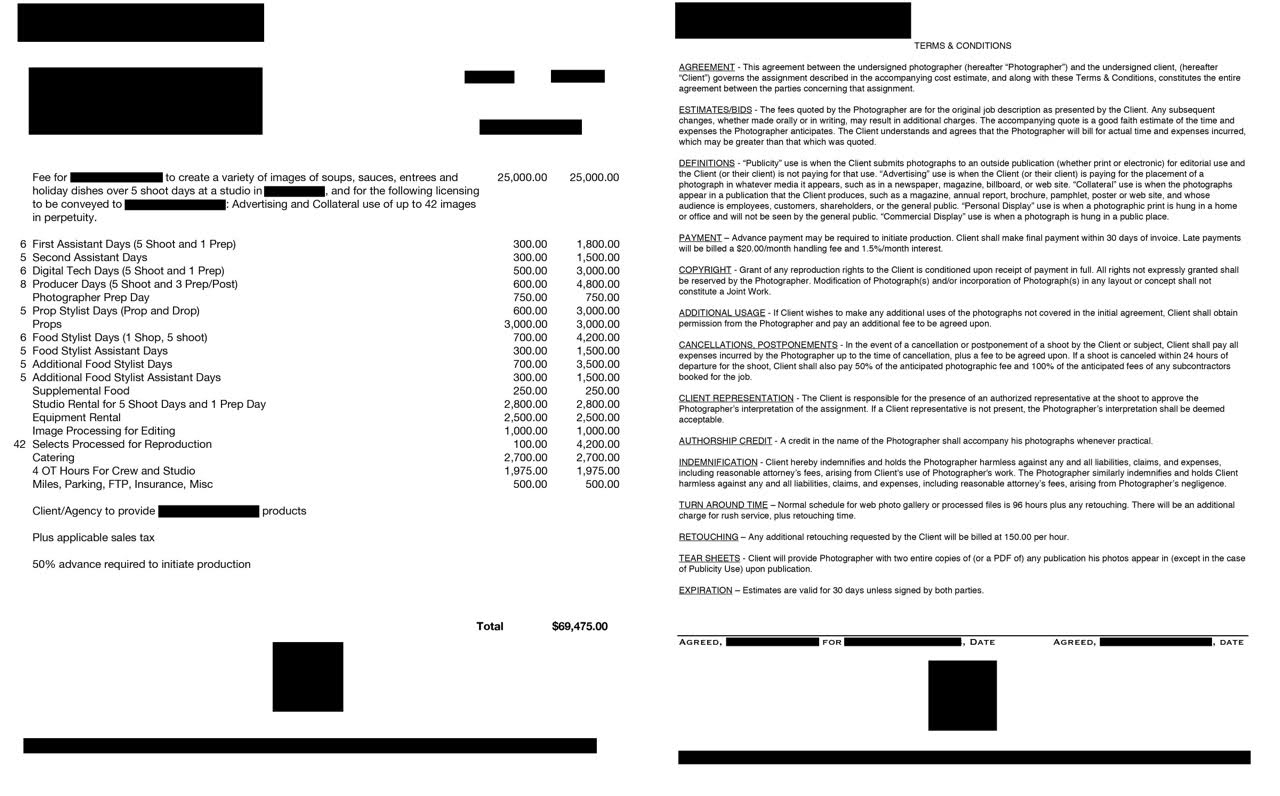
Creative/Licensing: The agency approached the photographer with a request to photograph 42 items for their client who primarily makes prepared soups. The client was branching out into manufacturing other items besides soup, and they needed images to showcase 8 sauces, 8 entrees, 10 soups and 16 holiday food items. We received one comp of a close up of a bowl of soup, and we were told that they didn’t have any other specific information on the complexity of the dishes that needed to be captured. The agency mentioned that they were anticipating 5 days of shooting, and this meant that the photographer would need to shoot at least 8 dishes a day, plus one day where he would photograph 10 dishes…no small task.
When I spoke with the account director at the agency, she told me that they were planning to use the images in web ads, on product packaging, on their website and potentially in other printed collateral pieces (although she couldn’t think of any likely examples), and they intended on using these images for 5-10 years. I learned that not only is it rare for this client to manufacture new items, but also that the client has never done a shoot of this scale before and didn’t set a specific budget. This told me that while the shelf life was lengthy for these photos, the client might be easily scared away by an exorbitant bottom line.
Based on their licensing needs, and due to the inexperienced client and the small size of the agency, I chose to price the first four images in the main categories (sauces, soups, entrées and holiday items) at $3,000 each. I figured that the images of their best selling items in each category would be the ones featured in advertisements, and that all of the other images were worth a bit less due to a decreased level of exposure. So, for the second and third image in each category, I dropped the fee for each one to a quarter of the full price (8 images at $750 each totaling $6,000), and then lowered it to a sixth of the full price for the fourth and fifth items in each category (8 images at $500 each totaling $4,000) and then priced the remaining 22 images at one-tenth the full price ($300 each totaling $6,600). This all tallied up to $28,600. This felt a bit high based on other projects I’ve estimated for food clients, so I ultimately decided to drop it down a bit to $25,000 which also helped to keep the bottom line under $70,000.
After coming up with my own fee, I checked it against other resources. Getty would price that first image in each group at $2,530 ($735 for the web ads, $1,225 for the packaging, and $570 for the website use) for 3 years. This was in line with the $3,000/image I originally came up with. Blinkbid priced 1 image at $4,500 for “website” and “collateral” use for 1 year, and FotoQuote also priced 1 image at $4,500 for their “web pack” which includes web advertising and use on a client’s website, however this didn’t include packaging use.
Assistants: In order to stay on pace with the schedule each day, we’d need the first assistant available for a prep day before the shoot to set up everything, and then both assistants would be there for all of the shoot days
Digital Tech: We’d also need the tech for the prep day and each shoot day, and we included his workstation equipment in the equipment line.
Producer: The photographer had a producer he worked with at $600/day (a bit lower than I might include typically) and he’d be a crucial part of the shoot to make sure each day stayed on schedule.
Photographer Prep Day: This was for his time to set up in the studio the day before the shoot
Prop Stylist and Props: We didn’t actually need a prop stylist on set, but we did need someone to gather all of the necessary items and drop them off at the studio. The food stylists would be able to collaborate with the photographer for prop placement in each shot. While a handful of the items would be reused, the prop budget included items such as bowls, plates, cutlery, and tabletops. After speaking with a prop stylist, we decided it could take between $50-$100 per shot in props, which would be between $2,100-$4,200. Also, since we didn’t know how many items could be reused, the prop stylist needed ample time to source unique items, come to the prep day to drop them off and sort them, and then return any unused items after the shoot. The veteran stylist I spoke to recommended that I include 6-7 days for her, but I felt that this was too high, so I included 5 days…which I still felt was on the high side.
Food Stylists and Assistants: I included 5 shoot days for two teams of stylists with their assistants, and also included an extra day for the primary food stylist to shop for supplemental food before the shoot. In order to shoot 42 dishes in 5 days, there would need to be 2 teams of food stylists with their assistants, and they would also need to follow a very strict schedule to complete the project on time. To help us think through how this would work, we created the following chart:

The chart details the schedule for each team over a 10-hour day. The numbers and letters in each slot correspond to the dish number and team. For example, 1a means the first dish for team A, and 3b means the third dish for team B. This schedule would allow the food stylist’s assistant to prepare a dish for 2 straight hours, one hour of which the food stylist would be lending a hand. After the hour when the stylist and their assistant prep the dish together, the food stylist will then spend one hour with the photographer shooting that dish while the food stylist’s assistant begins to prep the next dish. The photographer would switch back and forth between the two different teams with their own sets.
Supplemental Food: The client would be providing the majority of food, but the stylists would need supplemental items (like garnishes) to make the prepared foods look their best.
Studio Rental: The studio we had in mind had a weekly rate of $2,500. I included an additional $300 that the studio would charge for the few hours of prep time before the shoot days.
Equipment Rental: We always recommend that photographers charge for their own equipment. However, this photographer decided that he didn’t want to. The fee here represents $500 per shoot day for the tech’s workstation rental. The tech would be using a laptop on the prep day.
Image Processing for Editing: This covers the time, equipment and costs to handle the initial import, edit and upload of images for client review.
Selects Processed for Reproduction: 42 final images would be further processed and delivered.
Catering: I included catering for 12 people at $35 each for the 5 shoot days, plus and additional $600 for dinner on the day that there would be overtime.
OT Hours: On one of the shoot days the crew would need to stay an extra 4 hours in order obtain images of 2 additional shots needed in order to capture 42 dishes. I arrived at this number by calculating each crew member’s hourly rate (based on an 8 hour day) and multiplying by 4.
Miles, Parking, FTP, Insurance, Misc: I included an additional $100 per shoot day to cover these miscellaneous expenses.
Housekeeping: I made sure to note that the all of the manufacturer’s food products would be provided to the photographer, and noted the advance requirements.
Results: The account director told us that this estimate was competitive and definitely in line with the other bids they received, but they ultimately decided to hire a photographer located in the same city as the agency and client. The decision was also a creative one, as the client preferred the style of the other photographer.
Hindsight: If I had known that we were bidding against photographers local to the client and agency, and I was also told beforehand that our bottom line was comparable, I would have tried to adjust our estimate appropriately to offset any travel costs potentially incurred by agency/client representatives to fly out to our photographer’s city.
Support: Shouldn’t It Be A Two-Way Street?
If you’ve had a photo project on indie-go-go, or Emphas.is, or Kickstarter asking for money, I wonder: have you contributed to other photographer’s projects? If you’ve got a book-signing coming up, or have published a book, did you buy someone else’s book, or go to their signing, or for that matter, their gallery opening?
As much as I can say there is a photography community in New York, I find myself questioning how much of it is self-interest and how much of it is reciprocal.
via Stella Kramer.
Art Producers Speak: David Paul Larson
We emailed Art Buyers and Art Producers around the world asking them to submit names of established photographers who were keeping it fresh and up-and-comers who they are keeping their eye on. If you are an Art Buyer/Producer or an Art Director at an agency and want to submit a photographer anonymously for this column email: Suzanne.sease@verizon.net


Anonymous Art Producer: I nominate: David Paul Larson. “David is extremely talented, hard-working and wonderful to work with. Working with him is a definite creative collaboration and he brings a fresh and different perspective to every shoot.”
How many years have you been in business?
I have been shooting professionally for three years.
Are you self-taught or photography school taught?
I attended Columbia College Chicago and double majored in Advertising and Photography. I wanted to talk to my clients both as a peer and artist. After photography school I assisted Norman Jean Roy, Mark Seliger and Mario Testino. Assisting on large production, multiple day shoots is the best education.
Who was your greatest influence that inspired you to get into this business?
After being medically discharged from The United States Marine Corps I wanted a career that was detail oriented, fast paced, competitive and team driven. An early mentor told me that if I wanted to become the best I need to move to New York and learn from the best. New York has single handedly had more of an impact than anything else. Professionally and personally it has pushed me to places I never thought I would go. It’s an endurance race with yourself and your art.
Darren Aronosky, Stanley Kubrick, Guy Bourdin and Garry Winogrand have had a profound impact on my work as well.
How do you find your inspiration to be so fresh, push the envelope, stay true to yourself so that creative folks are noticing you and hiring you?
I am always looking for art directors,stylists and models to work with. I have found that the more personal work I create the more jobs I book.
Do you find that some creatives love your work but the client holds you back?
Rarely. I got into this business because I love collaborating and working with people. In the military everything is about teams and those lessons have translated a lot into my professional life. I get a lot of pleasure out of working with art directors and photo editors. Most of the work I get is a referral from existing clients so they often know a bit about me before we meet.
What are you doing to get your vision out to the buying audience?
I frequently post work on many social media platforms-Tumblr, Twitter, Instagram and Facebook. I love showing my work in person. I try to do that at least once a week. In addition, I am sending out an email promo every 45 days and printed mailers every two months.
What is your advice for those who are showing what they think the buyers want to see?
Oscar Wilde said it best “Be yourself; everyone else is already taken.” Don’t try to be everything to everyone. Shoot what you love and over time it will develop into your vision.
Are you shooting for yourself and creating new work to keep your artistic talent true to you?
I am constantly shooting for myself and for clients. I am interested in creating timeless, raw, beautiful images that will stand the test of time.
How often are you shooting new work?
I shoot at least once a week. It’s the only way to stay sharp with your craft. I think about photography as a muscle and it constantly needs to be stimulated, stretched and pushed.
David Paul Larson is a young photographer based in Brooklyn and is seeking representation.
APE contributor Suzanne Sease currently works as a consultant for photographers and illustrators around the world. She has been involved in the photography and illustration industry since the mid 80s, after founding the art buying department at The Martin Agency then working for Kaplan-Thaler, Capital One, Best Buy and numerous smaller agencies and companies. She has a new Twitter fed with helpful marketing information. Follow her@SuzanneSease.
How do you feel about color photography? I hate it!
It’s disgusting. I hate it! I’ve done it only when I’ve been to countries where it was difficult to go and they said, “If you don’t do color, we can’t use your things.” So it was a compromise, but I did it badly because I don’t believe in it.
The reason is that you have been shooting what you see. But then there are the printing inks and all sorts of different things over which you have no control whatsoever. There is all the interference of heaps of people, and what has it got to do with true color?
via Henri Cartier-Bresson: ‘There Are No Maybes’ – NYTimes.com.