The Daily Edit – Gate44 Artist in Residency : Colin Sussingham


Graphic Design / Art Direction:  Elle Rotstein 
Photographer: Colin Sussingham

Heidi: Was the desire to make something tangible born from getting away from the computer, screens, and behind a lens?
Colin: I’d say the goal generally for my personal work always has that in mind. Making something physical, whether it’s a book, zine, poster or just prints is really important to me. As a society we’re obviously fed way too much imagery through social media, streaming and advertisements, so making something that is tactile and can give the viewer a moment to pause and actually hold printed work is something special and meaningful to me.

In this age of digital overload, what suggestions do you have for those who want to get started making something physical?
My advice would be just go for it and don’t be afraid to experiment or mess up. I’ve been making zines since 2009 and to this day I still make some on a shitty laser printer at my house, and I still mess up my sequencing and flipping pages incorrectly when trying to print front and back. It’s all part of the fun and the process for me. There’s a ton of websites that offer affordable and high quality zine printing and many helpful tutorials on how to lay out artwork for print. Or if you have any friends that work corporate jobs you might be able to get them print some off for you at work. I did that for years. 

How much did the cultural immersion of being in Milan for the Gate 44 residency inform the work?
Milan as a city didn’t play much of a role. All the photographs were made prior to us arriving in Milan, and my wife, who attended the residency with me, had completed 75% of the layout prior to us arriving as well. We treated the residency like a full-time job, so we mainly got to explore the city in the evenings and on the weekends.

What was the creative intent of the book Constructive Interference?
This will be a long answer because there were multiple steps that brought us to the book concept and title. Originally we didn’t have a fully thought out idea. I took 100s of photos based off of Elle’s creative direction and my personal inspirations and then she sat with everything and made connections between the new images and many from my archive. Since she’s also an artist that mostly works in analog, we both collaborated on altering my digital works through collage and painting and then retaking photos of the new pieces to bring them back into the digital world.  The concept grew organically from Elle’s layout where she was making physical connections between my photos, one image would bleed into the other through the seam. While we were at the residency we didn’t have a title but we knew we wanted to express how human beings and nature are intertwined if you just pay attention. While we were brainstorming  titles I started researching water ripples since we had a few images in our layout. The term “constructive interference” refers to when two waves or pulses (whether it’s water, light, sound) align in sync and create a wave of greater magnitude than it’s original parts. We felt that it was a perfect title and metaphor for the book for many reasons. First, we were making connections between images that felt stronger once paired together, second, we were actually interfering with the images through our collaboration, physical touch, and all the printing methods. Lastly, the fluidity of the accordion binding and the silkscreened water pattern connected back to the water ripples that lead us to the title.

Are these pairings commentary on biomimicry?
Biomimicry definitely comes into play. A lot of the work I’ve been shooting over the past few years has related to that theme in some way. Not only how we as humans copy what we see in nature, but finding moments within nature that relate to each other. Finding connections and also moments of contrast. There were some pairings that came from happy accidents and some that were much more intentional. A lot of it is to the credit of Elle’s art direction though. She spent a lot of time composing the layout

How did this idea evolve, and were you and your partner involved in the program?
We were invited to do the residency in March of 2024. Our time slot was going to be the first two weeks of September that year, so we started working on the project pretty much immediately after we found out.
My wife is an artist and we collaborate often on projects, she did the art direction and design/layout of the book. We hand-printed it with two print/book binding technicians from the residency.

Was this more of a book-making process and photography sequencing experience?
Yes, our intention was to create something special between the two of us, and different from what we both typically create as artists. Both Elle and I have printmaking experience from our college days, but this was a totally new direction for me in terms of creating an art object. I’ve been combining analogue techniques with my photos for many years now, but I had never thought about hand binding my work. This experience definitely opened my eyes to another level of photography and presentation that I would like to continue to explore. In terms of the concept and photography sequencing, it was very fluid and experimental. We didn’t have a concept at the start, we just gathered inspiration and let the idea behind the book unfold naturally.

This looks like 4 accordion signatures, hand-bound with a belly band – were all these new techniques for you?
Yes these were new techniques for us. One of the technicians at the residency is focused solely on book binding, so she was there to walk us through the process and bind the book while we worked on printing and the design.
If the book is open end to end, it’s about 18 feet or more. We printed on two different kinds of paper, so the pages had to be glued page to page with an overlap at certain points.

Tell us about the overlap.
They had to overlap because the book is made up of two different kinds of paper. Due to that we couldn’t print in one continuous sheet. We printed on a paper with a metallic sheen and some that were more matte. So there were spreads where those two papers met and therefore had to be glued together on their backsides.Elle’s art practice involves drawing with graphite and black ink, and she felt strongly about using a paper that could create that same metallic shine effect as another nod to combining our two art practices. Once printed I also felt it added a level of depth that the book wouldn’t have had if we printed the whole thing on one kind of white paper. We individually silkscreened the back of each page with an inverted water texture from the book.

Can you describe a typical day in the Gate 44 program?
There’s an apartment at the residency so you’re staying right next to the studio. We would normally start working around 9am, break for lunch, (Italian work lunches are apparently around 1.5 to 2 hours, which we loved) fresh pasta from a small family run spot that everyone who works at the residency goes to. Of course finish with a coffee or tiramisu before going back to work until 6pm. Then we’d explore the city, have dinner or meet up with friends at a bar, sleep and repeat.

Assume all the photography was collected before the project and then the body of work took shape while there?
All the photographs were taken before, the majority of the design and layout as well. The first week was mostly experimentation and troubleshooting with a variety of media and printing methods (collage,silkscreen,relief printing,painting,burning). The second week was focused mostly on printing and binding. We made an edition of 4 books.

What are you working on now?
I’m working on publishing a new personal photo book that I’ve been shooting since 2020. In the process of reaching out to publishers currently.

The Art of the Personal Project: Karan Kapoor

The Art of the Personal Project is a crucial element to let potential buyers see how you think creatively on your own.  I am drawn to personal projects that have an interesting vision or that show something I have never seen before.  In this thread, I’ll include a link to each personal project with the artist statement so you can see more of the project. Please note: This thread is not affiliated with any company; I’m just featuring projects that I find.  Please DO NOT send me your work.  I do not take submissions.

Today’s featured artist:  Karan Kapoor

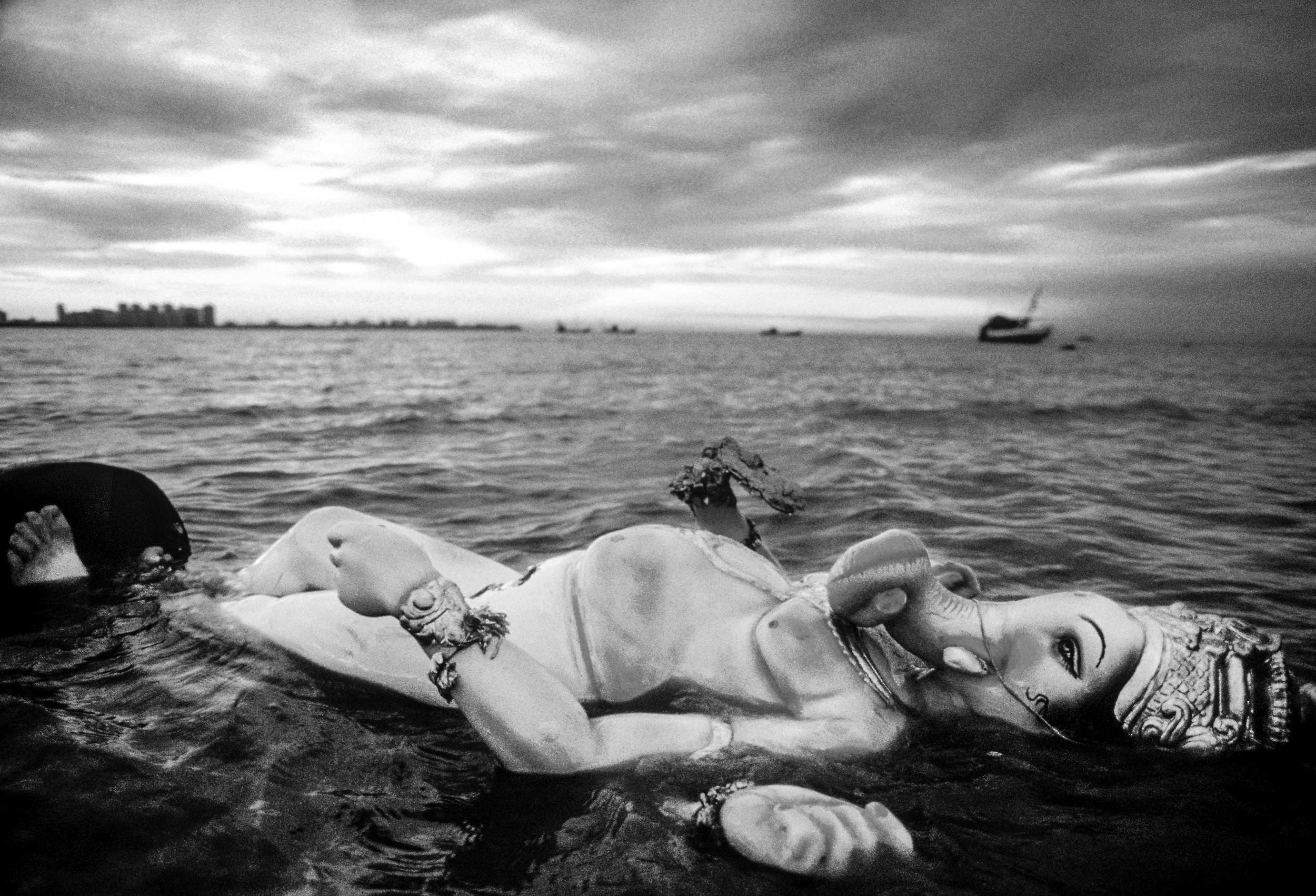
Ganpati Immersion: My First Project

This series holds profound significance for me—marking both my return to Mumbai, the city of my birth, after years at boarding school in England, and my debut as a photographer. Through the lens of the Ganpati festival, I sought to reconnect with the city’s energy, its traditions, and its soul.

The festival culminates in a moving ritual: the immersion of Lord Ganesh idols into the ocean, symbolizing renewal and impermanence. With a pair of Nikon FM cameras loaded with Kodak Tri-X 400 film, I ventured into the vibrant chaos and quiet beauty of the celebrations the morning after… At the time, Tri-X film was hard to come by in Mumbai, and I had only 3-4 rolls for the entire project. Every frame mattered, and each shot demanded intention and precision—a limitation that shaped my approach to storytelling.

One defining moment came when one of my cameras slipped into the sea—a loss that mirrored the themes of the festival itself. Fortunately, the camera was repaired, reflecting the spirit of resilience and restoration that characterized those times and became an ethos for my creative practice.

Shooting in black-and-white with Tri-X film allowed me to focus on texture, contrast, and emotion, stripping the visuals down to their essence. Each photograph captures not only the event but the layers within it—the intricate artistry of the idols, the shimmering water, and the heartfelt devotion of the people.

This project was a deeply personal journey. Returning to Mumbai after my time in England gave me a fresh perspective, allowing me to see the familiar through new eyes. Documenting the Ganpati festival reaffirmed my belief in the power of photography to preserve fleeting moments, honor traditions, and reveal the extraordinary within the ordinary.

To see more of this project, click here

Instagram

APE contributor Suzanne Sease currently works as a consultant for photographers and illustrators around the world.  She has been involved in the photography and illustration advertising and in-house corporate industry for decades.  After establishing the art-buying department at The Martin Agency, then working for Kaplan-Thaler, Capital One, Best Buy and numerous smaller agencies and companies, she decided to be a consultant in 1999.  Follow her on Instagram
The Art of the Personal Project: Fulvio Bonavia

The Art of the Personal Project is a crucial element to let potential buyers see how you think creatively on your own.  I am drawn to personal projects that have an interesting vision or that show something I have never seen before.  In this thread, I’ll include a link to each personal project with the artist statement so you can see more of the project. Please note: This thread is not affiliated with any company; I’m just featuring projects that I find.  Please DO NOT send me your work.  I do not take submissions.


Today’s featured artist:  Fulvio Bonavia

BEAUTY INTERRUPTED

This series questions the nature of beauty, while simultaneously showing the beauty of nature.

When I returned to my studio in Milan just after lockdown, my aim was to capture the inherently perfect aesthetics of these plants. Maybe it was the time and place of the shoot, but something about beauty for its own sake didn’t feel quite right. As I was working, my eyes fell on a piece of plastic, which I dropped onto a flower, interrupting its beauty. In a way, this is exactly what is happening to our planet – the disturbance on nature that can no longer remain hidden.

To see more of this project, click here

APE contributor Suzanne Sease currently works as a consultant for photographers and illustrators around the world.  She has been involved in the photography and illustration advertising and in-house corporate industry for decades.  After establishing the art-buying department at The Martin Agency, then working for Kaplan-Thaler, Capital One, Best Buy and numerous smaller agencies and companies, she decided to be a consultant in 1999.  Follow her on Instagram
The Daily Edit – Respect, curiosity without judgment, human to human. By Sarah Sherman


Sarah Sherman

Heidi: You attended the event as a photojournalist and part of “the huddled masses” – can you unpack how you felt like you were both?
Sarah: Everyone was expecting D.C. to be cold, but as all major events moved inside or were canceled entirely, everyone was left outside with dwindling options, including press.

The photographers with indoor access were swiftly cut down to a slim group of AP and White House Press Pool photographers stationed inside. Most press passes became mute—they didn’t get you inside the Rotunda anymore. You had access to the streets like everyone else.

The Capital 1 Arena was opened as a holding shell for the simulcast. It was the official backup location, so that’s where most of the core base of Trump supporters were going, and I was going with them. We all walked together trying to find the place.

As part of the “huddled masses,” I shared in the frustration, cold, and confusion. But as a photojournalist, I was there to observe and catch the images that illustrated this complicated political and emotional backdrop, and the historic day. Being in the cold gave me a physical show of the disparity between the wealthy attendees’ experience and that of the everyday supporters.

The city was fenced off like a maze. Members of the Special Services, police, National Guard, and military manned the barricades. As such, they were the only people to ask for directions. We asked guards at every gate we passed. They simply didn’t know where the Arena was or how to get there, and it seemed they hadn’t been told. And it seemed like it was on purpose. The disorganization and lack of information for the people felt almost cruel, or, to assume the best of the Trump Administration, a huge failure in planning.

There was a massive lack of pomp and circumstance. Sharing in the same experience as the average Trump supporter showed me the event’s class divide—for the more well-to-do attendees there were packed and patriotic schedules—spreadsheets filled with exclusive galas, private watch parties, luncheons, music, and a banquet of indoor events that you either had to pay quite a lot for, or be invited by an insider. For the average person the choices were to either wait in line for two hours to see Trump simulcast on a screen, or watch from a bar if there was any space/tickets left. Most bars and restaurants were not allowing free entry to see the inauguration on their TVs.

You did a stellar job at dealing with comments on IG about the bag pile and the polarizing narrative by thanking the person for their insight and knowledge. In a few words, how do you use respect as a tool during these dynamic times?
Yes, a woman in my comments wrote that the experience I described of attendees being required to throw their bags into a trash pile to enter the arena was not her experience at all. I know what I saw, so I took no offense. I sent her a link to a video of all the piles of bags. She commented back that actually her bag was one of the bags in that pile, but that it was more than worth it for her, and that’s why she did it. I thanked her for sharing that honesty, because that is the truth that people want to hear. A lot of Democrats would be quick to ask what could compel someone to throw an LV purse away to see a simulcast in an arena, but when we listen, we often get the answers. I really felt honored that she was able to let her guard down and share that with me, and my followers.

You had a lovely and very human framing of your images on IG, “We are all brothers and sisters on this earth together” – how do you let those you are photographing know you come in peace and respect?
We really are all in this together whether we like it or not. The hate won’t help. Things might get a lot worse and they might get better–those who voted for him will experience the outcomes too, just like people who didn’t vote for Trump. The way I view it, there is evidence in the world to support any conclusion. Respect is about recognizing the humanity behind every perspective, even when it’s challenging.
My approach is rooted in nonverbal safety–I try to attune to the emotion of my subject and match it so they see me seeing them. I rarely cover my face with my camera—I want them to see my eyes and share a moment with them. Or if they’re smiling and singing I smile and sing too so they know I’m with them, and not here to embarrass them. By being present and engaging with my subjects in a truly curious and nonjudgmental manner, they know I am a friend. Sharing moments of camaraderie—whether through conversation, shared laughter, or simply by showing gratitude for their openness— helps establish that trust. When people feel respected, they’re more willing to let you into their world. And how boring would it be if I only knew people who dressed and thought just like me? I want to see the circus. I want to be immersed in the circus.

Observe History: As an observer, you bring an aesthetic and POV with your framing and the moments you select. What were you trying to communicate with this image set?
I wanted to show moments of extreme highs–screaming, singing, embracing–with more somber images of people in the cold, to show the whole gamut. The “huddled masses” and their sacrifices and big emotions were so visually different from the exclusivity and mild smiles of wealthier attendees’. I was highlighting the tension between unity and disparity.  By highlighting the perseverance, emotions, and camaraderie of the people in the cold, I wanted to show the commitment and resilience of everyday individuals, and what that looks like. There were high spirits amidst harsh conditions, reflecting a realistic view of the event–Trump’s supporters were all there because they wanted to be, and come rain, snow, or shine, they were not giving up on seeing him sworn in, even if they were left out in the cold.

What was left out of frames on the image sets? Meaning, what was happening outside the frame that didn’t support your POV, if anything?
Some moments of hostility among the attendees were left out—not that they didn’t happen, but if there was a fight in the Capital 1 Arena line, the offenders were removed immediately, and the police were quicker than I was. These next four years will be a shared experience for all Americans no matter if we voted for him or not. Images that reinforced oversimplified or harmful stereotypes were left out. Images of angry white women were left out (too much of the blame for Trump’s success has already gone to women). It’s important for me to show viewers that not just white Americans attend these events. I wanted to include what I believe is a powerful and underestimated diversity amongst the President’s supporters. Additionally, the experiences of those inside luxurious events weren’t my focus. I didn’t include images of law enforcement even though that was a staple for me when I documented the Republican National Convention. They weren’t the focus, the people were. I caught glimpses and images of opulence in hotel lobbies, or in lines for fundraising Galas, and even outside, but the story to me was more about staying aligned with what I really saw–the narrative of the “huddled masses”, and what seemed to me like a suddenly discarded pillar of Trump’s supporters–the poor and working class base.

How did you get to the point where they were dropping pants to show their tattoos in total elation?
Moments like these are often born from genuine camaraderie and mutual trust. He was elated, he was so proud to show me his tattoos and that his commitment to Trump had paid off. And that his guy won. I encourage people by talking to them while I’m photographing. I say what I really feel, and I give them compliments; “Dude, this is insane and badass, you’re so brave,”. When he dropped his pants, I knelt down on the floor of the bar to look. Once I did that, a whole crowd gathered to take their own photos because they saw his art being respected and they realized he wanted his art to be seen. My ability to connect with people from a place of curiosity—without judgment, human to human—makes people feel comfortable and safe enough to express themselves freely. Moments of unfiltered reaction are easily able to be photographed when people feel seen and respected.

By being present and effusive in a celebratory atmosphere, I build verbal and nonverbal rapport with my subjects through shared energy and curiosity. Their joy makes me feel joy, because it’s very real and it’s intimate. When I hear a man belting out ‘Glory Glory Hallelujah’ with the choir on the bar TV, I feel the power and vibration of his voice and how genuine his feelings are, even on a controversial subject. I can feel their relief and excitement. In those moments I am totally present with them, not thinking of any potential “worst case scenario” outcomes of the election. In those moments I am embedded in the atmosphere and that alignment allows the images to almost flow through me with very little decision making.

The Art of the Personal Project: Aaron Anderson

The Art of the Personal Project is a crucial element to let potential buyers see how you think creatively on your own.  I am drawn to personal projects that have an interesting vision or that show something I have never seen before.  In this thread, I’ll include a link to each personal project with the artist statement so you can see more of the project. Please note: This thread is not affiliated with any company; I’m just featuring projects that I find.  Please DO NOT send me your work.  I do not take submissions.

Today’s featured artist:  Aaron Anderson

Periphery

This was a personal project that had been on my mind for some time, and in the Spring of 2016 all the pieces finally came together. The idea was relatively simple, creating authentic portraits of people struggling with homelessness, but it involved quite a few moving parts that needed a team of people to solve. After multiple rounds of meetings and pitching we landed on building a studio-like space at the Springs Rescue Mission in Colorado Springs (https://www.springsrescuemission.org/) and allowing for 30 minutes with each subject. Our goal was for these people to feel seen and heard, for someone to look them in the eye and tell their story, maybe for the first time.

We spent most of every session talking to each person, finding out about them, hearing their story and memories from their childhood. In the beginning I was nervous about asking them some of these questions, things like “what’s your favorite food?” or “tell us one of your fondest memories from childhood?”, but in the end they were happy to tell us, more than that, they were excited that someone wanted to know. We heard beautiful stories that day, from pet racoons to strawberry festivals and everything in between. As they spoke, I was struck by how we are all connected through this desire to feel seen and heard, yet so often they are treated with such contempt. We pretend not to see, we look another direction, cross the street, busy ourselves on phones to seem unaware. Even though this project was done in 2016, how much truer is this today?

After about 20-25 minutes talking with each person, while drinking a cup of coffee and having a snack together, we created a portrait. What I realized right away was how incredibly vulnerable this moment was, they were allowing me to show them at what is typically the lowest point they have been in their life. When we started the first portrait I knew this was different than any portrait I had done, we were going to have to break through shame and discomfort in just a few minutes, but how? After a few seconds of looking through the camera I realized that wasn’t going to work, so I stood up with my hand on the button and started talking to them again. I would ask about something from their story, looking at them in the eye and listening. While they talked, I pressed the shutter button, only a handful of times, and never for more than 5 minutes…some of them didn’t even realize I had started or finished. What we ended up with was beautiful, they were moments of story and connection.

My goal with this project was never to just take some images and post them on social media or a website somewhere, it was always to create something that would inspire people to change how they see. Because of this there was the pursuit of another big idea, having them displayed in a museum. We had the images printed huge (4 ft x 6ft), and thanks to the Fine Arts Center in Colorado Springs, we were able to display them in a gallery for three months. There was a beautiful opening where people from all walks of life came together to support our community, and perhaps to see these people in a way they never have before.

In the end this project was even bigger than I could have dreamed of, and the images are still being used to this day to raise money and awareness in our community. I hope this project can inspire you to use your gifts to give people a voice, to bring light and connection through your art in a way that only you can.

To see more of this project, click here

If you would like to support The Spring Street Rescue Mission, click here

Instagram

APE contributor Suzanne Sease currently works as a consultant for photographers and illustrators around the world.  She has been involved in the photography and illustration advertising and in-house corporate industry for decades.  After establishing the art-buying department at The Martin Agency, then working for Kaplan-Thaler, Capital One, Best Buy and numerous smaller agencies and companies, she decided to be a consultant in 1999.  Follow her on Instagram
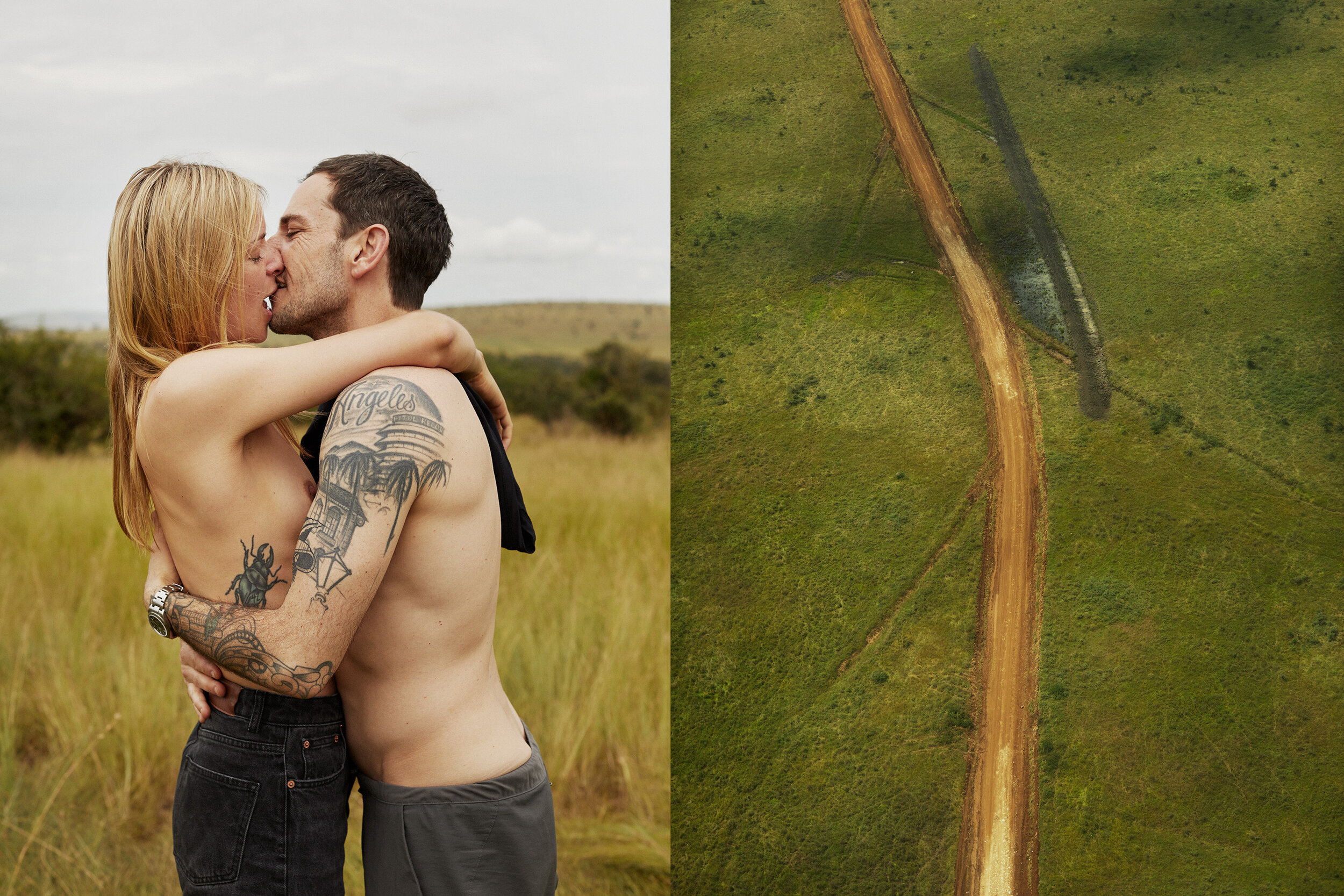
The Daily Edit – Ashok Sinha: Art of Looking through Windows and “The Fight to Save Googie”

The Arby’s cowboy hat sign on Sunset Boulevard in Los Angeles still remains while the location is now a Prince Street Pizza pop-up

America’s oldest surviving McDonald’s dates to 1953:  Architect Stanley Clark Meson
initially outlined the tall sheet metal arches with flashing pink neon. Subsequent
corporate modernization mandates got ignored since this franchise predated the
McDonald’s Corporation. After McDonald’s purchased the property with demolition
plans, the National Trust for Historic Preservation listed it as endangered, in 1994.
The stucco shed structure and canted plate glass windows were subsequently
restored.
Norm’s Coffee Shop: Restauranteur Norm Roybark opened this Googie 1957 landmark by Louis Armet, Eldon Davis, and Helen Fong. Currently the oldest in his Norm’s diner chain, it preserves the nautical sign and sharp cantilevered canopy. In 2015, real estate investors applied for demolition, but the local cultural commission voted for preservation as a Historic-Cultural Monument.
Pann’s: Original family owners lovingly maintain this space-age 1958 diner with a “tortoise
shell” roof by Louis Armet, Eldon Davis, and Helen Fong. Classic Googie features
include the animated neon sign, tropical plantings, terrazzo floors, plate glass
windows, and stone walls. Frequently used in films, the building received a 1993
Conservancy Preservation Award following restoration.
Apollo Theater, 253 West 125th St., Manhattan
Rainbow Room, 30 Rockefeller Ctr.
White Horse Tavern 567 Hudson Street, Greenwich Village, Manhattan
Early evening view of LED sign
Dublin House

Ashok Sinha 

Heidi: “Just as today’s brands are built to shine on Instagram and TikTok, Googie structures were built to entice through a car window” – The New York Times noted people are looking out the window decades later you peer from an airplane seat. What are the creative parallels?
Ashok: I have been intrigued by LA’s love affair with the automobile and how it shaped the city’s built environment, tracing back to a time when cars themselves were objects of beauty. Those cars are no longer on the streets today but the buildings from that era (built in the ‘Googie’ architectural style) still remain. These buildings were like advertising billboards – symbols of consumerism that sent a universal messaging to the drivers and beckoned them to come inside. The Googie project recently published in NYT is a continuation of my personal photo series and book titled ‘Gas and Glamour’ and allowed me to connect with that lost design history and capture LA’s car-culture-induced optimism and ambition reflected in polychromatic, star-spangled coffee shops, gas stations, car washes, and others that once lured the gaze of passing motorists.

As luck might have it, I was recently assigned to photograph a similar story for the NYT, but this time in New York about the city’s disappearing neon signs.
This year marks the centennial anniversary year of the first neon sign in Times Square, yet it has been marked with a loss of one vintage neon sign after another, either because the business it hangs on is shuttered or its owners opt for LEDs. This photo series captures an urban landscape in transition, highlighting iconic New York City neon signs that are about to be turned off, and others that have already been dismantled or replaced by LEDs. Much like the last of the Googie establishments in LA, the story about neon signs highlights the typography, graphic design, and curbside appeal and neon’s importance in luring the gaze of passing pedestrians of New York City. Fittingly, it might be the beginning of a sequel to the west coast Googie project- ‘Glass and Glamour’ this time, perhaps?

How did the visual experience of programming satellites for the U.S. government inform your personal work?
Working on satellites is often a lonely and solitary affair (and I frankly hated it). However, it does give you a sense of humanity’s place in the universe and how we are just a tiny part of that giant extraterrestrial equation. The work is monotonous, but you do get to dream a bit and get lost in that world on a daily basis.  Looking back at those years, I believe that that mindset of logical thinking, patience, problem-solving and daydreaming all contribute to the way I manifest my thoughts and ideas through my photography work today.

Exacting Proportion asks the viewer to consider the sense of place and self—why are these considerations important to you?
Many years ago, when I visited the top of the Empire State Building one foggy night, my view of the world changed. I was consumed by the immense sky to which very few people have access in Manhattan. That led me to document a view of the world that put the scale of our communities in perspective. Living in a big city like New York, we often lose ourselves in the world surrounding us and fail to realize civilization is limiting, even at its best. Only when you start looking under the prism of a collective horizon can we evoke the constraints of our existence and better understand the delicate balance between us and the universe we all share. Through my photographs, I wanted to point out the environmental and cultural similarities between all of us, taking delight in the colorful differences, as well as infuse a hint of humor by positioning humankind as tiny in such a large universe.

Tell us about the self-made camera modification for your work “New York to LA.” What were the considerations around the seat assignments and weather conditions?
The entire body of work was shot through airplane windows and made over many years of personal trips between New York and Los Angeles. Minimizing reflections on the (plexiglass) airplane window was my main goal for creating an ad hoc attachment to the camera lens. Using black cine foil and gaffer’s tape, I devised a flexible “tent” to put the entire camera inside it and get the lens as cloo the plexiglass as possible.

Seat assignments were crucial. You ideally want to be sitting forward of the wing, otherwise, the engine turbulence creates blurry areas in the image. I also studied airplane seat maps and flight paths to make sure I was sitting on the correct side of the airplane, what terrain the airplane would be flying over etc. Most importantly, I only shot when the flight was below cruising altitude, and only at those moments whne the airplane (window) is almost parallel to the ground below, which usually means a few minutes while the airplane is turning and pitching during takeoff and landing. In order to maximize my chances of “usable” photography time, I often opted for multi-stop flights over nonstop ones.

What were some of the biggest lessons while creating this body of work since there are so many variables?
Weather was also a big factor and while I had no control over it, I used it as much as possible to work in my favor. For example, I have photographed the same landscape over different times of the year and have been delighted by the results.
While this project has definitely taught me the power of preparation and planning before any shoot, it has helped me in having an open mind and remaining flexible because the best pictures are often made that way.

Your architecture and interior work celebrate clean lines, structure, and beauty – how do your personal projects and initiatives contrast this work?
I have a curious mind that is constantly working overtime! As much as I enjoy and relish the minimalist simplicity in architecture and interiors, my personal projects are an outlet to explore other topics and subjects that I’m interested in. For example, my interest in human-driven stories has resulted in short documentaries (Forgotten Artisans of New York, Pigeon Kings of Brooklyn, Sticker City), while my affinity towards the natural world has led me to create several bodies of work that explore landscape (Exacting Proportion, New York to L.A.) and lastly, my curiosity about identity and self-expression has resulted in portrait projects (The Hindu Bagpipers of Secaucus in NYT and the Languages of New York short video interview series.)


The Art of the Personal Project: Loli Kantor

The Art of the Personal Project is a crucial element to let potential buyers see how you think creatively on your own.  I am drawn to personal projects that have an interesting vision or that show something I have never seen before.  In this thread, I’ll include a link to each personal project with the artist statement so you can see more of the project. Please note: This thread is not affiliated with any company; I’m just featuring projects that I find.  Please DO NOT send me your work.  I do not take submissions.

Today’s featured artist:  Loli Kantor

“I feel that my mother was not fully recognized during her lifetime, nor after she died. Between being a mother and an artist, with this work, and the time I’ve spent with the images and documents, I honor her. I’m expressing my love for her, bringing her back to life, and giving her a voice.”  — Loli Kantor

To see more of this project, click here

Purchase the book here

Instagram

APE contributor Suzanne Sease currently works as a consultant for photographers and illustrators around the world.  She has been involved in the photography and illustration advertising and in-house corporate industry for decades.  After establishing the art-buying department at The Martin Agency, then working for Kaplan-Thaler, Capital One, Best Buy and numerous smaller agencies and companies, she decided to be a consultant in 1999.  Follow her on Instagram
The Daily Edit – Jay L. Clendenin: Los Angeles Fire and Citizen Journalism


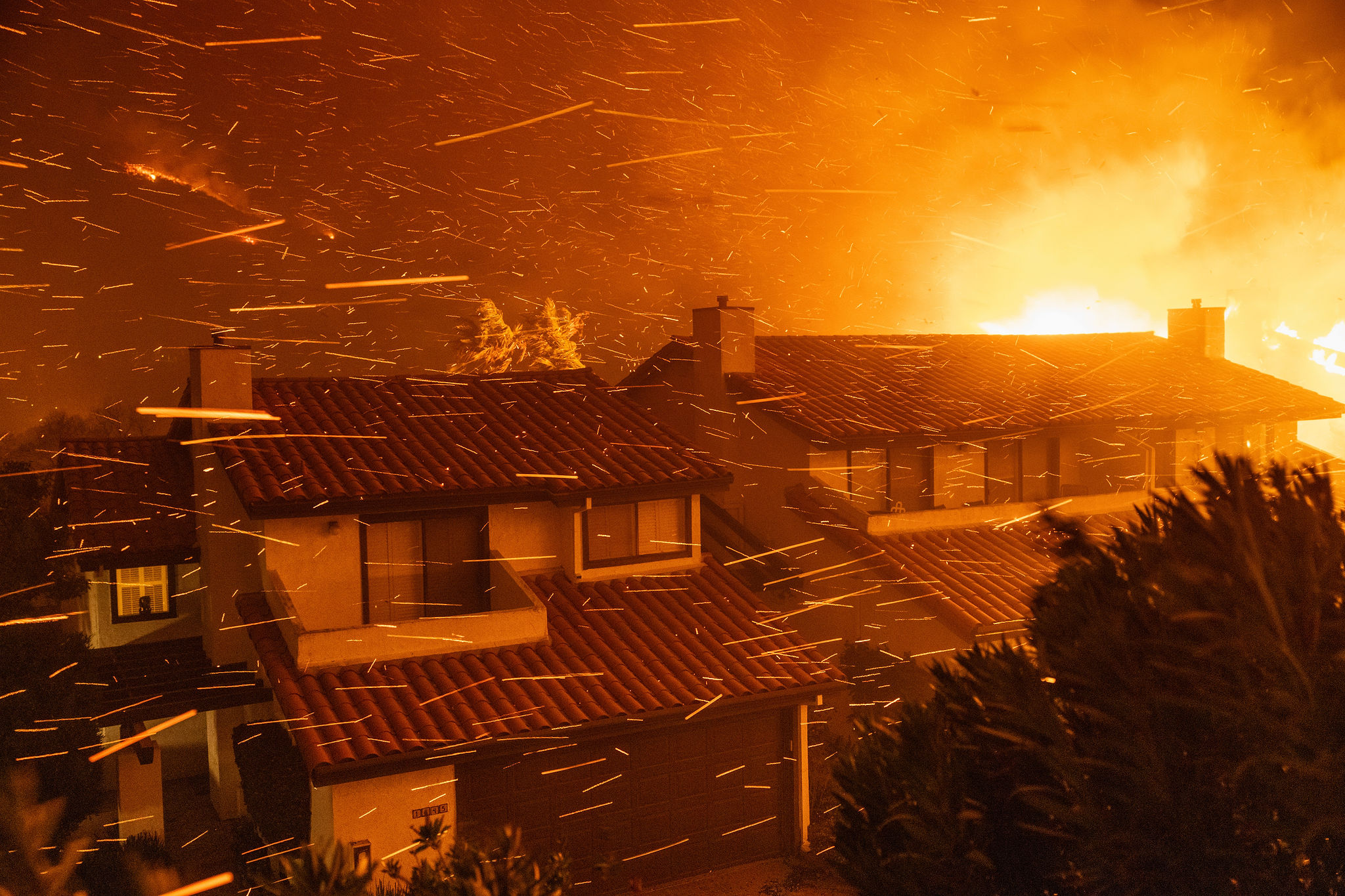
PACIFIC PALISADES, CALIFORNIA – JANUARY 08: Embers fly through the air in the Highland neighborhood during the Palisades Fire.
PACIFIC PALISADES, CALIFORNIA – JANUARY 08: Firefighters battle flames from the Palisades Fire
PACIFIC PALISADES, CALIFORNIA – JANUARY 08: A tree remains intact, in the devastation
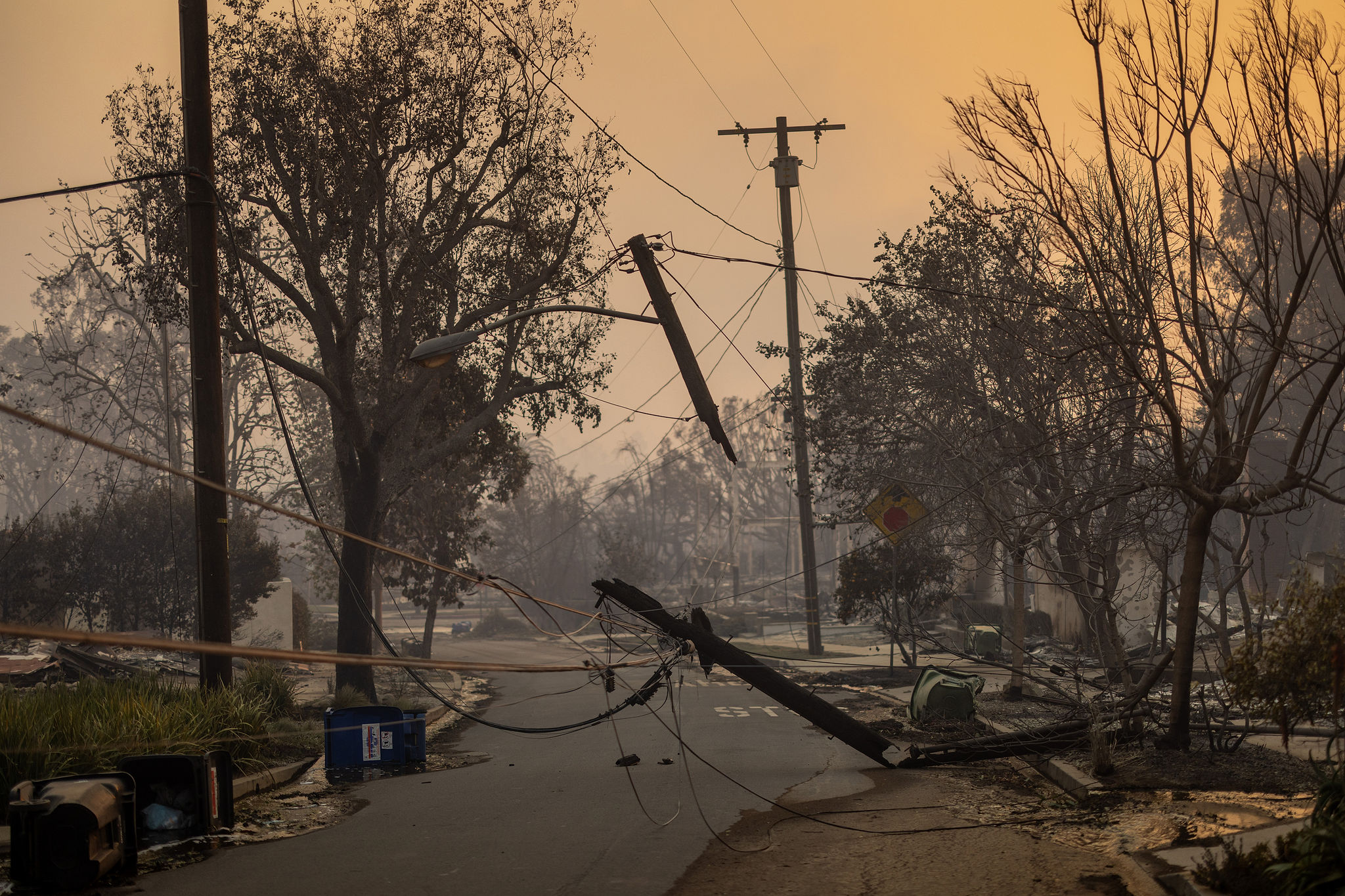
PACIFIC PALISADES, CALIFORNIA – JANUARY 08: Power lines hang on broken power poles, in the middle of a street
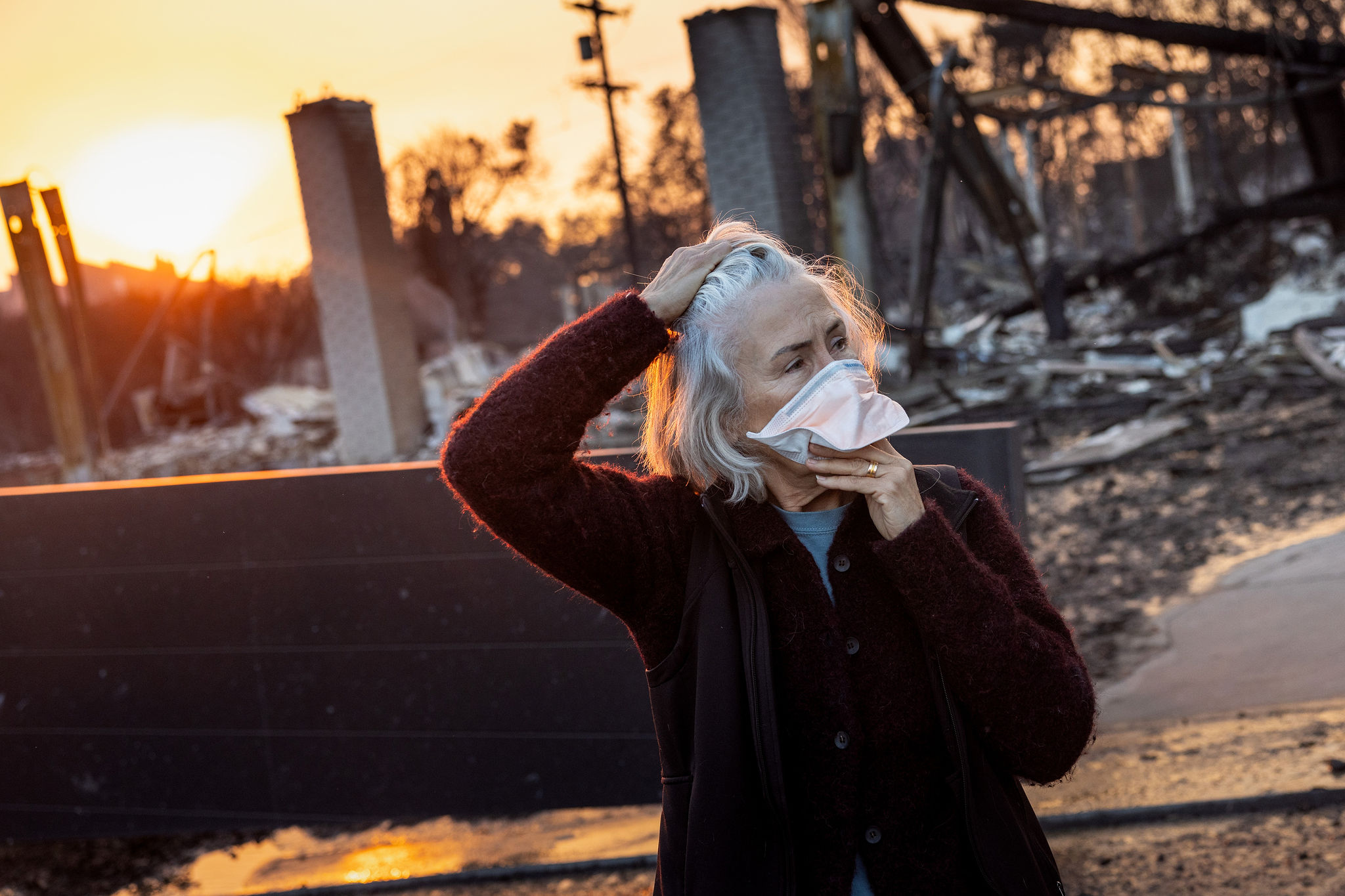
PACIFIC PALISADES, CALIFORNIA – JANUARY 09: Gail Wirth, whose home of 35 years on Charm Acres Place was destroyed in the Palisades Fire, says she thought she’d be back in to get things after a couple days, only to lose everything
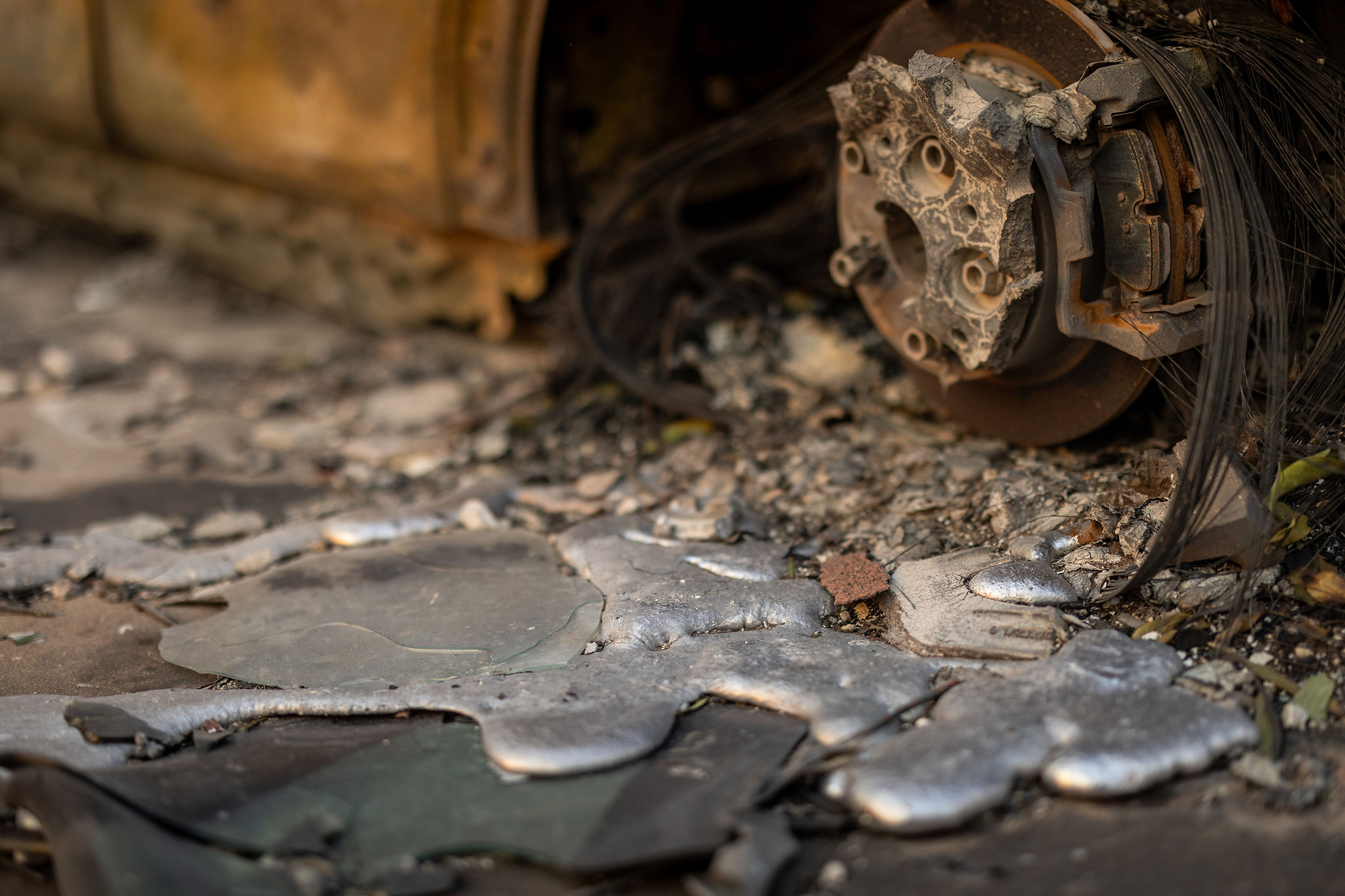
PACIFIC PALISADES, CALIFORNIA – JANUARY 08: Melted metal near a destroyed car
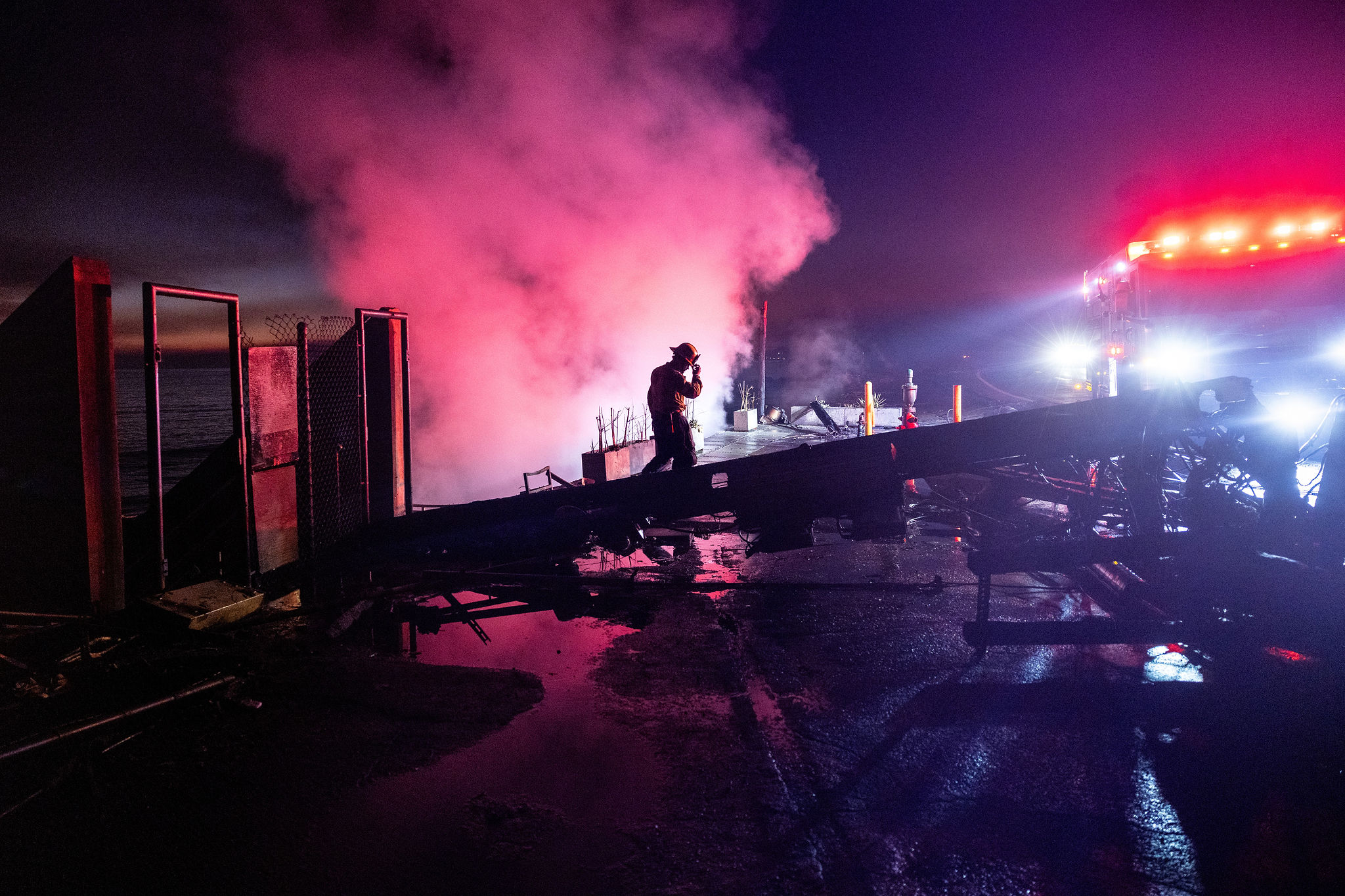
PACIFIC PALISADES, CALIFORNIA – JANUARY 09: A firefighter walks back to his vehicle after checking out a spot fire along Pacific Coast Highway
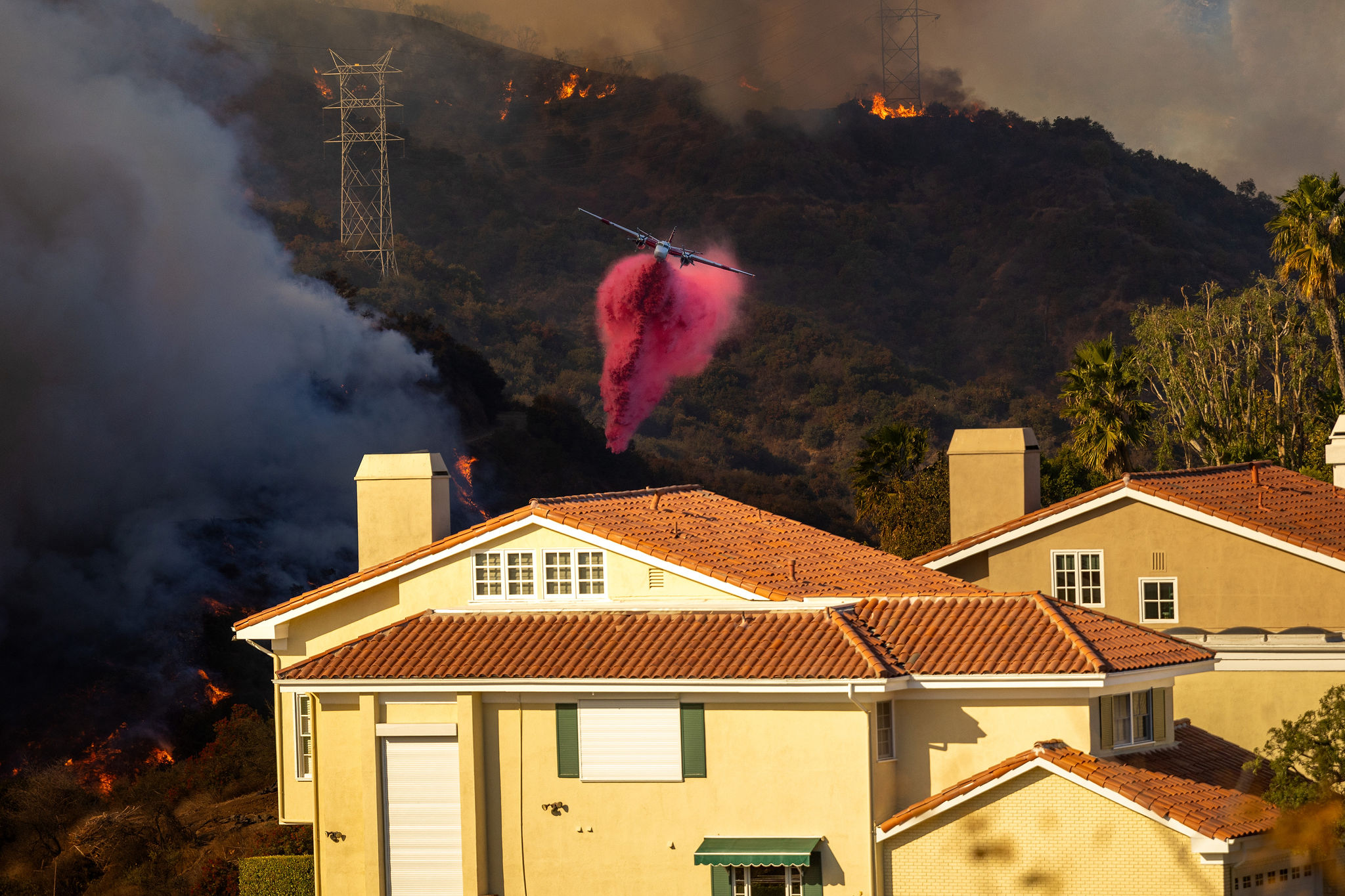
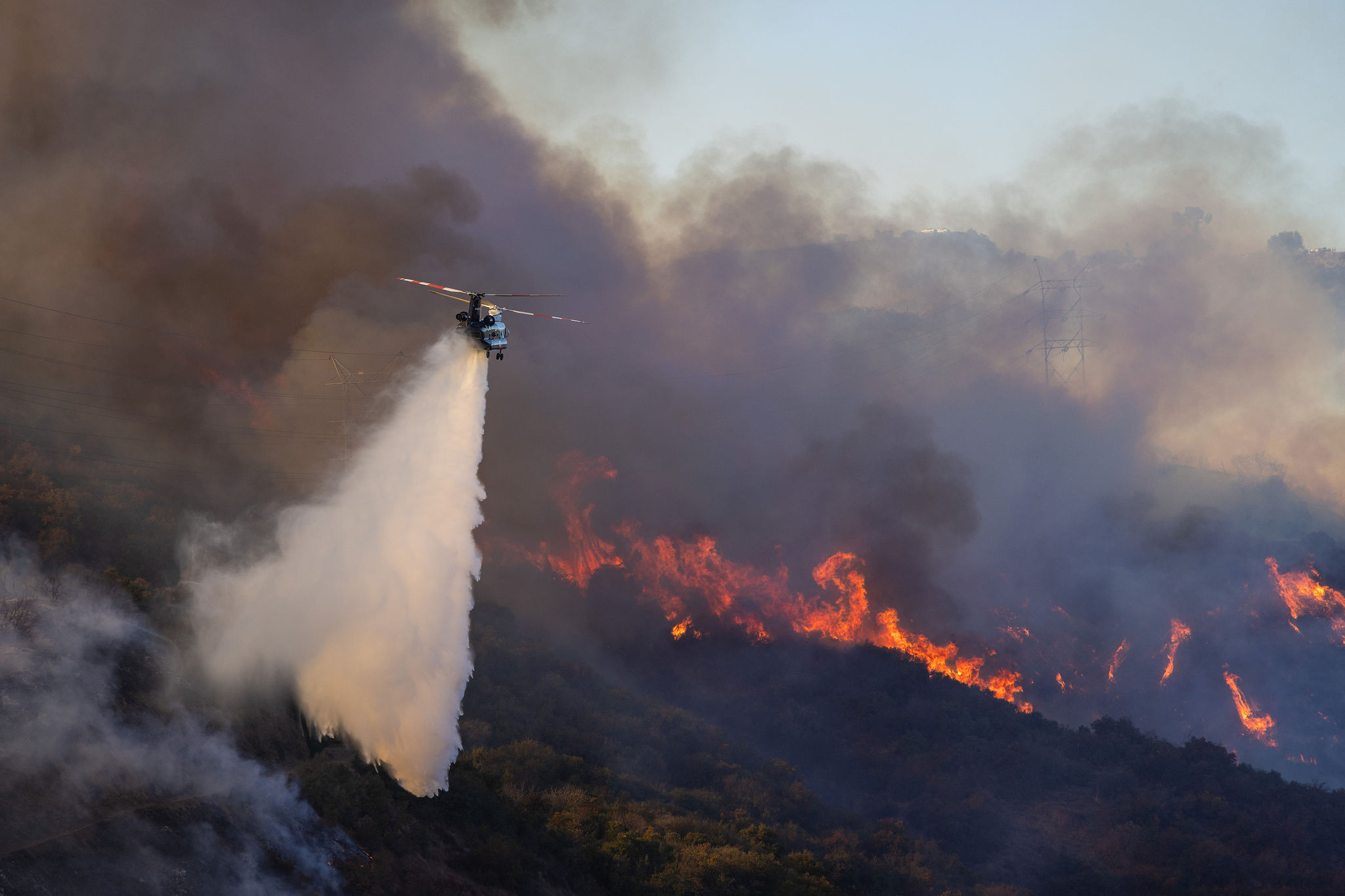
BRENTWOOD, CALIFORNIA – JANUARY 11: A Cal Fire plane drops fire retardant over the Palisades Fire, along Mandeville Canyon, photographed from the Mountaingate development, above Mandeville
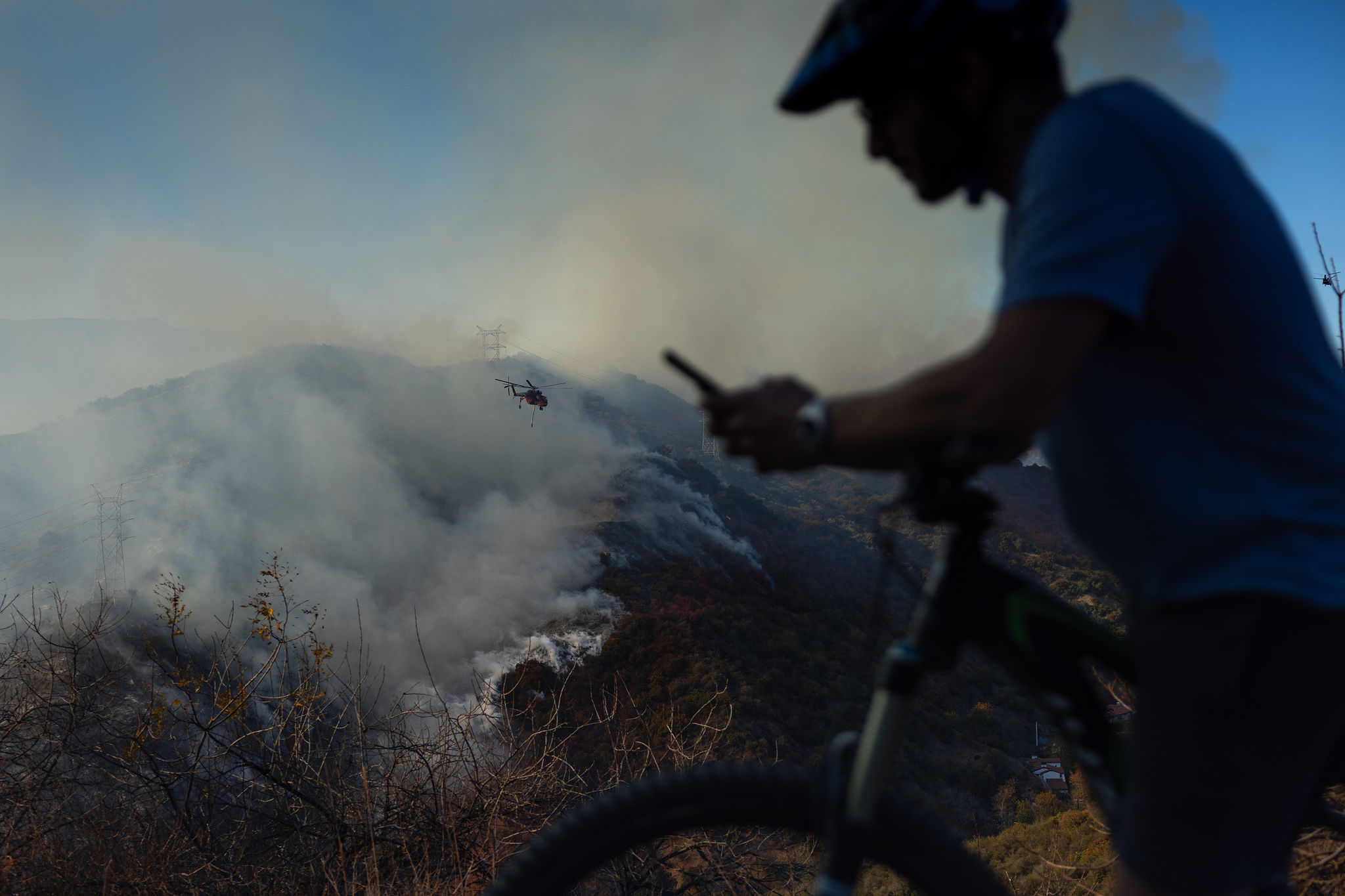
BRENTWOOD, CALIFORNIA – JANUARY 11: A man on his mountain bike stops to take a picture, while a watering dropping helicopter prepares to drop on the Palisades Fire, along Mandeville Canyon, photographed from the Mountaingate development, above Mandeville
BRENTWOOD, CALIFORNIA – JANUARY 11: An L.A. County Fire watering dropping helicopter drops on the Palisades Fire, along Mandeville Canyon, photographed from the Mountaingate development
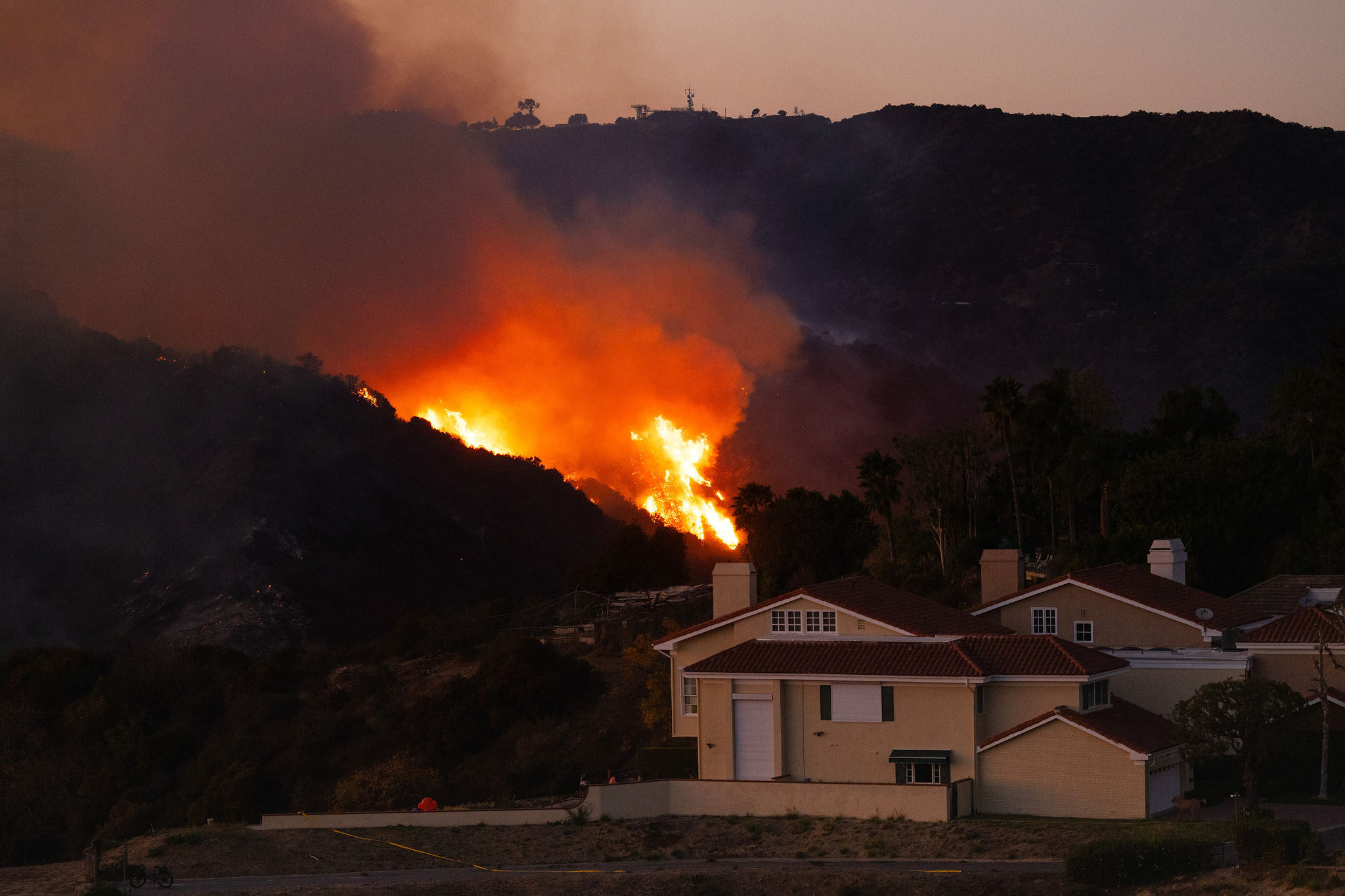
BRENTWOOD, CALIFORNIA – JANUARY 11: Flames are seen behind homes in the Mountaingate development, above Mandeville Canyon, After the sun went down and fire air operations worked to extinguish flames
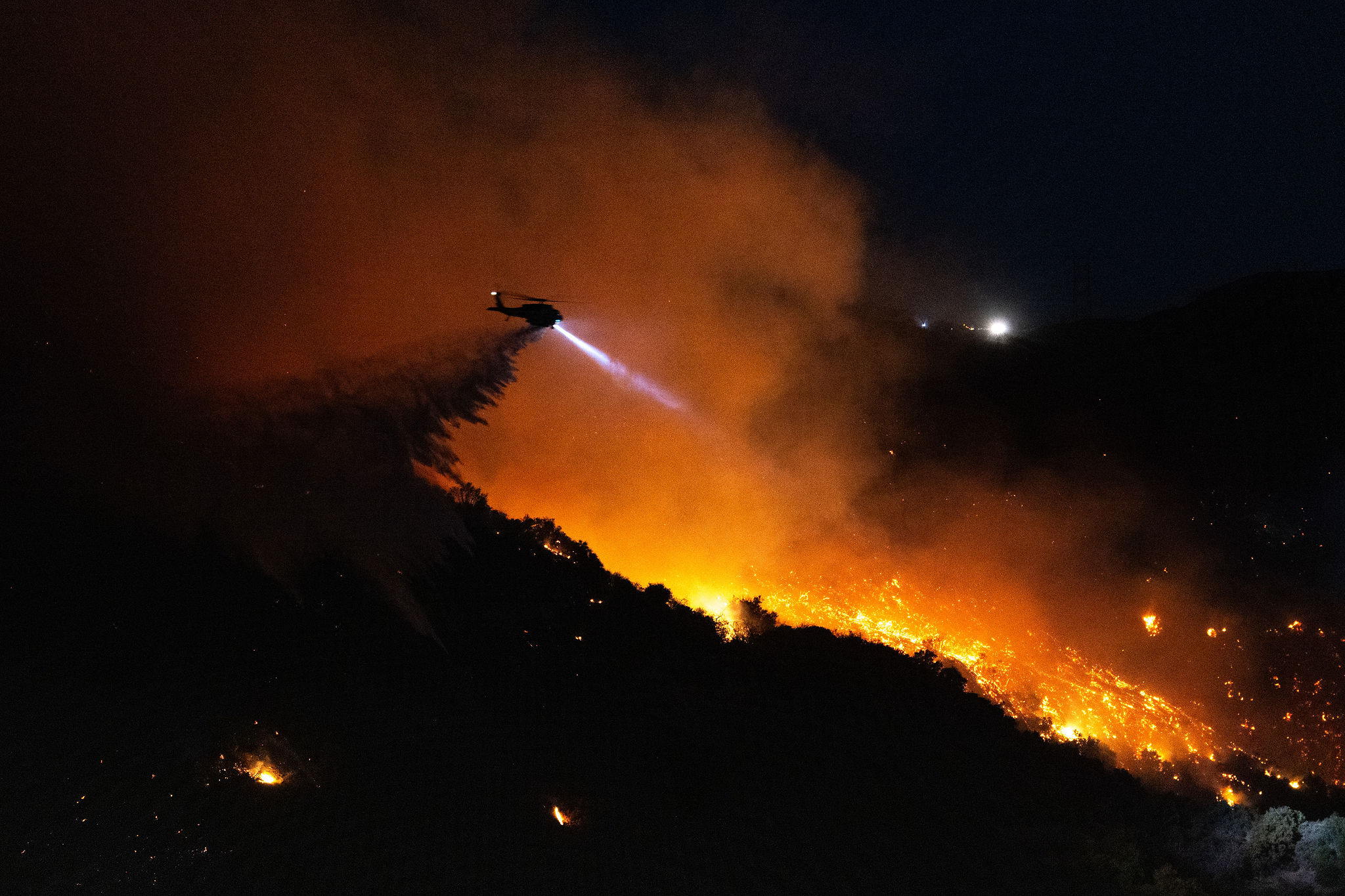
BRENTWOOD, CALIFORNIA – JANUARY 11: A fire air operations helicopter drops water along Mandeville Canyon during the Palisades Fire, photographed from the Mountaingate development

PACIFIC PALISADES, CALIFORNIA: Cars left behind in driveways following evacuation.

Jay L. Clendenin

Since leaving the Los Angeles Times,  Jay Clendenin has primarily been photographing corporate and commercial projects, mostly in the entertainment world where he spent the majority of his 16 years at the LAT.
“When doing editorial work, I’ve started distributing my news and enterprise images through Getty Images and entertainment work through Shutterstock – all that got turned on its head last week with the merger of these two companies.”

We caught up about his experience covering the LA fires.

Heidi: Please share your thoughts on citizen journalists and what they need to consider.
Jay: The term “citizen journalist” makes me cringe. I am very aware of human behavior and the desire to “know” and “report” what’s happening (in particular when it’s their neighborhood). But there are a couple of significant distinctions between said “man-on-the-street” spreading a “story” and a trained Journalist (capital J) reporting: ethics and facts. It’s true that the Rodney King video (dating myself) was “citizen journalism” and was incredibly impactful on society – unfortunately, not enough to convict?! Where as today, I’m seeing people abusing the homeless with humiliating videos of their circumstances, all in the name of “citizen journalism.” And with the fires, people are sharing wild accusations/aspersions about the number of fire personnel, water supplies, and who happened to be on vacation when the fires broke out. No investigating for facts, just hitting “share” and adding “this has to stop,” as if the things said were facts vetted by credentialed journalists.

You were a staff photographer for the Los Angeles Times where editorial integrity was essential.  How have things changed when stories go unchecked or lack empathy for the crisis?
Being a trained, experienced Journalist as part of a major news organization comes with great responsibility. We try for multiple sources, probe officials for more info, and try to be on the ground to see things first-hand. It is also important to vet people we talk to. During the Palisades fire, after a couple of questions to some people on e-bikes, I realized they did NOT live in the neighborhood, and I said they shouldn’t be riding around amongst the ruins. If they didn’t have bad intentions, they could easily have been accused of it. And thankfully, there are curfews now and they’re making arrests.

LA Magazine and Wired were recently called out for posting illegal drone footage – how has the increase in social media and scooping news impacted traditional media gathering practices?
Drones are an incredible tool that can add a very visceral, immersive effect to story telling. I’ve embraced it, even got my Part 107 license. Part of getting a license and being “legal” is following FAA regulations and local laws. During major disasters, especially fires, a Temporary Flight Restriction (TFR) often goes out, to keep the skies clear for fire and safety aircraft. You don’t fly your drone. Period. When these media outlets choose to run these very “clickable” videos acquired illegally, they encourage the behavior. And for the “haters” on social who love saying “you’re just jealous you didn’t think of it first!” Let me tell you, all of us licensed operators, are VERY aware of the visual impact of these scenes and have interest in capturing the scene with our drone, but we KNOW the safety considerations and are very conscious of the illegal behavior by un-licensed “content creators” and hobbyists.

Explain the danger of flying drones during an active fire of this magnitude while a Temporary Flight Restriction (TFR) is in place.
The near-worst-case-scenario of flying a drone during a TFR happened during the Palisades fire, when a fire righting aircraft hit a drone, damaging the aircraft and knocking it out of commission. Someone’s greater interest in clicks, lead to interrupted fire-fighting capabilities during this horrific disaster. I can’t imagine the anger of homeowners who see that story while they’re praying all the efforts can save their home and community.  Losing the air attack is huge. I was at the top of Mandeville Canyon last night (Saturday) and the fire retardant and water drops did the majority of flame suppression, slowing the growth on the eastern flank. Further update on drone activity and arrests can be read about here. “California authorities say there have been at least 40 incidents in which unauthorized drones have forced firefighting aircraft to pause operations, putting more lives at risk as the fires continue to spread and firefighters on the ground are left without air support.“

What safety considerations have you taken while covering the fires?
I have a fire brush jacket and pants, helmet and goggles. I use n-95 masks, conveniently on-hand after Covid! I don’t have “fire” boots, but wear my Blundstones and try to avoid walking on smoldering piles – they aren’t rated for that high a heat. I also work to only wear cotton items, which is hard these days, as so much of my wardrobe has become nylon/synthetic fibers. Synthetics are much quicker to ignite and I’d rather decrease the chances of melting clothes on my body.

Are you part of a photo collective during a local crisis?
I’m not part of a formal collective, but stay in contact with many photojournalists on assignments, who tend to have more resources available to them. Again, with big events, experienced PhotoJournalists know the ropes and safety is a priority. I’ll ask for best routes to enter areas, etc. It’s also great for hearing about spots that are super sketchy or not easily accessible without additional gear, like a 4×4 vehicle.

How did you get your start in photojournalism?
I started in photojournalism at L.A. Pierce College, running on several fires in the L.A. region in the early 90’s. We had our college paper as an outlet/publication, but also were able to get the Daily News to let us process and print our film, occasionally publish, and always give us replacement roles of film. We weren’t fully-vetted journalists yet, we were training to be. So we were still more reliable than a “citizen journalist.” I don’t want to prevent accurate reporting from being done, but someone who has a big TikTok following, does NOT a journalist make. Reach out to real Journalists, see how they report, what questions they ask. And please stop with the video Supercuts of people’s property burning and using gimble spins, even if you actually did it “by hand” and brag about it. 🤬

The Art of the Personal Project: Amanda Lopez

The Art of the Personal Project is a crucial element to let potential buyers see how you think creatively on your own.  I am drawn to personal projects that have an interesting vision or that show something I have never seen before.  In this thread, I’ll include a link to each personal project with the artist statement so you can see more of the project. Please note: This thread is not affiliated with any company; I’m just featuring projects that I find.  Please DO NOT send me your work.  I do not take submissions.


Today’s featured artist:  Amanda Lopez

Featured in NPR The Picture Show / Pablo Valdivia

Photographer pays homage to Our Lady of Guadalupe and reclaims her connection with the divine


It’s not uncommon to see an image of Our Lady of Guadalupe on murals, candles, statues and even clothing. She’s a significant religious figure who signifies hope and protection for countless Latinos in the U.S. and abroad.

For photographer Amanda Lopez, her image goes beyond religion, serving as a powerful emblem of home.

Catholics believe that, in 1531, the Virgin Mary appeared before Saint Juan Diego Cuauhtlatoatzin, an Indigenous farmer at the Hill of Tepeyac in a suburb of Mexico City. According to the story, she left on his cloak an image of a brown-skinned Virgen de Guadalupe, which still hangs at the Basilica of Our Lady of Guadalupe in Mexico City.

This would also be where Lopez began her own years-long journey documenting her image for Guadalupe, a project that pays homage to the “divine feminine energy, sacredness, and healing that Guadalupe’s imagery can encapsulate for people of all genders and backgrounds.

” In it, Lopez reimagines Guadalupe in a contemporary context.

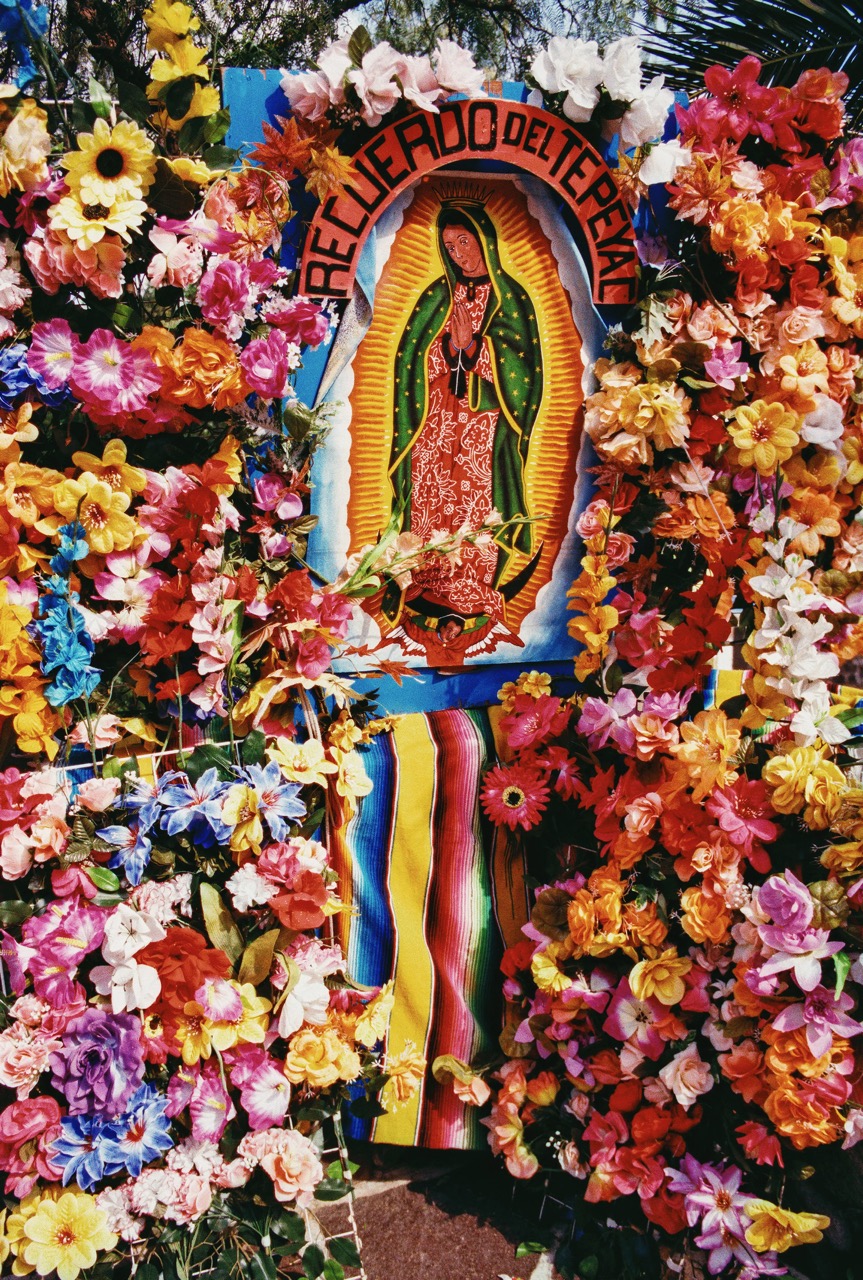
During a college trip to Mexico City, Lopez visited the basilica and was moved by the sacredness of the moment. She photographed a floral “set” on the grounds, and it became an image that stayed with her for years to come. However, like many Mexican Americans, this wasn’t exactly her first encounter with the Patroness of Mexico.

Growing up as a first- and second-generation Mexican American in California’s capital, Guadalupe was a deeply ingrained part of her daily life. She attended a church named Our Lady of Guadalupe up to her teenage years and was surrounded by Guadalupe’s image in her childhood home. Her family’s Catholic values initially shaped her own, though she began to question them as this project took shape.

“The question that I kept asking myself when I was working on this project was, ‘What does it mean to be a good woman — a Mexican woman, a former Catholic woman, a good woman — in my grandmother’s eyes?’ ” Lopez said. “You have to be humble, respectful and quiet. You go along with the status quo. And then I was really uncomfortable with that idea.”

Lopez then began to deconstruct that line of thinking and began to visualize how she could portray these conflicting thoughts photographically. “And that’s when I started to reimagine what Guadalupe might look like and understand that to be a ‘good woman,’ you don’t have to be any of those things.”

Lopez deliberately excluded adjectives commonly used to describe Guadalupe such as “Lady,” “Virgen” or “Madre” when naming the series.

“I wanted to move beyond traditional notions about womanhood and let viewers create their own meanings. I went through my own unlearning by questioning those same terms and, in that process, was able to reconnect with her.”

For Lopez, Guadalupe signifies all that is good and loving. And her definition of what “good” meant transcended a religious context as she delved deeper in her relationship with her.

“She’s all encompassing — what is nurturing and what is caring. For me, that’s not an exclusively religious thing. She’s evolved to this symbol that actually reminds me so much of my own grandma.”

Lopez grew up seeing her grandma Isabel — also known as Nana — on a daily basis. Guadalupe was a religious presence who guided Isabel through a life filled with many highs and some heavy lows. And though Lopez has a different relationship with the patron saint than her Nana ever did, she wanted to honor everyone’s individual journey with Guadalupe.

“I know so many people who have this connection to her [Guadalupe] that are not Mexican, that are not straight, that are not women and that are not religious … And so when I was making these photos, I wanted to have the opportunity to chat with folks and ask, ‘What is it about her image that you resonate with?’ ”

For some, she’s a religious icon. For others, a cultural figure. Many are also simply captivated by the beauty of her art. For Amanda, she represents the connective thread that unites us.

In 2021, the Smithsonian National Museum of American History added 15 of these photographs to their Photographic History Collection. Now, they are being exhibited in Sacramento, Calif., the city where Lopez first connected with Guadalupe.

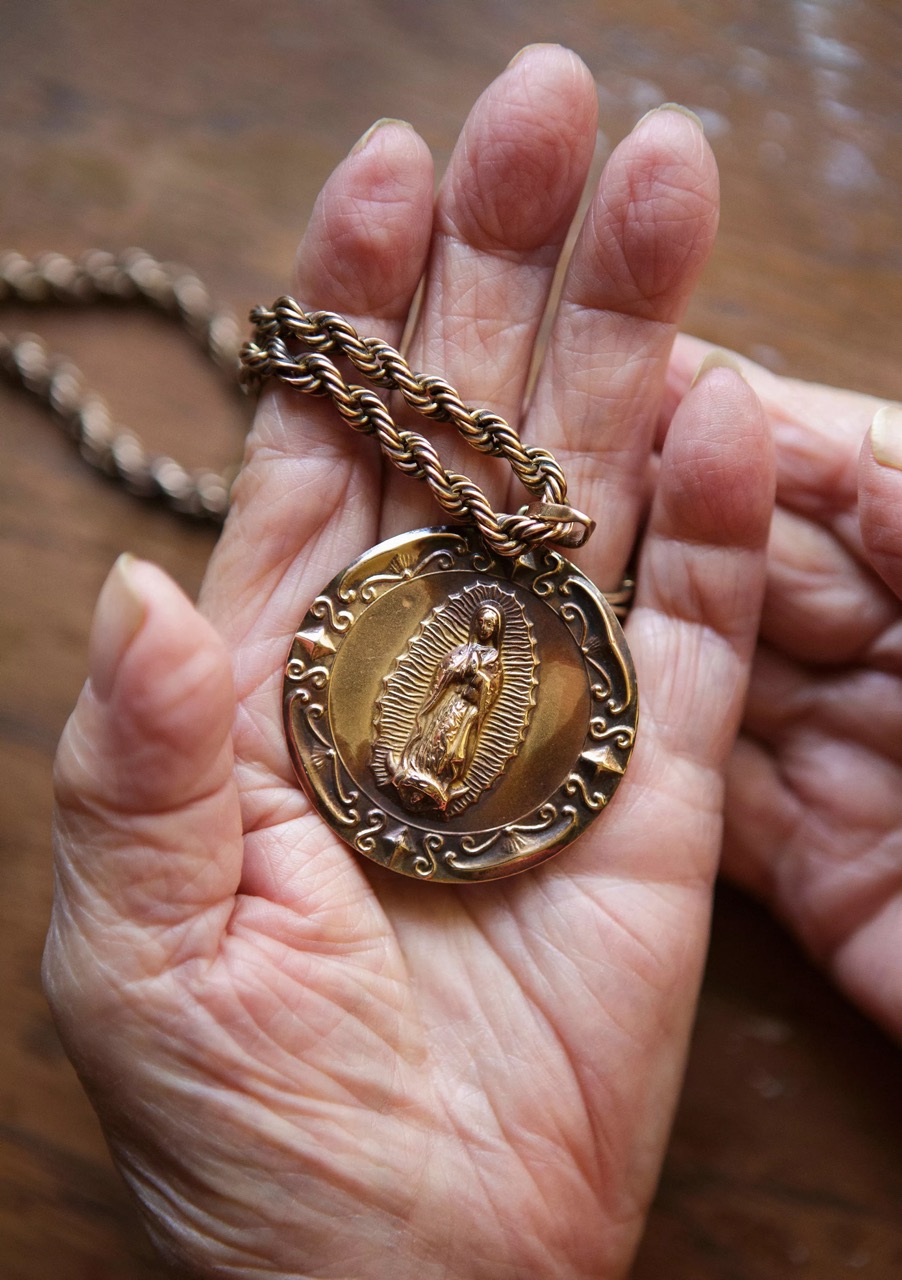
“It’s a little bittersweet because my grandma won’t be there,” she said. Isabel died in 2020 at the age of 91 and was buried with her favorite Virgen de Guadalupe necklace. “But she’ll be there in spirit.”


Nuestra Madre. Sacramento, CA 2019
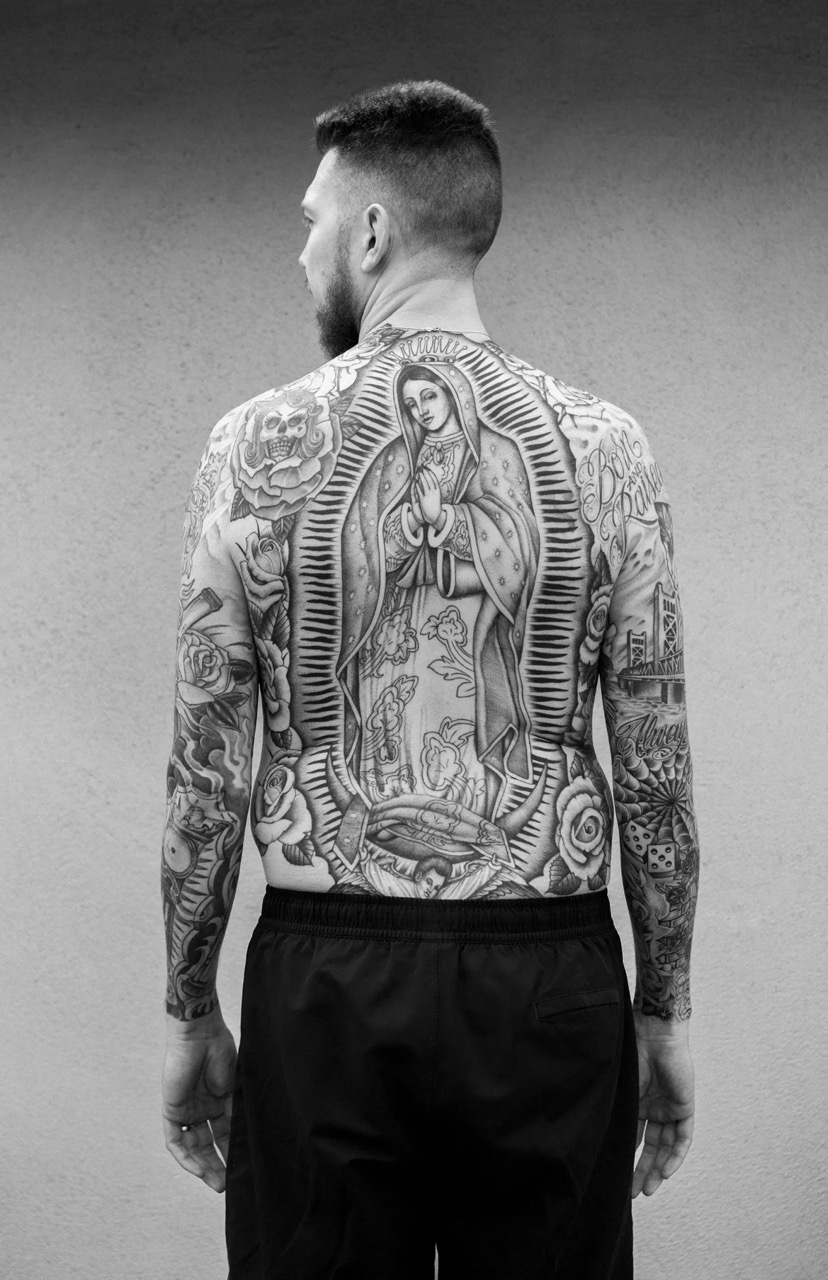
Tyler Wichmann shares his Our Lady of Guadalupe back tattoo, created by renowned tattoo artist Chuco Moreno.

Recuerdo de Tepeyac. CDMX, Mexico. 2006

Nana’s Hands. Sacramento, CA. 2019.
My grandmother always wore her gold Our Lady of Guadalupe necklace. I never once saw her without it.


To see more of this project, click here

To purchase Guadalupe Zine click here

Instagram

APE contributor Suzanne Sease currently works as a consultant for photographers and illustrators around the world.  She has been involved in the photography and illustration advertising and in-house corporate industry for decades.  After establishing the art-buying department at The Martin Agency, then working for Kaplan-Thaler, Capital One, Best Buy and numerous smaller agencies and companies, she decided to be a consultant in 1999.  Follow her on Instagram


The Art of the Personal Project: Tom Hussey

The Art of the Personal Project is a crucial element to let potential buyers see how you think creatively on your own.  I am drawn to personal projects that have an interesting vision or that show something I have never seen before.  In this thread, I’ll include a link to each personal project with the artist statement so you can see more of the project. Please note: This thread is not affiliated with any company; I’m just featuring projects that I find.  Please DO NOT send me your work.  I do not take submissions.

Today’s featured artist: Tom Hussey

“And to All a Good Nightcap: The 12 Cocktails of Christmas”

 And to All a Good Nightcap: The 12 Cocktails of Christmas is all about capturing the heart of the holiday spirit through mixology and storytelling. Each cocktail in this series isn’t just a recipe—it’s a celebration of tradition, creativity, and the joy we share during this magical season.

With this project, I reimagined Christmas as a blend of flavors, community, and the cultural traditions that make the holidays so special. Santa himself takes the lead, narrating each drink with his signature charm and nostalgia. From the boldness of The Smoking Gun to the tropical refreshment of the Key West Mojito, each cocktail tells a story, inviting you to savor not just the taste but the moments they create.

This project wouldn’t have been possible without an incredible team. A huge thank you to Patty Hussey from The Production Party for her amazing work as producer and stylist, and played the part of Santa for the drink images. Thanks also to Ken Womack and Mike Stopper from The Agency Hack, for bringing it all together with their fantastic title and design.

For me, this project is about more than cocktails—it’s about celebrating the joy of connection, the stories we share, and the memories we create over a glass. Here’s to raising a toast to life’s most spirited moments. Cheers!

To see more of this project, click here

Instagram

APE contributor Suzanne Sease currently works as a consultant for photographers and illustrators around the world.  She has been involved in the photography and illustration advertising and in-house corporate industry for decades.  After establishing the art-buying department at The Martin Agency, then working for Kaplan-Thaler, Capital One, Best Buy and numerous smaller agencies and companies, she decided to be a consultant in 1999.  Follow her on Instagram
The Art of the Personal Project: Jason Knott

The Art of the Personal Project is a crucial element to let potential buyers see how you think creatively on your own.  I am drawn to personal projects that have an interesting vision or that show something I have never seen before.  In this thread, I’ll include a link to each personal project with the artist statement so you can see more of the project. Please note: This thread is not affiliated with any company; I’m just featuring projects that I find.  Please DO NOT send me your work.  I do not take submissions.


Today’s featured artist:  Jason Knott

Beyond the Margins by Jason Knott

An inconvenient truth of life. There is a fragility. There are no guarantees.

Partnering with Catching Lives, a hardworking and underfunded group of dedicated people in Canterbury.
I was determined to offer what help I could to highlight the current growing crisis we are facing of Homelessness on our streets. After many weeks of gaining the trust of a few of their ‘clients’ I have been fortunate enough to be invited into their world to produce a set of poignant portraits. Shock, sadness and at times anger do not begin to describe how fragile our lives are and how quickly things can take a turn for the worse. The project sets out to document the journey of those I met revisiting the places where they slept rough on the streets and in many cases after a long personal battle, before finding their new homes.

The biggest thing I learned though shooting this project is how fragile we all are as humans. For those who find themselves suddenly displaced in society — we all have a duty of care.

To see more of this project, click here

Instagram

APE contributor Suzanne Sease currently works as a consultant for photographers and illustrators around the world.  She has been involved in the photography and illustration advertising and in-house corporate industry for decades.  After establishing the art-buying department at The Martin Agency, then working for Kaplan-Thaler, Capital One, Best Buy and numerous smaller agencies and companies, she decided to be a consultant in 1999.  Follow her on Instagram
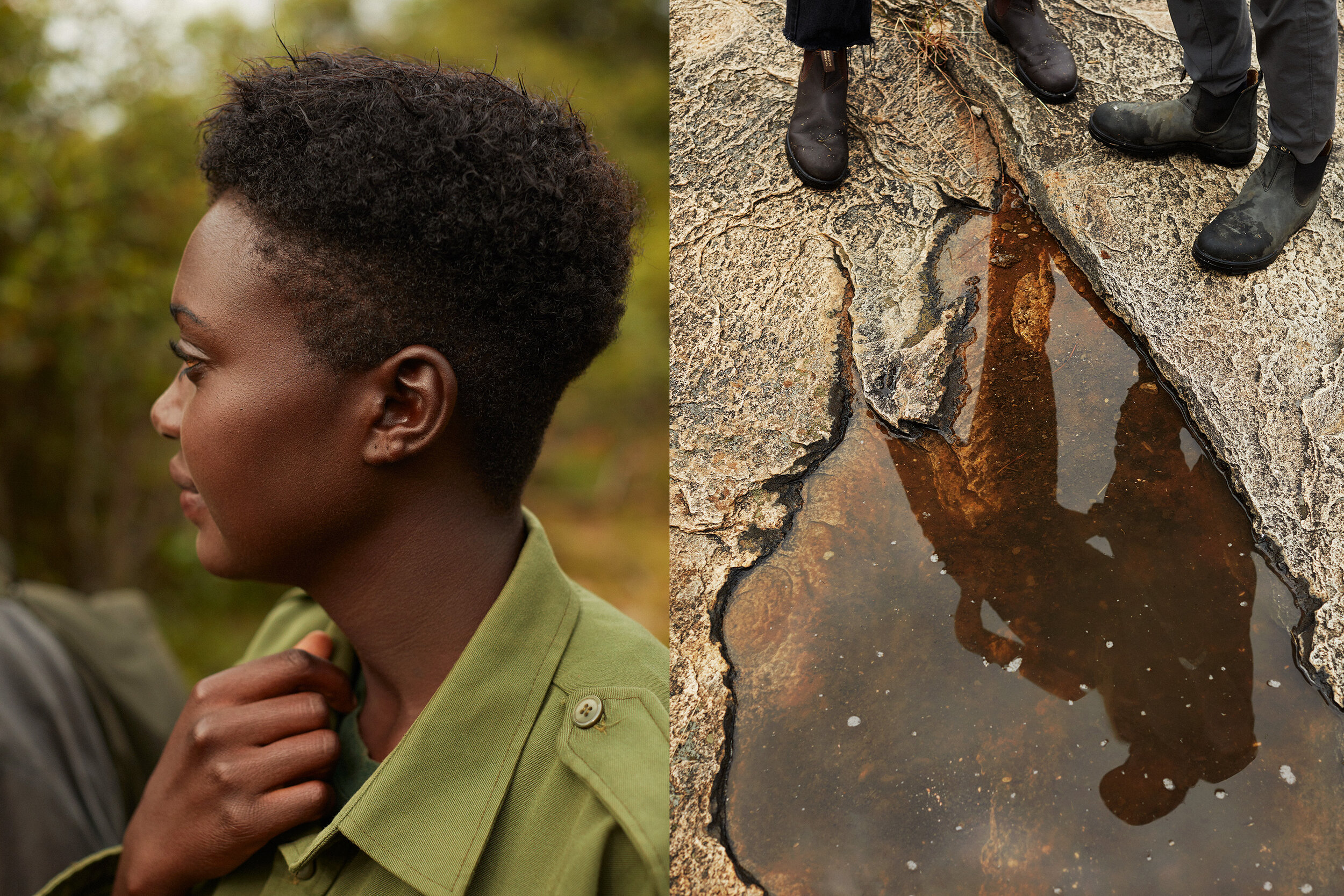
A New Winter – Sofía Jaramillo


A New Winter – Sofía Jaramillo

Heidi: What are your hopes for this body of work?
Sofia: This is an ongoing project. I hope to make a book eventually!
This project has two main goals:

  • To encourage conversations about diversity and inclusion in winter sports
  • To create representation for people of color in winter sports culture.

I plan to showcase this work at various museums and galleries, particularly in the Mountain West, to promote dialogue about the evolving culture of winter sports and explore ways to make it more welcoming for everyone.

How did this project come about?
This project began years ago when I walked through the Sun Valley Lodge. Sun Valley is the first ski destination resort in the U.S., meaning it has some of the earliest marketing images of destination skiing in the country. These were the first images to define what ski culture would be like in the United States. Many of these photographs are displayed in the lodge, particularly in an iconic hallway lined with hundreds of images.

While I was there, I noticed that out of the hundreds of images on the walls, only one featured a person of color. This stark observation made me reflect on the correlation between the representation of individuals in those historic images and what we see, on average, at ski slopes today. For those who don’t ski or haven’t spent much time on ski hills in the U.S., according to the Snow Sports Industry of America’s 2022-2023 annual report, only 13% of all skiers were Hispanic, 9% were Black, and 8% were Asian, making skiing one of the least diverse sports.
When I saw those images, I thought, “How does this relate to who we see skiing today, and how exciting would it be to remake and reimagine ski history in a more inclusive way?” As a young Latina who grew up in Sun Valley, this project reflects my personal journey with identity and my desire to see a future in winter sports culture where everyone feels they belong.

How did you decide on the casting?
The first year of casting, I called up all my friends to see who might want to support and be part of my crazy idea. I am lucky that some of my good friends are also great models and we got a really great group together for the first year this way. I invited everyone out to Sun Valley and we shot for 3 days.
The second year was way different. We started planning casting a lot further in advance and we worked with a dedicated Casting Director. Terumi Alana Murao, who is also our stylist, stepped it up and offered to do the casting as well. Turns out Terumi is just as talented at styling as she is casting and we were able to lock in some incredible models!

We are specifically seeking athletes and models who are not only outstanding in their fields but also share our project’s mission of representation and inclusion in outdoor sports. Many of the models we have chosen are involved in either operating or volunteering with nonprofits and organizations that promote participation in outdoor sports among people of color. Quannah ChasingHorse and her family started Native Youth Outdoors, which provides access to the slopes for Native Youth in Alaska. Juju Milay started Colour the Trails, a nation wide organization in Canada that helps get folks of color outdoors in many different sports.

How did you decide on which images to reimagine?
I spent about a year researching images and looked at different sources from library archives and books, to online archives.

My main source was actually the Wood River Historical Museum in Sun Valley. I spent hours going through old slides with an archivist looking at images and browsing their online archive. The historic images absolutely fascinate me! Many of the images that caught my eye were shot by Union Pacific Railroad photographers. The railroad started Sun Valley Resort and had their own photographers. Beyond those photos, I was drawn to the works of other photographers like Slim Aarons, George Silk and Ray Atkeson for their minimalistic style and ability to showcase the pure joy and pleasure of ski culture.

Historically, Black and Brown bodies have rarely been depicted in moments of joy, pleasure, and strength in photography. Instead, the images that dominate history often reflect narratives rooted in struggle or oppression. This absence speaks volumes and it’s one I seek to challenge with my work. In this photo series, I juxtapose Black and Brown bodies with spaces and scenes they have not traditionally been depicted in, such as the world of skiing and luxury. Slim Aarons’ work, for instance, often celebrated exclusivity and affluence, aligning closely with the early imagery of skiing in the U.S. By placing BIPOC+ individuals in these contexts—where their presence has historically been erased or marginalized—I want to reimagine these spaces and expand our understanding of who belongs in them.

How can people support the project?
If brands or agencies would like to support this project, they can either hire me for similar concepts or donate vintage clothing for the shoots. Anyone can contribute directly to the project by donating to the Sun Valley Museum of Art and specifying that the donation is for “A New Winter”. Supporters can also purchase fine art pieces through Ochi Gallery, where we offer a variety of sizes and price points. If you know a book publisher who might be interested, please connect me with them. Additionally, I am available to speak at your event! I have a 20-minute keynote presentation on the history of skiing and this project.

Can you share a little bit about the process from the first photo to creating the last photo?
This was quite a journey for us. In the first year, our goal was to prove we could even just make this happen with a dedicated team of eight people. We learned a lot, starting with five scenes that were all single portraits.

By the second year, we shot eight scenes, including three group shots. We went from having a small crew the first year to having over 30 people on set on year two for some of the scenes. During the second year we were way more set up because I had built community connections in Sun Valley like private supporters and the Sun Valley Resort that was a huge supporter of this project. They ran lifts for us even after they were closed, helped us dig snow pits and gave us lift access. One of the most unexpected parts of this project, was how much the community in Sun Valley showed up to support it and make it happen. I plan to continue it in the snow sports realm and beyond, and I’m excited to see how it evolves after being showcased at the museum and gallery this winter.

We sat together at Center in Santa Fe for The Democratic Lens: Photography and Civic Engagement lecture. What kind of framing did that provide?
Yes! Getting to hear that talk was such a treat. I remember it being very informative and was so grateful that you invited me. The talk was about how photography informs who belongs and the different ways photographs currently and previously influence citizenship and who is deemed worthy of it. The talk had a significant impact on this project because it helped me realize the true purpose of my work: to question how images inform and influence notions of belonging. How do images, especially in a historical context, inform and influence who belongs? How do historical images perpetuate stereotypes?

The Art of the Personal Project: Doug Menuez

The Art of the Personal Project is a crucial element to let potential buyers see how you think creatively on your own.  I am drawn to personal projects that have an interesting vision or that show something I have never seen before.  In this thread, I’ll include a link to each personal project with the artist statement so you can see more of the project. Please note: This thread is not affiliated with any company; I’m just featuring projects that I find.  Please DO NOT send me your work.  I do not take submissions.


Today’s featured artist: Doug Menuez

In the dance between commercial obligations and personal passion, photographers often find solace and inspiration in the pursuit of personal projects. Photographer and Director Doug Menuez, having spent most of his life behind the lens and professionally shooting for decades, recently embarked on a sabbatical with his wife to Portugal. In this time, Doug has had more opportunities to shoot personal projects and get to know the country and people and has opened the door to a new chapter in his photography. 

Initially living in a 500 year-old “noble” manor house in a medieval village, they recently moved to an ocean view apartment in a beach town famous for having the longest left hand break in Europe. As he immersed himself in the culture, language, and landscapes, the country revealed itself in multifaceted ways. From the lively streets of Lisbon, adorned with culture and a vibrant nightlife that attracted notable personalities like John Malkovich, to the romantic cobblestone streets of wine country, each corner of Portugal became a canvas for Doug’s lens.

What aspects of Portugal make it an exciting destination for shooting assignments?

Having become well-acquainted with the language, culture, and diverse topography of Portugal, I think it’s a great place to hold a shoot. The mainland itself offers a staggering variety, from historic cities like Porto to the picturesque countryside, mountains, and valleys. The Atlantic and Mediterranean coastline, featuring renowned surf towns and the world-famous waves of Nazare, adds another layer of charm. I am captivated by the sun-drenched beaches, villas, and villages of the Algarve coast. Each mile of the country offers something different, but it’s a relatively small country making moving to each region quite easy.

Logistically, how are you finding producing shoots in Portugal?

Since arriving in Portugal, I have reconnected with a long-time collaborator, European Producer Staffan Tranaeus, who has been based in Lisbon for the last 30 years. Staffan’s company, Southwest Productions, has an extensive track record of producing advertising shoots, broadcast productions, documentaries, and TV features across Europe and the world. Their knowledge and network make Portugal a well-wired and accessible destination for creative projects, providing photographers with a valuable resource for seamless execution and exploration

What are the greatest benefits of shooting in Portugal?

There are relatively low production costs here, especially compared to LA or New York. This includes talent, locations, scouting, and casting, making it an attractive destination for creative projects. Crews are experienced and professional, and all the latest gear is here. Plus, with an average of 300+ sunny days a year in most locations, Portugal provides a reliable and stunning backdrop for photoshoots. The country’s excellent infrastructure, pristine highways, comfortable trains and other mass transit, as well as numerous high-quality hotels, ensure smooth operations. Despite its ancient history and appearance, Portugal is a surprisingly high-tech country, way ahead of the US in many areas such as super high-speed internet. As an additional bonus, the warmth of the people makes the entire experience even more enjoyable.

To see more of this project, click here

Instagram

APE contributor Suzanne Sease currently works as a consultant for photographers and illustrators around the world.  She has been involved in the photography and illustration advertising and in-house corporate industry for decades.  After establishing the art-buying department at The Martin Agency, then working for Kaplan-Thaler, Capital One, Best Buy and numerous smaller agencies and companies, she decided to be a consultant in 1999.  Follow her on Instagram
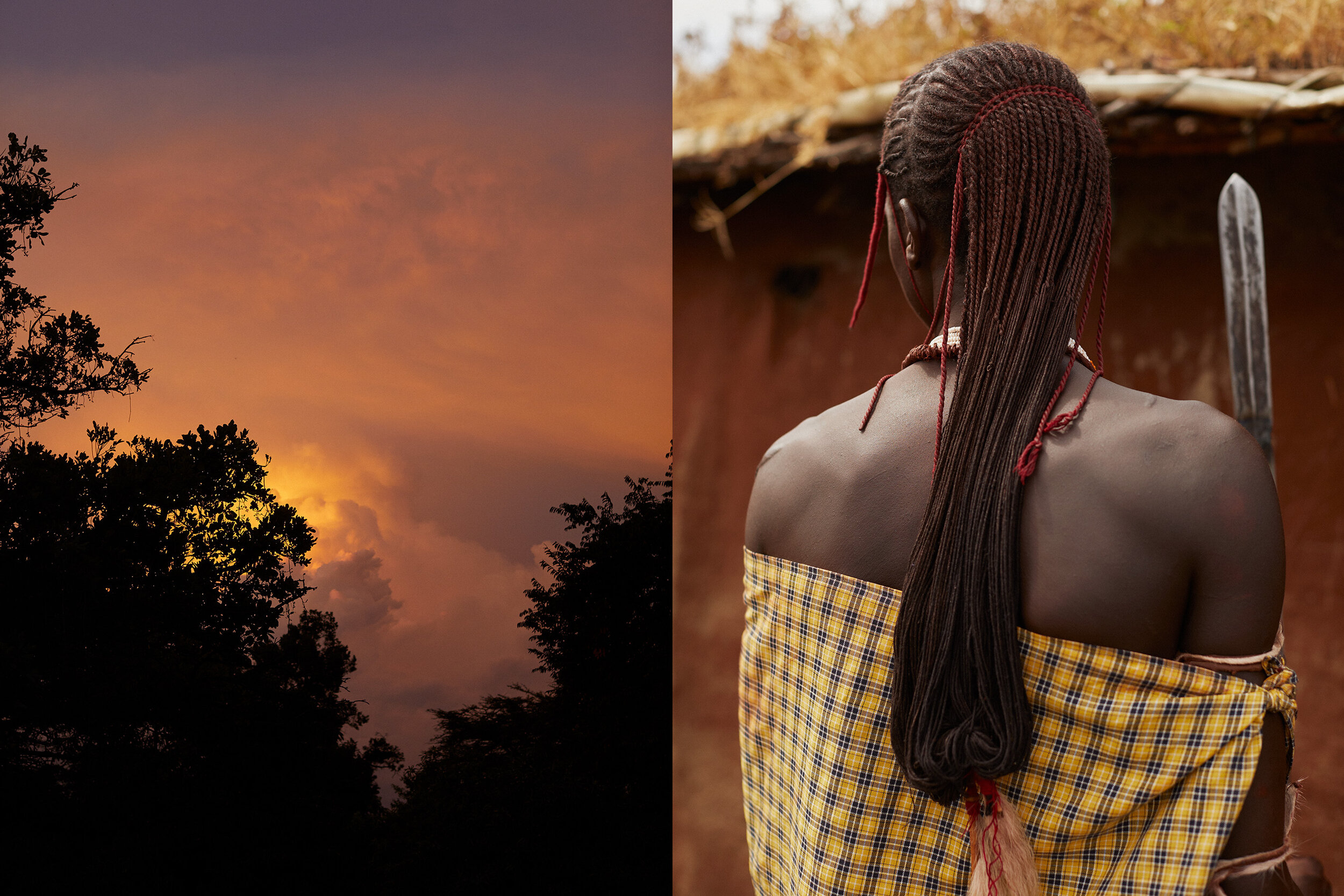
The Daily Edit – Getting it Right in Camera: Daniel Pullen


Daniel Pullen

Heidi: You started during the tail end of disposable cameras and analog creativity—how did that impact your early career? 
Daniel I started with disposable cameras, then eventually moved on to a point-and-shoot and then an SLR. Shooting with film was challenging for me; it had a steep learning curve. You would wait weeks to get the film back, only to learn from your mistakes. Additionally, I couldn’t afford a lot of film, so I had to be selective about what I wanted to shoot. You really had to think about what you were photographing. Now, with digital, I often find myself not thinking and just firing away—there’s not even an inkling of thought, just mindless shooting. Forcing myself to slow down is difficult; however, I find that I make better photographs when I take my time. I believe that slowing down works for both photography and life.

Homesick was your first zine, documented on film, followed by Mommicked—both have soul-stirring narratives, why no surf photography?
Homesick was a zine my wife and I put together; they were all shot over a few years using a digital camera. The idea was to highlight aspects of Hatteras Island that I would miss the most or things that are dear to me. There are very few surf photos, but the ocean is prevalent in the zine. Surfing is obvious; however, I didn’t want it to revolve around surfing. There is so much more to life here than just surfing. Hatteras Island is incredibly dynamic, and putting surfing prominently in my work would have pigeonholed it. A couple of years later, we released Mommicked. Mommicked is about living through and navigating heavy weather here on Hatteras and how it impacts our community. Once again, even though surfing is the obvious focus, I chose to go in the opposite direction—to showcase what truly happens here before, during, and after storms. I guess I moved away from surf photography and fully embraced documentary photography.

How did working with film inform your digital work, if at all?

When I began photography, I was shooting film. Since I wasn’t developing my own work, I had to get it right in the camera, which became ingrained in me: get it right in camera, get it right in camera. That mindset has certainly carried over into the digital side of photography. Although there is more leeway with post-processing, I still aim to do my best in getting it right in camera, which also means less time sitting in front of a computer.
You’ve been photographing dynamic weather for almost 30 years—how did that documentary work evolve into a successful wedding photography business?
Documenting weddings and family portraits provided income to cover my bills and living expenses. Documenting the weather has always been a passion for me, but it never really generated that much income. Even to this day, it doesn’t generate income, but photographing weddings and family portraits gives me the time to shoot the things I’m passionate about (weather/surf) that don’t generate income but feed my soul. I photograph an average of around 40-50 weddings and about 90-120 family portraits a year. This allows me to pursue my passions while managing wedding and portrait numbers, which is definitely a juggling act.

Tell us about the making of this photo from an abandoned rental home and the trajectory that followed.
We are a really small community here, and pretty much everybody knows everybody. You grow up with half the island. It has its faults, but for the most part, it’s great; I love the small-town vibes.
The houses aren’t abandoned; they are rented out by the week. I think, for this particular storm, the people who were supposed to stay at that house were moved to one that wasn’t flooding. My friend Jake Throne posted a video of water pouring into the downstairs area of the house, which had a pool table in the middle of the room. I texted him to ask which house it was. I knew it was in a general area but wasn’t sure which particular house it was.

The next morning, I went out with my daughter and entered the house I thought Jake was talking about, but it turned out to be a completely different one. When we went in, the pool table was racked; someone had already played and set it back up. My daughter broke the balls, and I snapped a few pictures of her playing pool. I then asked her to step out of the frame so I could take a few empty shots. There wasn’t a danger of getting arrested for trespassing, just the potential for a tongue-lashing for being in a rental house. We yelled before stepping inside to see if there were any renters there, but it was empty.

There is a massive rental home industry here on Hatteras Island and the Outer Banks as a whole. When I was a kid growing up here, there weren’t many houses on the beach. The rental property industry exploded in the 80s and 90s, with very few zoning laws to keep things in check. Thank God for the Park Service and the National Park, or else every square inch of the island would have been developed. Homes weren’t necessarily built on the beach, but over time, they have ended up there due to island migration, erosion, and sea level rise. Now, there are rows of houses in each village that are in danger of being destroyed by the ocean. When it’s calm here, the views from the houses are great, and the proximity to the beach makes for a short walk to the ocean. However, that doesn’t translate well when we have a storm.

I snapped about 10-15 frames, was in the house for about 5 minutes, then left. I shared the image on Instagram, and within 24 hours, an editor from Time Magazine reached out to me. It was initially supposed to run in a climate change issue but ended up as an image in Time’s Top 100 of 2020. It’s surreal to have the image in that collection, especially since it seemed like the world was on fire back then, and the images taken worldwide were incredible. Having a photo in that collection will always be a career highlight for me.

You’re a self-described climate advocate and have been documenting the barrier island, which behaves like a living, breathing piece of land. When did you start to see catastrophic changes, and what are your hopes for this body of work?
I live on a barrier island off the coast of North Carolina. It is a sandbar—a thin strip of sand located 30 miles out in the Atlantic Ocean. It’s a wild place. Barrier islands are supposed to migrate over time from east to west. When you take something as dynamic as a barrier island and place static structures on it, like roads and houses, conflict is bound to arise over time. It’s a slow process, but it currently appears to be happening rapidly; this has been building up over the past 40-50 years. Houses are falling into the ocean, and roads are washing out. That has always happened here, but due to the way homes were built in proximity to the ocean, we are witnessing drastic changes. I think we have lost about six houses this year due to island migration, erosion, and sea level rise, and the road has washed out numerous times. As for houses collapsing, there has definitely been a shift over the past couple of years, and it is only going to get worse. I don’t have a specific plan for what will happen with the photos I am creating about these storms, but for now, my aim is to tell the story of how our community is dealing with these weather events. If my work can somehow inform policy changes related to zoning laws and educate people about how barrier islands function, I suppose that would be the long-term goal. At some point, I would selfishly like to create an updated version of Mommicked.

You grew up in Buxton, NC, home to the famed Old Lighthouse Beach, the spot where East Coast pro surfing was born. Russell Blackwood, a great surfer and photographer, was a friend and mentor and he passed down advice along with his old Nikonos V camera. Years later, Russell’s son, Wolfi, named you as one of his mentors. What does that say about the Cape Hatteras community?
Daniel: I wouldn’t say I’m one of Wolfi’s mentors, but we are good friends. I got to see Wolfi grow up and was there for his first attempt at paddling out at big Lighthouse and getting denied. I’ve witnessed him turn into an amazing surfer, charging the Lighthouse at its absolute rawest. We still surf together—me, Wolfi, and his dad. Wolfi and his wife are expecting a girl in a couple of months, starting a family of their own. It’s super odd to think that our kids will grow up together since I have a 20-year-old, an 18-year-old, and a 1-year-old. Our community is incredibly tight-knit. We are small, and for better or worse, we experience our community’s highs and lows. I wouldn’t have it any other way.

Best career advice?
I wish I would have gotten this advice when I first picked up a camera (but I prolly wouldn’t have listened)…over 30 years ago.
Buckle up….
Compose and wait.
Create photos that resonate with the heart.
Do what it takes, do the work.
Be honest with yourself.
Don’t take the easiest safest path.
Technical has to be automatic…like breathing.
Make your work personal.
Look beyond the obvious.
Compose and wait…(needs to be said again and again and again)
Work the scene.
Trust your gut.
In every situation there is opportunity for a great photograph.
Always shoot with a purpose.
Show the truth.
Success does not give you knowledge, failures do.
Start appreciating things around you.
A moment can change your life.
Great photography is always on the brink of failure.
In any given moment…we have two options…to step forward into growth…or step back into comfort…

And worst?
Probably when I was starting to shoot surf photos.
you need to shoot really tight.
You have to shoot surfing a certain way…
Looking back it was so cookie cutter…but I get the advice…it was a way to help you produce surf images that fit into a narrative or into the pages of a magazine or website…
But leaves absolutely no room for growth or creativity

The Daily Edit – Standing Strong: Josué Rivas

Canoe ceremony at Oceti Sakowin Camp. Cannon Ball, North Dakota, USA. August, 2016.
Children running free. Cannon Ball, North Dakota, USA. August, 2016.
Men setting up an altar. Cannon Ball, North Dakota, USA. August, 2016.
Spirit of the Missouri River. Cannon Ball, North Dakota, USA. September, 2016.
Man braiding his hair. Cannon Ball, North Dakota, USA. September, 2016.
Tepee poles. Cannon Ball, North Dakota, USA. November, 2016.
Thanksgiving ceremony. Cannon Ball, North Dakota, USA. November, 2016.
Water of Life. Cannon Ball, North Dakota, USA. November, 2016.
Police mace Water protectors. Cannon Ball, North Dakota, USA. November, 2016.
A group of women carry a wounded warrior. Cannon Ball, North Dakota, USA. November, 2016.
A man gets treated with a solution made of half liquid antacid and half water after being sprayed with mace. Cannon Ball, North Dakota, USA. November, 2016.
Police barricade. Cannon Ball, North Dakota, USA. November, 2016.
Chief Arvol Looking Horse sits near the Dakota Access Pipeline during a prayer. Cannon Ball, North Dakota, USA. November, 2016.
Resistance. Cannon Ball, North Dakota, USA. November, 2016.
Matriarch. Cannon Ball, North Dakota, USA. November, 2016.
Water protector praying by the river. Cannon Ball, North Dakota, USA. November, 2016.
A girl and her horse. Oceti Sakowin Camp. Cannon Ball, North Dakota, USA. November, 2016.
Diné walker. Cannon Ball, North Dakota, USA. November, 2016.
Elder praying during a peaceful demonstration. Cannon Ball, North Dakota, USA. November, 2016.
People cross a handcrafted bridge to Turtle Island, a sacred site and burial ground. Cannon Ball, North Dakota, USA. November, 2016.
People stand near a handcrafted bridge. Cannon Ball, North Dakota, USA. November, 2016.
Man under a tepee near the Dakota Access Pipeline. Cannon Ball, North Dakota, USA. November, 2016.
A woman walks in the snow during a blizzard. Cannon Ball, North Dakota, USA. November, 2016.
Two men get sprayed by law enforcement with high pressure water during a demonstration near the Oceti Sakowin Camp. Cannon Ball, North Dakota, USA. November, 2016.
Last stand at Oceti Sakowin Camp. Cannon Ball, North Dakota, USA. February, 2017.
The end of the Oceti Sakowin Camp. Cannon Ball, North Dakota, USA. February, 2017
People peacefully leave the Oceti Sakowin Camp. Cannon Ball, North Dakota, USA. February, 2017.
Sacred Fire. Fort Yates, North Dakota, USA. September, 2017.
Young man putting down tobacco. Fort Yates, North Dakota, USA. September, 2017.
People harvesting wild sage. Fort Yates, North Dakota, USA. September, 2017.
Young man leaving a tepee. . Fort Yates, North Dakota, USA. September, 2017.

An upside down American flag waves at a healing gathering. Fort Yates, North Dakota, USA. September, 2017.

Creative Director: Josué Rivas
Founder of  INDÍGENA

Heidi: You drove 1,400 miles to Standing Rock and committed seven months of your life to being in the community, serving as a witness and documentarian to ensure that Indigenous perspectives were included in the narrative. Eight years later, the images made in “Standing Strong” remain iconic and impactful. How has this body of work informed your creative evolution?
Josue: In retrospect, I gained a deeper understanding of the significance of a movement transcending traditional creative practices. The protocols and prayers I experienced, led by both elders and youth at Standing Rock, were integral to this transformation. Addressing the question of creative evolution, it’s fascinating to reflect on how this large gathering was inherently infused with conflict. The challenge lies in honoring these moments through spiritual practice while still innovating the narrative. My approach to creating that work was rooted in intention—seeking to create a space where we could tell our own stories, which I believe is a fundamental human right. I think there’s something we can all learn from Indigenous stories, especially in this current time.


Two of your illustrated images appear in “Protecting the Right to Protest,” written by Annie Leonard. Can you share the story behind the weather conditions on the night when two water protectors were sprayed by police with high-pressure hoses? The image holds a tension between peace and violence, appearing almost magical at first glance.
On November 20, water protectors were sprayed with freezing water by law enforcement. Standing Rock represented a moment in time we probably won’t relieve in a while. These impactful moments served as a portal—through my documentation I hoped to document an awakening for both Indigenous peoples and society at large.

One of my mentors, Nick Tilsen who is the president and CEO of NDN, described this as the “curb cut effect.” When certain groups are treated with dignity, it leads to broader societal and cultural shifts in how we treat one another. The stories I create aim to ignite a piece of this curb effect by honoring Indigenous sovereignty.

Looking at Standing Rock and the lasting value of that work in society, I see how it can continue to evolve. It was during my time in the Magnum Foundation Fellowship with Fred Ritchin that he encouraged me to let go of the pressure to be overly precious about my images. He reminded me that I don’t have to be a traditional photojournalist or win a Pulitzer Prize to create images that are a cultural currency to society. This approach has influenced how I approach my later projects. The collaboration with Patagonia was a reflection of this, layering existing images with elements not visible through the lens.

How did your storytelling process align with current cultural narratives?
During my time at Standing Rock, I began to grasp the longevity of the experience and its stories. Storytelling should not merely document a fleeting moment or platform, nor should it reside solely in a viral image. The iconic image had a profound societal impact, yet it can be exchanged for something more immediate—a viral video or story that shifts perceptions and cultures. Layering images creates a new toolkit for storytellers. We are shifting away from the notion that an award represents the pinnacle of achievement, and embracing how short form videos or images from a smartphone can profoundly influence communities and society.


Purpose, collective healing, and the power of community are central to your work. Why do you believe this story held purpose and power?
In an era where social media dominates our lives, it’s crucial to remember that it can serve as a transformative tool—regenerative instead of exploitative. My intent is to reveal through this work that transformation is possible when you share your story.

I’ve always appreciated the added layers of context that photography and storytelling can provide, tell us about your process.
With the Patagonia project, we layered images, granting the process its own significance while remaining open to how it might be perceived.
For “The Right To Protest” project, I collaborated closely with artist Tekpatl from our creative agency INDÍGENA. Despite my busy schedule, we leaned on one another to showcase various layers of the story. This collaboration was particularly poignant since the images we illustrated were created on Thanksgiving Day about seven years prior. Tekpatl brought balance to our work, grounding it by representing unseen energies in the images—using a technique Yael Martinez introduced in photojournalism, who has been a significant inspiration

Please download, print this image and scan the QR code in the bottom right.

When did you begin incorporating AR into your photography? Was “Be a Good Ancestor” the starting point for your multimedia and motion work?
I’ve always seen myself as more than a photographer and more of a conduit to something bigger than myself. My intention is to be of service. What happens when we accept that images are tools for society, not mere illusions; they can convey truths. Can one story carry a universal truth?

To try and find the answer to some of these questions we created “Standing Strong,” a multi-disciplinary visual project using augmented reality and community intervention. This project showed how we can innovate within our imagery while embracing new technologies—the message continues to evolve and spread.

Empowering Indigenous youth and refining journalism to be more inclusive and collaborative are essential values in your work. Fast forward to 2022; as a juror for the World Press Photo Contest and with your recent inclusion in the ICP’s exhibit “We Are Here: Scenes from the Streets,” have you noticed increased representation among storytellers?
Yes and no, at times I see the intention for collective change and it’s also a process. I think our days are ahead as we build systems to transform visual storytelling. I think it’s the beginning of the blossoming of years worth of work by people that came before us, we just keep doing the work.

You founded INDÍGENA. Are you returning to your role as a witness and documentarian, ensuring Indigenous perspectives are part of the narrative—especially in light of recent election results?
Social Justice Documentary work is always going to be part of my creative practice, it’s also limiting. I see this practice as an evolving song, an offering. Currently, I am co- documenting stories from boarding school survivors through a trauma informed lens. We are also innovating the way we tell those stories. Reflecting on the recent election results, I see how images will be powerful tools for communication and change but also confusion. We have reached a point where images serve not only as interpretations but as instruments for shifting societal consciousness. Ultimately, I hope my work demonstrates that transformation is possible when you share your story.

The Art of the Personal Project: Karan Kapoor

The Art of the Personal Project is a crucial element to let potential buyers see how you think creatively on your own.  I am drawn to personal projects that have an interesting vision or that show something I have never seen before.  In this thread, I’ll include a link to each personal project with the artist statement so you can see more of the project. Please note: This thread is not affiliated with any company; I’m just featuring projects that I find.  Please DO NOT send me your work.  I do not take submissions.


Today’s featured artist: Karan Kapoor

My shoot with Alon Fainstein began during a project I was shooting in Cape Town, where I was introduced to him by my producer, Gavin Schneider. Alon is not just an ironmonger; he is a storyteller, weaving narratives of transformation and discovery through the medium of metal.

I am drawn to photographing people who are deeply passionate about their work, and Alon embodies this passion fully. As he reflects, “Every time I work, I learn and discover something new about the material and myself. I feel that my work grows and evolves with me. The two are symbiotic and go hand in hand. To say that there are limits to forging would be to say that there are limits to inspiration, creation, and growth. When I feel connected, I find them in an abundant supply.”

Through my photographs, I aim to capture the essence of this connection—the symbiotic relationship between Alon and his craft. His workshop becomes a stage where sparks, textures, and shadows reveal the ongoing dialogue between artist and material, inspiration and creation. These images celebrate the unyielding spirit of those who find beauty and meaning in their work, reminding us of the boundless potential within ourselves and the world around us.

To see more of this project, click here

Instagram

APE contributor Suzanne Sease currently works as a consultant for photographers and illustrators around the world.  She has been involved in the photography and illustration advertising and in-house corporate industry for decades.  After establishing the art-buying department at The Martin Agency, then working for Kaplan-Thaler, Capital One, Best Buy and numerous smaller agencies and companies, she decided to be a consultant in 1999.  Follow her on Instagram

Charlotte Schreiber Breaks Up With Her Identity As A Photographer

by Angie Smith

Angie: How did you get started in your career as a photographer?

Charlotte: I’ve been a photographer for the past 15 years. I studied photography here in Germany. I had chemistry and art as majors before I finished high school. We had a photography assignment and there was a small dark room that we could work in. I know it sounds so cliche, but when you are in the darkroom and the image suddenly appears on paper, it’s this magic moment. I said to myself: ‘Oh, this is fun and I think I’m good at it. Is a photographer something that you can become? Let’s see how this plays out.’

Me and my father‘s first 6×6 camera, ca. 1989.

Sometime into studying, my father passed away and I had to get rid of his things. The attic was full of his photographs and Super 8 films. I remembered that he taught me a lot about photography. When we would go on holiday, he always had a camera. There are pictures of me as a 4-year-old trying to take pictures. Now looking back, I realize photography was such a big influence, it was always there. So the idea of becoming a photographer didn’t feel too far-fetched.

Angie: What was your first published photo?

My first proper assignment was for Nylon magazine.

I was interning with a photographer in New York and she had to travel to LA for work. She said: ‘I can’t take you with me on the shoot, but you’ll have time, so I’ll give you contacts. Why don’t you show your portfolio around?’

I said: ‘I don’t have a portfolio.’

She said: ‘Okay, when I’m back, you’ll create a portfolio and start showing your stuff around.’

She gave me all her contacts. I was very young and I had no fear. I would go everywhere and anywhere. I went to Nylon Magazine and asked for a meeting. I had my meeting and the next day, they called me with a small shoot. I got paid $50 for it, which I would never accept now, but I thought: ‘If I can do this in New York, I can definitely do it in Germany.’

After my time in New York, I photographed a cookbook with a friend. We sold the concept to the publishing company– that was the first book that I made and was the gateway into my next project, Makers of East London where I visited artists in their workshops across East London, documenting their workflow. That period of time was full of a lot of coincidences and luck and it was one of the most important times that prepared me for everything else because I was constantly producing photographs for my portfolio.

When people ask what kind of photography I do, I say that it’s everything that’s atmospheric.
I’m a very emotional person and I do emotional portraits, but what I’m good at is giving people space. My portraits are good because I can hold space for people to just be themselves. Which I find is important for the work I do.

Often, the person will see their image and say: ‘No one has ever photographed me like that. I feel like it’s the first time that somebody has seen me the way I really am.’ That is the biggest compliment you can probably get as a photographer.

Fashion editorial for Le Mile magazine, photogra- phed in my first studio in 2015.
Author Peter Høeg at his hideway place in Denmark, 2015.
Tokyo, 2016.
Tokyo Metropoliton Government Building, 2016.

I’ve been freelance for the past 15 years. The pandemic was quite good for me. I think it divided the people– some stopped working and for others, it fueled them.

I was successful because it’s just me and my camera. I don’t have much overhead, assistants and tons of equipment. During Covid, people knew I could be distant from the subject and shoot quickly. That was kind of my thing and editors knew they could get what they wanted.

I think a lot of photographers pushed through the pandemic and then it came to that point for me where it wasn’t working anymore. I didn’t get assigned to anything. People stopped reaching out. Financially it was really, really bad. In the beginning, I thought, well, it’s gonna pick up but it never really picked up.

In a way, I got lucky because I was dealing with an illness and I couldn’t do anything. I had to stay in bed for a really long time and I was constantly thinking about my career not working.

I had a lot of time and I was thinking about what else I’d be good at. I have experience with grief and death in my family. And it’s been something that I’ve had to deal with and do on my own. In Germany, no one talks about grief and death because you’re not taught how to.

I photographed a grief counselor once and the memory popped in my head again. I thought: this could be something. The second I said it out loud, I thought: This is what I’m going to do.

I applied to a program and it’s going to start in May. The training goes for about a year and then I’m a certified grief counselor. After that, I want to go into the funeral business.

I think what connects grief work and my photography is that I’m able to find beauty in whatever I see. Obviously death is not beautiful but it is natural, it’s part of life and it’s happening for all of us. To define the beauty in something makes it easier for people. And to be honest, we are all gonna die. It’s just something that’s part of life.

Anne Petersen for Mercedes, 2021.

Angie: What has the grieving process been like with your photo career changing? Have you let go slowly or made a sudden cut?

I do feel like I need to make a cut. I think I’ve just reached the point where I know I am good at what I do but I also have so many more talents and it’s just time for me to move on. Photographers put so much into their careers—it’s just so personal. Every time you get rejected, it’s hard to not take it personally.

Photography is something that I’ve been successful at and I’ve loved it. But I’ve been angry for so long. I’ve asked: ‘Why? I don’t want it to be over. It’s something that brought me so much joy. I met amazing people and I went to great places. Why is this ending?’

Christine Lagarde, president of the European Central Bank, photographed in 90 seconds for manager magazin, 2022.
Jens and Marc Brune for manager magazin, Norderney 2023.

I have a small studio and I have it for another couple of months. I made an offer to people who want to be photographed– that they can come to the studio and pay whatever they can afford for a portrait. This is me slowly saying goodbye to the studio.

I’m probably going to keep one small point and shoot. I don’t think I cannot take pictures. It’s something that I’ve done for the past 20 years– it’s a big part of my life. When I talk about it with people, I feel happy with the decision and that it’s the right decision but I’m also sad and I circle back to the same question: ‘Did I do something wrong? Is it my fault that my photography career isn’t working anymore?’

I’ve been breaking up with my identity of being a photographer and I have been going through all the stages of grief over that.

Angie: What a beautiful way to say goodbye. When did you know it was time to throw in the towel?

I think that’s everybody’s own personal decision. I’m slowly approaching 40 and I always want to know how to pay rent. I’m just tired of constantly being the person saying to the photo editor: ‘I need more money. I can give you what you want but you have to pay me properly because I’m good at what I do.’

I’m young enough to start over and feel like I can do so much more. And you know, I don’t want to be that person in 10 or 15 years when there’s no no other way. I am at peace with having made that decision and I’m excited to do something different. But I still ask myself: ‘Why did this not work? Is it my photography? Am I not at the right time in the right spot? Should I have done something differently?’

I am a hard worker and I gave it my all – but it just didn’t happen.

Lisa in the studio, 2024.
Sarah in the studio, 2024.

[Six months later…]

Angie: How did it go letting go of your studio? How did that feel and where are you in the process of changing careers?

I am still working on letting it go. I’m starting to slowly be okay. It’s still a dream that I had to give up. I have been crying a lot. When I went through images of my career for this interview, I was going through my archive, bawling my eyes out. This has been a great 10-15 years of lots of hard work. I did amazing things and I met amazing people. Sometimes I still ask ‘why do I have to stop doing this? I am really good at what I do’.

I just started the grief counseling program and I am in the middle of it now. Going through the training, we talk a lot about finding creative ways to make people feel comfortable and seen. Taking portraits of people is very similar– trying to empower people and have them look at themselves and make them feel good and seen and safe. I realized that they are trying to teach me something I have been doing for the last 15 years.

Angie: How does it feel to be on the other side of changing careers?

It’s been a really hard process with so many layers but I’ve finally come to a point where I am excited to reinvent myself. I am so free, it scares the shit out of me. I can be whoever I want, I can explore myself and different ways of living.

In the beginning I thought I wanted a hard cut from photography. But at this point, I am starting to be softer with myself about ending it. I have no clue where I will end up, I am just here trying my best to find myself and find new ways to explore my talents.

With photography, I have more boundaries than I used to have, which gives me the freedom to be more myself with making photography work. I am declining a lot of jobs because I don’t accept the terms or budget and it gives me the freedom to choose what I am the best at. I am making great work now because I don’t care as much about what I should do. I am excited for the first time in a very long time. I found my way back to why I got into the business in the first place. Sometimes I wake up and ask myself: ‘Who am I today?’ It’s so nice. I am trying to be gentle and give myself space and see where life takes me.

The Art of the Personal Projects: Kip Dawkins

The Art of the Personal Project is a crucial element to let potential buyers see how you think creatively on your own.  I am drawn to personal projects that have an interesting vision or that show something I have never seen before.  In this thread, I’ll include a link to each personal project with the artist statement so you can see more of the project. Please note: This thread is not affiliated with any company; I’m just featuring projects that I find.  Please DO NOT send me your work.  I do not take submissions.

Today’s featured artist:  Kip Dawkins

Photographer Kip Dawkins recently took on a personal project aimed at capturing the character and light of the Southern California desert. Unlike his work as a commercial photographer, there was no styling required for this shoot. Instead, he met and photographed partygoers at a van show and rock concert. The images radiate a sense of danger and freedom. The muted tones add an extra layer of authenticity, drawing the viewer into this subculture and the spare beauty and outlaw vibe of the desert.

To see more of this project, click here

Instagram

APE contributor Suzanne Sease currently works as a consultant for photographers and illustrators around the world.  She has been involved in the photography and illustration advertising and in-house corporate industry for decades.  After establishing the art-buying department at The Martin Agency, then working for Kaplan-Thaler, Capital One, Best Buy and numerous smaller agencies and companies, she decided to be a consultant in 1999.  Follow her on Instagram