Ian Parry Scholarship Deadline- June 20th

Ian Parry was a 24 year old photojournalist who died while on assignment for The Sunday Times during the Romanian revolution in 1989.

To honor him his friends and family set up a scholarship where each year a competition for photographers who are either attending a full-time photography course or are under the age of 24 is held. Entrants must submit a portfolio of their work and a brief synopsis of a project they would undertake if they won. The prize is £2,500 towards their assignment. Metro Imaging also offer £500 worth of vouchers to the winner.

Additionally, World Press Photo automatically accepts the winner onto their final list of nominees for the Joop Swart Masterclass in Amsterdam.

Visit the website to sign up (here).

Photoshelter Announces New Stock Photography Event

July 20th is “Shoot the Day” and Photoshelter is throwing a huge event with classes, competitions and parties (here’s the website) and there’s plenty of stuff to sign-up for so get going cause it looks like spots are limited.

They’ve also got an interesting shoot competition happening where 20 PhotoShelter photographers will be chosen (after applying first) for fully staffed photo shoots. All photo shoot expenses will be covered, including location, prepping models, lighting, and analysis of images. A makeup artist, stylist, and photo assistant will be provided where possible. Not sure if that includes the traditional “Sushi, Wrap Dinner” where the photographer and photo editor try to get fired by eating and drinking the entire shoot budget in one sitting, but if it does count me in.

Additionally, PhotoShelter surveyed over 700 photo buyers, editors and art directors and discovered an urgent need for certain types of imagery in the global supply of stock Photography.

Can you guess what item from the following list was on that survey?
[Poll=3]

The answer is (here).

If that’s not enough, they also just launched a new feature called School of Stock (here) where photographers can go get skooled on the in’s and out’s of the stock photography business. There are sections on production, model releases, lighting and topics that buyers are interested in are explored in depth. There’s even a section for newbies that simply defines stock photography. Apparently the definition has changed (here) since I started in this business and stock is no longer defined as “shit leftover from a shoot that nobody wants.”

An Endless Stream Of Photography

The stream, it’s more like a fire hose really, so whatever you do don’t try and take a drink from it. I found these two posts by Liz Kuball (here) and Robert Wright (here) on the sheer volume and mediocrity of photography on the web quite interesting. Interesting because there’s a side to this business that normally only Photo Editors and Art Buyers are privy to. The volume and desperation of an enormous group of aspiring somewhat professional even sometimes highly professional photographers that those on the hiring side of this equation are exposed to on a daily basis. The mountains of promos, the book drops, the phone calls and the stock. Oh, god the stock, let’s not even get into the stock photography here, because that’s a pile of shit you’ll never get through with a grain scoop. Backhoe maybe, shovel never.

Anyway my point here is that there’s so much going on in this business that’s not worth paying attention to. I’m not even talking about the amateur stuff that’s gone from the shoe box to flickr or on the personal website either, I’m talking about photographers who make money shooting shit.

David Alen Harvey has it right when he says, “all of you are now in a position to show your work in a way i never had nor did anyone in my generation have..the net….right here…right now… this forum…if you go out and do the work, you will be seen by more potential Medici’s than i have seen in my entire career….yes, yes (i can hear the excuses already) there are more of you…true….but in the sea of photographers out there , i still see about the same number of “supertalents” as in years prior…more people taking pictures, but few doing it in a special way….but if you are “special” there are also way way more opportunities…and so so much room for invention….i swear, i have never seen so much room!!!”

You’re seeing what I’ve been looking at since I started in this business. The volume of noise is loud but the signal is the same as it has always been, clean, pure and tranquil.

Listen for the signal.

Sam Zell Attempts To Destroy His Newspapers

Mr. Zell, not satisfied with the slow decline in advertising and audience his recently purchased newspaper empire (which includes the Chicago Tribune and LA Times) will most certainly experience over the next decade, decided to quicken the pace by trimming news pages across the board and inserting more simple to digest graphical content (a la USA Today). Additionally, in an unprecedented move it was announced that control of the LA Times Magazine would be turned over to the business side of the company (after replacing the entire editorial staff, natch) in what I can only assume will be the making of a giant advertorial for whomever is buying. Sam Zell’s magnanimous failure as a media baron will be clearly marked by these enormous blunders and I suppose the only winner in this is for the NY Times as readers will likely flock to them for in-depth reporting on news stories.

The Graphic Design of Geoff Mcfetridge

I really dig the work of Geoff Mcfetridge and in this video (here) he talks about creating work that is personal, so when people come to you for something they saw in it you can simply expand on the relationship you already have with it. That’s good advice for all creative people.

He’s also in the Beautiful Losers Movie.

Photo Assistant Resource

Anything you want to know about becoming an assistant or if you’re a photographer looking to hire an assistant can be found at: http://www.1prophoto.com/

I love how the review of the new OctaPlus57 includes this important tidbit: “No more pinched or smashed fingers during setup or break down like you get with the Elinchrom Octabank.”

Can Visa pour l’Image Remain Relevant?

For the past 19 years photographers and photo editors have gathered near the Spanish border in Perpignan, France for a grand festival to celebrate photojournalism. This years festival from August 30th to September 14th will mark the 20th such meeting and I have been handed an interview with Jean-François Leroy the festivals founding and current director, where he tackles a few of the hard questions facing photojournalism and acknowledges completely missing the boat on the internet.

In 2000 I was scheduled to attend for my first time and my ticket was abruptly canceled by the editor when it was determined that visiting the festival was an unwise expenditure of our resources in suddenly tightening budgets. The opportunity to go never presented itself again and so I’ve been stuck hearing the stories of what went down from the people who visited but never having access to the photography or lectures presented at the festival to incorporate into my own magazine.

This of course, is the problem with Visa pour l’Image, everything that happens in Perpignan stays in Perpignan. And, now it’s even more serious because not only have you missed the opportunity to reach hundreds of photo editors who couldn’t attend you now need to reach beyond the magazines and convince consumers that important, powerful stories like the one’s featured at the festival need to be seen in publications. The consumers are in charge now and it’s only going to get worse so convincing Editors and Photo Editors to buy stories is no longer good enough, you also need the support of the end user.

The internet is the perfect medium for photojournalists and documentary photographers to show their work and if Jean-François is serious about keeping Visa pour l’Image relevant he needs to find ways that the festival can reach beyond the city limits of Perpignan, so we can all hear about the great reportages that were shown and the one’s that need a home and in many cases some will reach consumers online without a publication.

It’s time for someone with a powerful voice in the world of photojournalism to take the reins and lead this industry to the next level. I think Jean-François Leroy may be the right person to do it. Here’s an excerpt from the interview:

You’re great friends with Paul Fusco, from Magnum Photos, and often work with him. What’s the story behind that friendship?

In 2000, Jean-Bernard Maurel, who was working with Magnum Photos at the time, told me he’d found something in a drawer and was I interested. He pulled out a report Paul Fusco had done in 1968 after Bobby Kennedy’s assassination. Paul had covered the funeral train carrying the coffin placed on an open car and draped with the American flag, going all the way from Los Angeles to Washington. Thousands of Americans had gathered along the railroad track to see the funeral train go by and pay their last tribute to Bobby Kennedy. Paul, who was beside the coffin, photographed all these people, this cross-section of America bidding farewell to a dead man. For 32 years, the report had never been published! No one had shown any interest in it! We featured it as an exhibition at Visa pour l’Image, in a linear presentation, as if we too were in the train and were traveling across the States. When Paul arrived in Perpignan, he gave me a hug and said: “At least there’s you to understand my work.” And we’ve been great friends ever since. I really admire him as a photographer; his work on Chernobyl was outstanding and had all of Perpignan in tears. I think it’s such a shame that there are some people today who make millions, and a man like Paul, whose work is of such historic importance, is virtually destitute! That really riles me!

Without mentioning any names, some of the top ten photographers in the world today, including war photographers, “live in a garret”, surviving on less than 1000 euros a month, struggling to make ends meet.

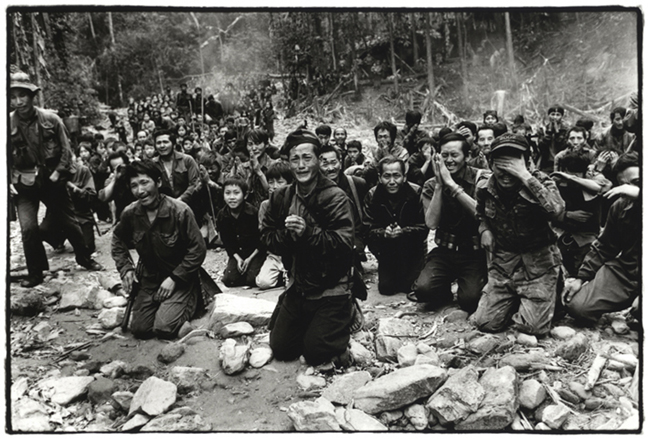
Philip Blenkinsop- NoorYes, it’s a real problem; I’ll give two examples. Yuri Kozyrev is a contract photographer for Time Magazine, and has been going to Baghdad a couple of times a year for the last five or six years. Now look at his work, at what he produces, then compare it to what you see in Time. There is a gaping abyss between what his real work is and what gets published. Another example is Stanley Greene who wanted to do a report in Afghanistan and needed to find 8000 euros to get there, but couldn’t raise the money. I’m sorry to have to say this yet again – everyone’s getting sick of it, and I’m told that I’m biting the hand that feeds me– but we have to stop saying that the press doesn’t have any money! The press can find the money to buy exclusive rights to celebrity photos. A couple of years ago, one weekly magazine paid 150,000 euros for the exclusive rights to Jean-Paul Belmondo’s wedding; and they can’t fork out 10,000 euros to send Stanley Greene to Afghanistan for a month! It just makes me wonder. Fifteen years ago, when a newspaper commissioned a report, the paper would insure your equipment, pay for 150 rolls of film, cover all the lab development costs, and so on. Nowadays, you do digital work, your cameras aren’t paid for, you’re not even given a memory card – nothing. A digital camera costs a lot more than the camera you had fifteen years ago. And we’re not supposed to voice any criticism? Over the same period, the price of a page of advertising has gone up by a factor of 2 or 2.5; compare that to the prices paid for photos which have gone down by a factor of 2 or 2.5! Christophe Calais told me that he wanted to go to Kenya to report on the events there; he called a magazine he often works with, and was told “Listen, if you get the chance to take a shot of Obama’s grandmother, and if we do a double-page spread, I’ll give you 300 or 400 euros.” Hell! He wasn’t going there to do a Grandma Obama celebrity shoot! That’s the real problem, you see. Everything has become celebritized, everything is nice and clean, and we’re told that we mustn’t show any violence, but celebrities instead. Yet when you look at “real TV”, you’re shown violence! Lucas Menget, a top reporter with France 24 and a member of the Visa pour l’Image team, did an excellent 26-minute report on Iraq, and you can see violence there in his report. Just talk to Stanley Greene, Christophe Calais, Enrico Dagnino, Paolo Pellegrin, Noël Quidu, Laurent Van der Stockt, and so many others whose names I haven’t mentioned; they see violence out there in the field, in the events they cover. That’s the real story!

When we ask our parents and grandparents what they did about the Nazi concentration camps, they tell us that they didn’t know about them. And it’s true that many people only discovered what had really happened in the camps when they saw photos taken by Lee Miller and Margaret Bourke White. Today we’re lucky enough to be able to see everything. No country is completely closed off; it might be difficult to take pictures in Burma or North Korea, but you end up getting something. With modern transmission facilities, satellite phones and all the advances of communication technology, it’s much easier than it used to be. So what will we say when our children and grandchildren ask us what we did about Darfur? It’s a philosophical problem. Photographers and journalists, whether with the written press, radio or television, often run the most extraordinary risks so that they can show what’s really happening. For years we were told we had a duty to history, then a duty to remember, so let’s now say that we have a duty to see and to look! I don’t want to live in a virtual world, a nice little, cuddly, fluffy world where everybody’s happy, where everyone is sweet as sugar candy and where everyone has heaps of money. People often say that Visa pour l’Image is a festival with commitment; I would say that we are activists, that we want to be militant because we, the organizers and photographers at the festival, are journalists.

Continue reading
Yousuf Karsh Estate- New Website

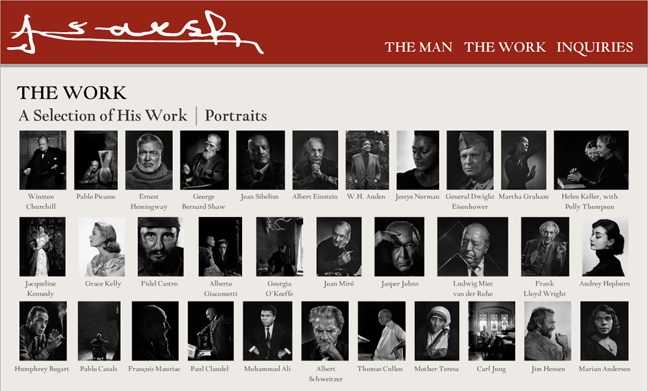
I see a growing trend here as the Yousuf Karsh estate (here) becomes the latest in a series of photography masters to unveil professional websites that will not only serve as wonderful resources for the photo community but act as a central resource for consumers and professionals looking to purchase prints and reprint rights.

During his career he held 15,312 sittings and produced over 150,000 negatives.

Yousuf Karsh Estate

Yousuf Karsh Estate

The short video clips (here) are particularly interesting to watch as Yousuf answers questions that we seem to ask photographers over and over.

Send Photos To AP From Your iPhone

Techcrunch is reporting from the Apple event today (here) that AP (Associated Press) is releasing an application for the iPhone that allows people to upload photos and text directly to AP when they witness live news events.

Trent Reznor Talks About Making Music For Free

I found this interview with Trent Reznor of Nine Inch Nails interesting because it’s apparent that he became the ambassador for “free music” not because he believes in it but rather because he believes it’s not going away. Here are the relevant parts:

Mr. Reznor has no global solution for how to sustain a long-term career as a recording musician, much less start one, when listeners take free digital music for granted. “It’s all out there,” he added. “I don’t agree that it should be free, but it is free, and you can either accept it or you can put your head in the sand.”

He knows what he doesn’t want to do: make his music a marketing accessory. “Now just making good music, or great music, isn’t enough,” Mr. Reznor said. “Now I have to sell T-shirts, or I have to choose which whorish association is the least stinky. I don’t really want to be on the side of a bus or in a BlackBerry ad hawking some product that sucks just so I can get my record out. I want to maintain some dignity and self-respect in the process, if that’s possible these days.”

Last year Mr. Reznor produced and bankrolled an album for the socially conscious hip-hop poet Saul Williams, “The Inevitable Rise and Liberation of Niggy Tardust.” When record labels didn’t want it, Mr. Reznor put it online: free to the first 100,000 downloaders as good-quality MP3 files or $5 for more high-fidelity files. He had thought that fans would willingly pay the price of a latte to support musicians directly. But fewer than 20 percent did so. “I think I was just naïve.”

At the time he called the project a failure, but he has reconsidered. “The numbers of the people that paid for that record, versus the people that paid for his last record, were greater,” he said. “He made infinitely more money from that record than he did from his other one. It increased his name value probably tenfold. At the end of the day, counting free downloads, it was probably five or six or seven times higher than the amount sold on his last record. I don’t know how you could look at that as a failure.”

Read the whole story (here).

Review Santa Fe Becomes Even Better

Review Santa Fe went down this past weekend and it’s always been a great resource for Photo Editors, Book Publishers and Gallerists looking for new talent. It’s also a great opportunity for photographers, because you can show your work to a very large group of people at once without the usual hassle of making appointments and then dragging your ass and book all over the city.

As a reviewer it was always a disappointment to see work being presented to other reviewers that you found interesting but wasn’t going to be shown to you. Also, it was difficult to remember work you’d seen half a year ago that you suddenly recall being nearly perfect for an assignment that just landed on your desk. All that has been solved now, because they’ve posted a sampling of the work from each of the photographers that were selected to attend (here). As a bonus most have a nice headshot of each photographer so you can see the person behind the images.

This will prove to be another valuable resource for finding new talent (Alec Soth was discovered there) well before they hit the mainstream.

Discovered via the new Boston Photography Focus blog (here).

Summer Break

Going on a raft trip. See you next week.

“Benedicto: May your trails be crooked, winding, lonesome, dangerous, leading to the most amazing view. May your mountains rise into and above the clouds. May your rivers flow without end, meandering through pastoral valleys tinkling with bells, past temples and castles and poets’ towers into a dark primeval forest where tigers belch and monkeys howl, through miasmal and mysterious swamps and down into a desert of red rock, blue mesas, domes and pinnacles and grottos of endless stone, and down again into a deep vast ancient unknown chasm where bars of sunlight blaze on profiled cliffs, where deer walk across the white sand beaches, where storms come and go as lightning clangs upon the high crags, where something strange and more beautiful and more full of wonder than your deepest dreams waits for you — beyond that next turning of the canyon walls.”

— Edward Abbey

Virtual Art Director

Clay Stang has a cool new feature on his website where where you can give him art direction from a pre-selected list of topics and he will execute the shot. Visit http://www.claystang.com and select “you call the shots.” I think it’s a very innovative way to show clients how you execute art direction. It’s also a little too realistic on the client side because selecting the shot by committee means we execute the “safe” shot.

Virtual Car Photographer

Ever dream of becoming a car photographer? Here’s your chance, visit Sexy Subaru to shoot studio shots of the 2009 Forester.

It’s so realistic that the assistants have already set up all the lights and then one of them drags a board over where, no surprise, the goddam art director has carefully laid out all the shots. Oddly, you’re shooting slide film and you only get 24 shots per setup.

Heidi Volpe- Art Director, L.A. Times Magazine

Heidi Volpe and Michael DarterI’ve known Heidi for quite awhile now, we worked on and off together at Outside Magazine over a few years and still talk frequently about photography and the industry on the phone. She has an impressive resume of magazines where she’s worked that includes: Philadelphia Magazine, Men’s Health, GQ, TimeOut NY, Outside, Outside Traveler, Men’s Health 18, Muscle and Fitness and finally the L.A. Times Magazine. LA Times MagazineI think the makeover she’s given the LA Times Magazine is nothing short of brilliant. Sure, I’m biased towards full bleed images and minimal design fuss but her 18 Society of News Design awards last year proves the design community is behind that aesthetic as well. What’s even more remarkable is that a place as troubled as the LA Times would allow Heidi to continue to do such brilliant work. I think it’s more a testament to the power of a strong willed Art Director than it is any genius on the part of the management.

It must be impossible to work without a photo editor I mean honestly, how any magazine survives without the sage advice of a photo editor is beyond comprehension. Ok, seriously there’s a fairly large group of publications out there that don’t employ a photo editor and my theory is that it changes the photography choices because the person making them is concerned with how they will work with the design. Do you think not having a photo editor on staff effects a publications approach to photography?

LA Times MagazineI don’t think it affects the approach at all. I think it can be a great benefit. When I worked with Dan Winters and Christian Witkin they saw it as a great opportunity to have ultimate creative control and that’s how I see it. I’m smart enough to know superior photography is everything. I heard David Carson speak a long time ago about design, he said the answer is always in the picture and that stuck with me. LA Times MagazineAt a previous job I even got myself ejected for my taste in photography. I told the editor it wasn’t his fault he couldn’t recognize good photography because he’d only been exposed to a certain genre of imagery his entire career, which, I had no interest in working with. We had a battle over images John Huet shot for us which eventually led to an early departure.

There’s not much magazine publishing going on in LA or really, anywhere west of the George Washington bridge for that matter. Does that put more pressure on you to represent magazines that aren’t located on an island in NY? Why aren’t there more great publications in LA?

LA Times MagazineSure, I really wanted our book to be creative outlet for LA photographers. People gripe that there are no good photographers in LA, I strongly disagree and wanted to prove it and along the way support the photo community out here.

There are a few reasons for this, Life magazine (1936), Esquire (1933), New Yorker (1925), all started in New York City and they in turn spawned many more magazines. LA Times MagazineThey also raised an entire generation of editors, art directors, writers and photographers who went on to create and work at other magazines. Plus, now with the high cost of publishing you need corporate support to get started and all the publishers are in New York.

When it comes to awards and use of photography, newsstand magazines have always felt that newspaper inserts have an unfair advantage. You’re not subjected to the crazy newsstand, advertising and even some of the audience demands because your publication rides along inside the newspaper and is more of an added value then something that needs to pull it’s own weight. Would you agree with that?

LA Times MagazineInsert? Gawd, I hate that word. No, we compete with ourselves actually. We have to be something the paper isn’t and that can be hard sometimes because the Los Angeles Times itself has award winning photography. The LA Times Photo Director, Colin Crawford is amazing (examples, here and here).

Our struggles are different, it’s a content war to see who gets there first, we can’t cannibalize the newspaper’s feature sections so we always have to make sure whatever we are reporting is fresh and that can be difficult. Most magazines traditionally use newspapers to locate stories to further report in depth. We can’t do that. We do however have fewer coverlines on the image which is nice and no upc but we have advertising in every issue so it’s no different than a newsstand magazine. We need to pull our own weight especially now with many, many cut backs in this industry.

What are your main sources for finding photographers and how do you like to be reached?

I talk to a lot of photographers, go to openings, visit Art Center, look at magazines and look a lot online. Art Streiber is also a great resource and ambassador for the photo community out here (on top of being a great photographer).

So, you don’t really use promo cards or book drops?

No, I still rely on promos and book drops but word of mouth is my favorite method for finding photographers. I love talking to photographers about other photographers they’re into.

With your focus on all things LA will you hire photographers from other cities? Do you ever shoot anything outside of LA County?

We just shot a feature story in Paris. Is that far enough out of LA for ya?

If you have any questions for Heidi leave them in the comments.

Brands Follow Men Out of Print and Online

Some magazine publishers hoped that this year would see marketers shake off their exuberance for digital media. Perhaps, amid a sober reassessment of the actual results from so much digital experimentation, print could even recapture some of the ad spending lost to the internet.

Fat chance.

Instead, a combination of forces led by the broad economic slump is delivering as challenging a year as ever for traditional publishers.

Read the story on Advertising Age (here).