“Back in class, Quigley tells us we have to remember to bring in the hard copy of the New York Times every week. I take a deep sigh. Every single journalism class at NYU has required me to bring the bulky newspaper. I don’t understand why they don’t let us access the online version, get our current events news from other outlets, or even use our NYTimes app on the iPhone. Bringing the New York Times pains me because I refuse to believe that it’s the only source for credible news or Pulitzer Prize-winning journalism and it’s a big waste of trees.”
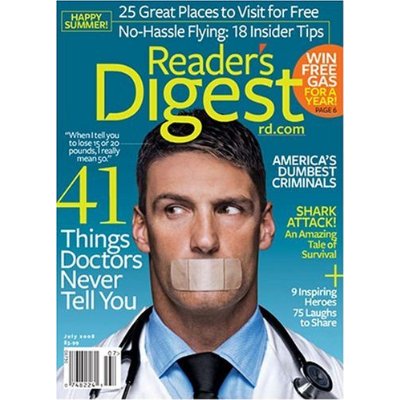
I had a serendipitous encounter with Bill Black, DOP at Readers Digest and on a whim asked him a few questions about the magazine. I hadn’t seen it in awhile (mom’s house maybe) and was unsure what they were doing with photography, but boy am I glad I did and you might be as well.
I haven’t been following Readers Digest lately. Is it still the 2nd largest magazine in the country?
Yes. Reader’s Digest actually has the highest paid circulation of 8 million subscribers in the US.
Can you tell me how you got started as a Photo Editor and how you ended up as DOP at Readers Digest?
Bill Black with his kids
I studied photography in school and had every intention of trying to shoot magazine editorial work. I had an incredibly lucky start when I was interviewing with Adrian Taylor, then Art Director of Travel & Leisure magazine. He was hectic and answering his phone during the entire 20 minute interview. On one call he was distracted and yelling while flipping rapidly through my portfolio, dropping cigarette ashes on my pictures telling the person “there was no way in hell his messenger had lost the slides.” Convinced he had only looked at one picture in my book I got a perfunctory “nice work kid ” and then he asked if I’d ever consider taking a photo staff position at a magazine like T&L. He laughed when I replied with an emphatic yes before he finished asking the question. I told him I would make sure they didn’t loose any more slides.
Taylor was a great mentor and with his introductions I was in some of the world’s best photographers’ studios talking shop and editing their work for a Tenth anniversary issue. I could not believe I was bringing Ernst Haas over a six pack of his favorite beer to discuss and edit his best color work of Venice …then over to Arnold Newman’s place to look at portraits. Burt Glinn, Jay Maisel, Pete Turner, Inge Morath, Elliot Erwitt, Mary Ellen Mark, Tom Hollyman–the list went on and on. Eventually I was promoted to Picture Editor of T&L and had the most amazing eight years that anyone could have had in magazine publishing.
The editor in chief, Pamela Fiore, was a firm believer in offering her staff opportunities to grow professionally. As a result I got to travel and photograph stories we published on exotic places like Papua New Guinea, Africa, Asia and regions north of the arctic circle. Even though I had such a rich and unique learning experience and had been given so much, I was still naive enough to think that I should pursue a freelance life of shooting for other magazines so I impulsively resigned my post. Big mistake. I really missed the comradery and the social interactions within a magazine staff and its contributors.
It was then I met Travel Holiday’s editor in chief, Maggie Simmons. The magazine was owned by Reader’s Digest and in the midst of being relaunched and redesigned. She was looking for a photo editor that had solid connections in Travel. I was so fortunate to have another incredible 7 year run with her at Travel Holiday. We racked up over a 100 prestigious awards for the photography alone and many others for writing and desig . She promoted me to DOP and gave me unprecedented creative license on hiring and directing photographers. Unfortunately, Reader’s Digest decided they couldn’t figure out what to do with an award winning travel magazine and sold it to Hachette. Hachette brought in their own staff and it subsequently folded. Reader’s Digest then asked me to become DOP of their flagship magazine. They wanted to overhaul the magazine and introduce more original photography. Voila.
I can imagine that one of your biggest challenges is assigning photography that’s compelling yet not challenging for your readers to comprehend, because isn’t the whole idea behind Readers Digest to take stories and compress them down so they’re easier to read?
Photograph by Kevin Horan
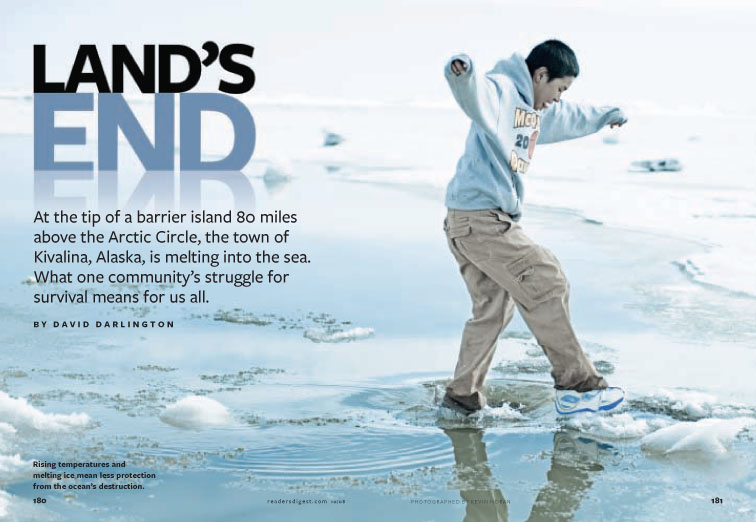
You might be surprised to know we frequently run 10 to 12 page features that are photo driven. Our newly hired editor in chief, Peggy Northrop is a passionate supporter of great photography. She has made it a priority to articulate a mission and aesthetic we’re all proud of. I think she is less concerned with compressing previously published material and more focused on commissioning great writers to write powerful, inspiring stories and give the magazine a louder more authoritative and original voice.
The photography needs to mirror that quest. Its size certainly presents challenges for photography but our readers love it for it’s portability and convenience.
Photograph by Kevin Horan
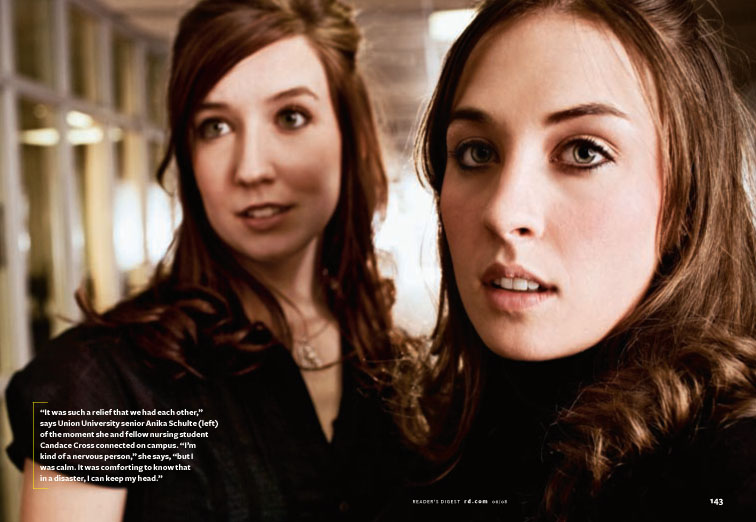
When producing photography we generally subscribe to the less is more concept as we want the images to have the most impact within our framework. This places a bigger burden on the images to engage the reader immediately with opener photos that reach out and grab you, that are uncluttered, appealing, well composed, graphically fresh, emotionally relevant and ultimately memorable. I don’t think it’s a matter of risking that our readers won’t comprehend the photography as much as will it hold their attention and pull them into a story. The magazine reader of this day is very demanding and highly sophisticated visually. They want to get into their story, absorb the information that’s important to them and move on. The photography needs to be the catalyst to that experience.
Your next biggest challenge must be attracting a younger audience to the title. Like most magazines out there I assume your demographic keeps getting older each year and we all know that the key advertisers want to reach the younger demographic so what can you do photographically to make this happen?
Photograph by Tamara Reynolds
Hire young minded photographers who want to help us. These are photographers who have studied us and tend to be highly creative, collaborative professionals who are constantly reinventing the norm, staying away from formula and coming to the table with fresh ideas for new approaches and solutions to breaking out of familiar patterns. This is a two way street and if we can team up with photographers on every project with this kind of joint energy and passion then I think you have the ingredients to produce quality in pictures that will transcend any generational differences or sensibilities.
You mentioned that you were assigning more photography than ever. Why is that?
It’s a requirement of the new direction and design of the magazine. Fewer pick up articles less stock photography and more original content that needs to be illustrated.
How much emphasis is on the website now? I see you have rd.com as a website, so somebody must have thought way back when, that the web was going to be useful to have the foresight to register rd.com. Any thoughts on how photography on-line will change in the coming years?
Yes our web forefathers were smart to do that and the current web team is also evolving the url to www.readersdigest.com. Right now both addresses will get you there. Currently we are producing a minimum of one slide show or multi media presentation from one of our features every issue. I strongly believe the web will become more and more of an outlet for quality photography. I love that photographers and magazine publishers/editors are thinking together in those terms. I think it can really enhance what is accomplished in print. There are those who forecast that the web will ultimately replace print. Not having a crystal ball, I think the mediums will both remain valid and offer different experiences for quite some time.
Tell me how you like to be reached by photographers and what types of photography you’re actively looking for?
We really aren’t staffed up to handle hard copy portfolios via mail or make appointments to review individual books at this time. I would highly recommend email and web links. We can’t always reply as our emails are overflowing but we do bookmark work we want to consider for future projects and are always adding to our talent pools. We’re a general interest magazine with a mass audience. Our visual DNA at its core is people. People in every spectrum of the human experience. The photographer’s work that can show us he/she can navigate easily through difficult emotional landscapes gaining trust and access with their subjects quickly is usually someone we will watch closely.
Email linda_carter(at)rd.com or bill_black(at)rd.com
I was sent this interesting Job opening with Titan Media and Technology Corp. They’re looking for 10-15 staff photographers to pay $45k a year plus benefits to travel for 10 to 15 days at a time, 15 times or more a year, away from NYC taking pictures.
Didn’t see anything about owning a flak jacket, so that’s a good sign.
I thought some of you might find this interesting.
Looks like Life Magazine will be publishing their collection for consumers to browse (here).
Thanks, Matt Wright-Steel.
Here’s an interesting idea. Someone from within a stock photo agency is anonymously posting gems from the collection as they run across them (here). The splash page at a stock agency website is always incredibly valuable real estate, so maybe there are other ways to get images from the collection in front of potential buyers. Via, Swiss Miss.
Jill Greenberg officially took herself off everyone’s list with that little stunt she pulled with outtakes from her McCain cover shoot for The Atlantic (I’m talking about all the photoshopping not the “lit from below” picture which felt like a nice try but not quite there) and made it a little more difficult for Photo Editors to get someone new and untested past the editor and more importantly the publicist.
If you have no idea what I’m talking about Mark Tucker has links to all the coverage and several questions of his own (here).
It’s the publicists who usually vet the photographers and if you’ve ever looked at a celebrity or political picture and thought “the most interesting thing about that picture is the person in it” that’s because safety is more important than creating something visually exciting. The challenge for Photo Editors has always been getting interesting photographers past the publicists because they always google them or come with a pre-approved list just to make certain the photographer will not do something unflattering or controversial. So, I’m shocked that the McCain camp approved her given the “candy and crying children” controversy that’s not much more than a google click away (well, it used to be a google click away…) but I’m guessing that The Atlantic didn’t seem to pose much of a threat so there was no background check on the photographer.
Hit pieces in magazines are not unusual, but it’s usually the writers that are the one’s waiting till the shoot is in the can, the fact-checking mostly done and then they can finally ring the subject up and start asking hard questions. What’s unusual here is that Jill went off and did it on her own without letting the magazine know what she was up to. Usually the magazine is involved in these kinds of decisions if not directing them in the first place. So, I can pretty much guarantee she’s not interested in getting hired anymore to do “the monkey light” and really just wants to be known as someone who manipulates. Even if some Photo Editor wanted to hire her now they wouldn’t get her past the editor let alone the publicist.
The Atlantic unfortunately got burned in the whole deal but there’s no way to know when someone is going to go rogue on you and if it ever happened in the past nobody would even know about it. The 2 week embargo seems unusual to me and it’s likely a function of The Atlantic wanting really badly to do something interesting in a very crowded newsstand and allowing Jill Greenberg to lay down the rules on what it would take for her to shoot a cover (at which point I would expect a photographer to tell me they hate the person they’re about to photograph and might not be the best choice for this assignment). If I’d been the Photo Editor in that situation I would be looking for a new job because I would have had to convince the editor to take a chance on a first time cover shooter for the magazine with very little political experience and on top of it get them to reduce the embargo to 2 week for outtakes.
Ultimately I don’t think she’s suddenly screwed it all up for photographers everywhere because shoots of this nature are almost always closely watched by the publicists, the terms with the magazine are exclusive and publishing outtakes from a cover shoot will land you in court
This was a very deliberate act by a photographer who knew she was going to get blackballed by publicists and make herself un-hireable in the editorial world to make a political statement or maybe she just wanted to remove herself from the editorial world in a dramatic way because in the end who but clients visits a photographers portfolio site and if you’re tired of having clients and working with publicists and just want to make art then this is one way to do it.
I’m enjoying this blog Recovering Journalist and found this post on newspaper websites spot on (here).
“…But that’s the problem: They’re usually putting out online versions of printed papers. They’re still pasting newspapers onto a screen–and the state of the online art has moved way past that.”
“Spend some time with an online newspaper–and compare it to leading Web sites–and you know what I mean. Most newspaper Web sites have a gazillion links on the home page; the eye has no idea where to look. They’re ugly, overstuffed and foreboding. They’re trying to do way too much. The most successful Web sites, by comparison, usually are minimalist, and designed for quick scanning and visiting. Believe me, there’s no fast read when the “National News” header on a newspaper Web site sits atop 10 or 20 small-type headlines. Snore.”
“There’s more: Newspaper Web sites still are organized like, well, newspapers. They follow the traditional News/Sports/Local/Features model from print. That’s not a bad organizing principle, but it may not be well-suited for the Web, where readers are used to quicker, even simpler organizational schemes. (Check out Google’s home page, which is still all about pretty much one thing: search.) Focus on what readers want, not on how your print newsroom is organized.”
A photographer takes pictures of people covering a coworker’s car in Post-It Notes. He posts the shots on Flickr and they go viral. More than a year later 3M, maker of the Post-It decides to try and capitalize on the image and contacts the photographer about a license. The photographer asks people he knows in the photo industry what a fair price might be and gives them a quote. Michelle, the emarketing supervisor at 3M tells him she will just copy it instead, for much less… and does. Read and see the whole deal (here).
Now, social media is great. Word can spread fast about cool and interesting things but you have to be a complete moron to not know that it can go both ways. Not only can they get sued for this type of behavior I’ve suddenly lost my appetite for Post-It’s.
“The best and most incredible event of this year VISA was probably the projections open to everyone, on a giant screen, in the Place de La Republique. The attendance was spectacular. It seemed that the whole city of Perpignan was there, forgetting the comfort of their homes and TV, to sit and watch great images. At a time when everyone screams the death of photojournalism, this was a nightly slap in their mouth. And it should make us wonder. If people are so hungry to see great photography, who is really killing photojournalism ? The public enjoys it, photographers are producing it, agencies are making it available, so why this slow disappearance?”
[…]
“Some agencies have seen their best year ever in 2008 and are very optimistic about the future.”
You probably know how much Photo Editors like their photographer lists and really any edited group of photographers is handy when looking for people to hire or looking for new people to add to your personal list.
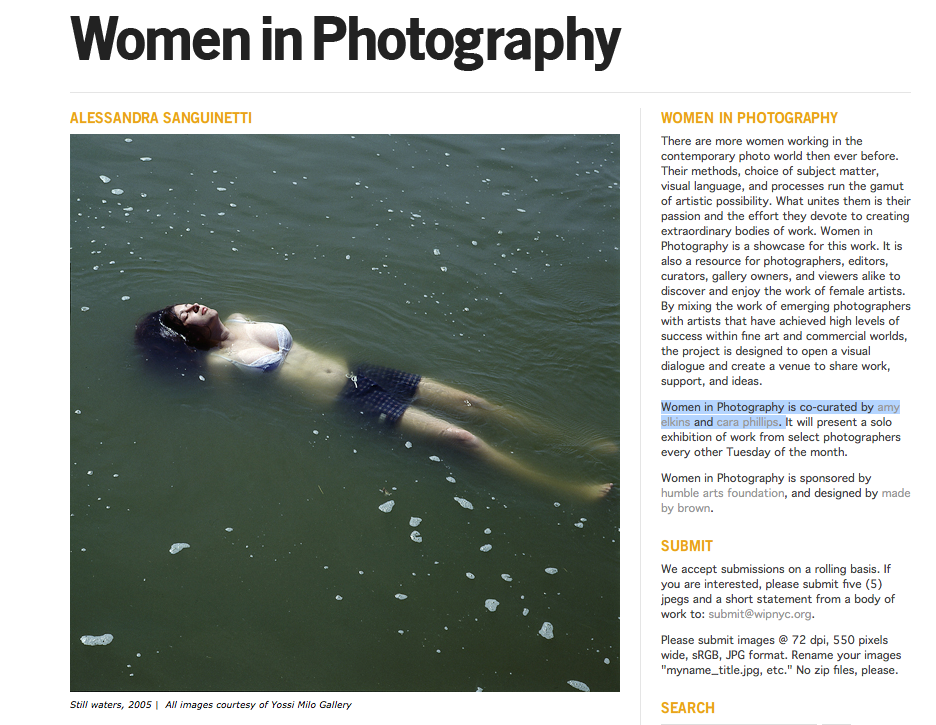
I think this Women in Photography website (here) will become a very strong group from which to find talented photographers to hire. I like that it has a very specific point of view as defined by the co-curators amy elkins and cara phillips.
I mentioned to someone the other day that there are many resources that serve as lists of photographers for the creative community that you can buy into. But, if you don’t agree with the list of people you’re buying into, why not just go make your own. If it’s useful and the creative community knows about it, we will use it. The Women In Photography website is a good example of this.
Wired continues to amaze me with their behind the scenes blog on the making of a magazine story. If you’ve never seen the edit on the first draft of a story go have a look (here).
I’d say most people writing about photography and/or photographers on a blog are using the “Fair Use” limitation in copyright law (here) as a way to avoid having to get permission and possibly pay for the use. I use it sometimes and in turn I can expect to see things that I write about quoted and used without my permission as well.
I’ve been asked a few times by readers “What’s fair use and what’s illegal when using photography that’s not yours on a blog?” I can’t actually answer that question, because I’m not a lawyer, but I would like to help bloggers understand the best practices for using photography that doesn’t belong to them, so when I saw this “Code of Best Practices in Fair Use for Online Video” (here) I thought I should create one for photography (and not 16 pages long), since it doesn’t already exist. There’s really no end in sight to the practice of bloggers writing about a photograph or a photographer and then posting a picture, so don’t you think it’s time we set down some guidelines on what acceptable and what’s not? I’m going to post the best practices guide on the url http://www.fairusephoto.com and I’d like it to represent what photographers and photo industry bloggers feel is acceptable. Here’s what I think:
Nearly all the photography in the world is copyrighted and belongs to the person who took the picture.
The absolute best practice for using photography that doesn’t belong to you is to ask for permission first.
Oh, you thought there was more? Email or call the photographer and ask for permission. It’s that simple.
If you are looking to cite “fair use” as a way to publish copyrighted images without permission because you believe it falls under the following:”for purposes such as criticism, comment, news reporting, teaching (including multiple copies for classroom use), scholarship, or research, is not an infringement of copyright” then you should follow these best practices:
Always include the photographers name and links to both the image(s) you are writing about and their portfolio in your story or in the caption to the image.
The destination of the anchor link for the image should be the page where the image was found (most blogging platforms have the anchor link to a larger size image so this has to be changed manually).
The bare minimum number of images should be used to make your point. You want to pique the readers interest so they visit the photographers site to see a full selection of images.
Use a screenshot of the image (instead of downloading the file used on their site) and include as much of the surrounding page as possible so it’s obvious that the image came from another website.
The end result should always be that readers, who find the photograph interesting, click to visit the photographer’s site.
Please understand that this is a best practices guide and following this guide does not exempt you from copyright infringement and potentially a lawsuit from the copyright holder. It is ultimately up to the courts to determine if your use was “fair use.”
Here are some resources for further exploring copyright and fair use:
Here’s a debate on Fox Business via Mr. Magazine where the two pundits brought on to debate Time vs. Newsweek end up taking different positions on what those two newsweeklies should actually be covering to stay relevant.
Dr. Husni, J schooler and clearly a big champion of printed magazines argues that newsweeklies need to change their content to better become a bridge between what happened last week and what’s about to happen and how it will effect readers. John Friedman columnist at Market Watch dismisses printed magazines and the newsstand entirely claiming that the battle is on the web and the newsstand is dead.
Do you carve out your place on a shrinking newsstand to deliver something nobody else does or do you evolve your business model to chase news online? To do both well, will take a serious investment.
Lots of hype and people reporting on this (here) and (here) and (here). Rolling Stone did a Holographic cover for their big 40th anniversary and completely sold out. Best selling issue ever. I guess that makes it worth the cost.